How Long Do Pomeranians Live? What 14 Years Looks Like on Our Girl
How long do Pomeranians live? The American Kennel Club puts it at 12 to 16 years. Our oldest girl is a black Pomeranian, and she’s 14 now, so she’s right in that range and still bossing everyone around on our walks.
My husband has had her since she was about six months old, long before I came along. Now we live with her every day, along with our two younger boys, who are both 3. So this isn’t a breed chart. It’s what 14 actually looks like on one Pom: what’s changed, what hasn’t, and the routine we keep for her now.
The numbers come first, then her real story. If you have a Pom who’s getting older, the daily care and vet sections are the ones I’d read.

| Typical lifespan | 12 to 16 years (AKC) |
| Breed size | 3 to 7 pounds and 6 to 7 inches tall (AKC) |
| When a Pom counts as senior | The AAHA defines senior as the last 25% of expected lifespan. For a 12 to 16 year breed, that starts around age 9 to 12 |
| Our girl | 14 years old, about 12 to 13 pounds, with my husband since she was about 6 months old |
| What changed by 14 | Not many teeth left, weaker eyesight, a little stiff, tires faster than her younger brothers, dry skin and nose |
| What hasn’t changed | Sleeps well, wakes up full of energy, still leads our walks |
| Her vet rhythm | A visit every 2 to 3 months for shots, plus a dental cleaning once a year |
| Best for / Good to know | Best for owners of an older Pom who want a real-life picture of the senior years. Good to know: for a specific health problem, your vet is the right call |
How Long Do Pomeranians Live? The Numbers
The American Kennel Club lists the Pomeranian life expectancy as 12 to 16 years. That’s a long life for a dog, and it’s one of the sweet things about this breed.
As for when a Pom becomes a senior, the American Animal Hospital Association defines a senior dog as one in the last 25% of its expected lifespan. If you do the math for a 12 to 16 year breed, that lands somewhere around 9 to 12 years old. So a 7-year-old Pom is middle-aged, not old, and our 14-year-old is well into her senior years.
One thing surprised me when I looked these numbers up. The AKC lists Poms at 3 to 7 pounds, and our girl is about 12 to 13 pounds. She’s just a bigger Pom, which is one reason my husband keeps such a close eye on her weight.

Meet Our 14-Year-Old Pomeranian
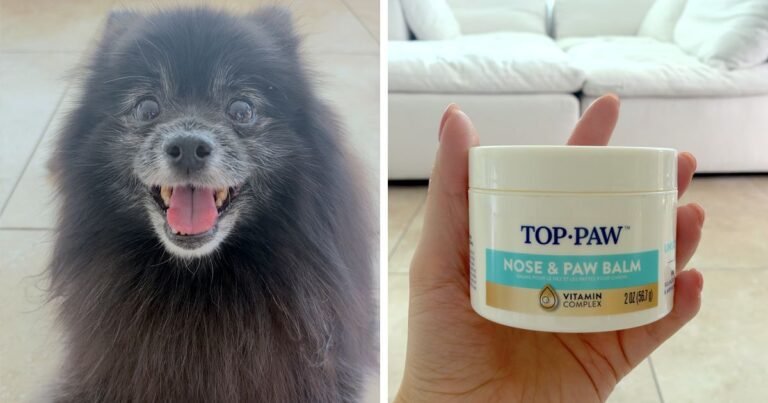
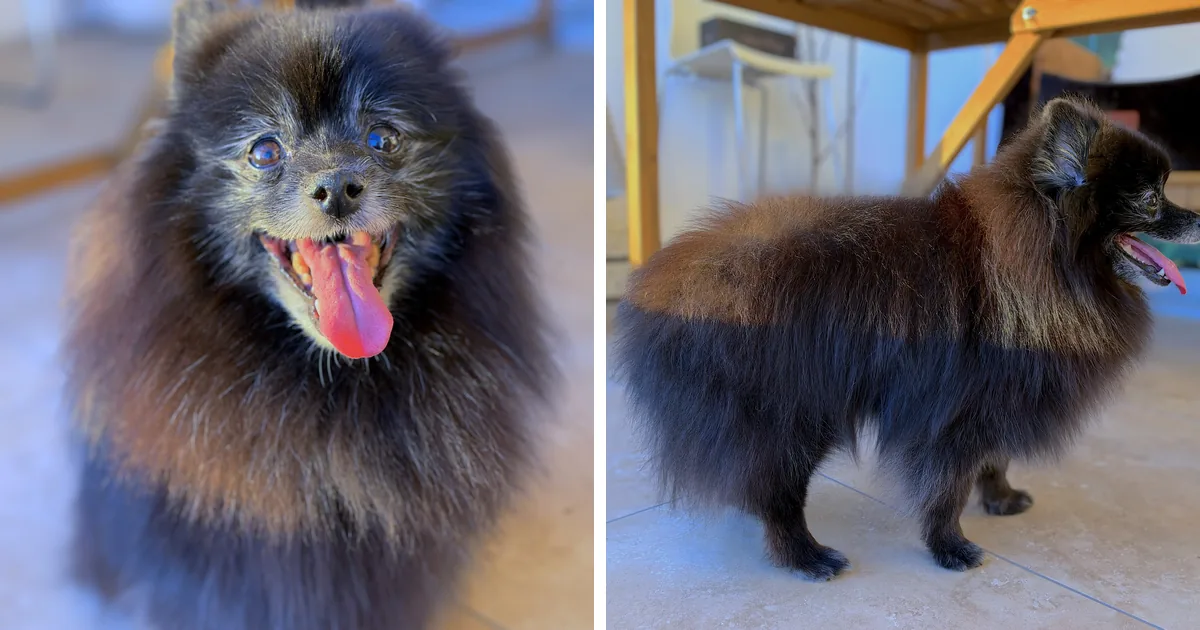
She’s our oldest and our only girl. She has a black coat with straight fur that sheds a lot. Every time I brush her, the gray undercoat just keeps coming, which I wrote about in how I deshed our dogs at home. And she has a big personality for her size.
My husband raised her from about six months old, so she’s been his girl her whole life. She lives with our two younger boys, a mini goldendoodle and a maltipoo, who are both 3. If you’re curious about the little guy, I wrote up how big a maltipoo really gets using our boy’s own numbers. I did the same for our other boy in how big mini goldendoodles get, with his photos from 14 weeks to now.

What 14 Looks Like on Our Girl
Here are the changes I actually see. None of these are a diagnosis, just what living with her looks like right now.
- Her teeth. She doesn’t have many left, so hard chews are off the table for her. She gets a dental cleaning once a year, and I wrote about the signs that tell me it’s time in signs your dog needs a teeth cleaning.
- Her eyes. Her eyesight seems a little weaker than it used to be, and once in a while she bumps into things. It breaks my heart a little every time.
- Her joints. She’s a bit stiff, though she doesn’t get up slowly. Years ago, before I met her, a back leg slipped out of place and she had surgery, and she recovered well. Last year she had a minor sprain that healed with medicine from the vet, and she hasn’t been in pain since. These are the signs of arthritis in dogs I keep an eye on now.
- Her stamina. When all three of them run around, she gets tired faster than the boys.
- Her skin and nose. Both get dry. Her skin flakes easily even with care, and I put a nose balm on her. Here’s how we handle her dandruff on bath day.
- Where she sleeps. She’ll hop up on the mattress, but when it’s time to sleep she goes down to the floor. So every night I lay a thick towel next to the mattress, and that’s where she sleeps.

What Hasn’t Changed at 14
This is my favorite part. She sleeps really well, and when she wakes up she’s full of energy again.
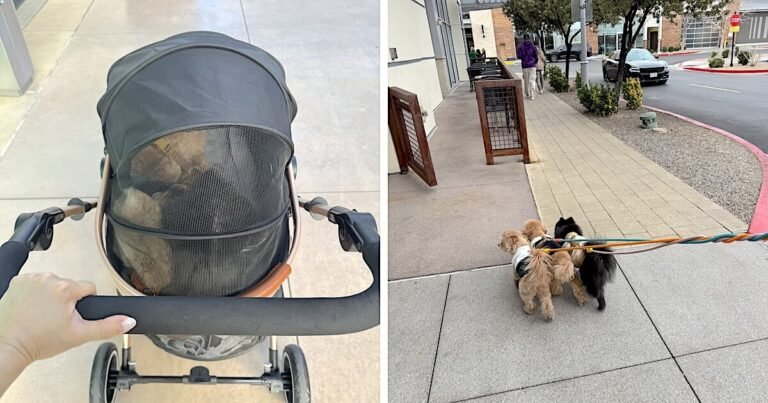
On walks she’s still the boss. We walk all three dogs on one leash that splits three ways, and she and our goldendoodle are the two leaders, always pulling to be in front. She’s seriously strong for a 14-year-old. She has to sniff every spot she wants and pee wherever she decides, and the rest of us just wait for her.
She walks with her brothers instead of riding. We save her stroller for car outings and trips, and I shared how I knew my senior dog needed a stroller if you’re wondering about one.
How Her Care Differs From Her 3-Year-Old Brothers
Living with a 14-year-old and two 3-year-olds at the same time makes the senior changes really easy to see. Here’s where her care is different from the boys’:
| Age | Her: 14. The boys: both 3, born 24 days apart |
| Coat | Her: straight, and it sheds a lot. The goldendoodle: almost straight and very fine, so he tangles the most. The maltipoo: curly, and he barely sheds |
| Joint support | Her: a Dasuquin soft chew our vet recommended (it replaced Zesty Paws Senior Advanced Mobility in October 2026) plus half a teaspoon of Missing Link Senior. The boys: Zesty Paws Hip & Joint Bites, an omega-3 oil, and 1/8 teaspoon of eggshell calcium |
| Supplements all three share | Zesty Paws Probiotic, Milk Thistle, Aller-Immune, and Clean Breath |
| Bowls | Her: a raised slow feeder. The boys: regular slow feeders |
| Chews | Her: no hard chews, because of her teeth. Sweet potato is everyone’s favorite |
| Sleep | Her: alone, on a towel next to the mattress. The boys: almost always curled up together |
| Getting in the car | Her: we lift her in almost every time. The youngest whines until we lift him too |
Her Daily Care Routine at 14
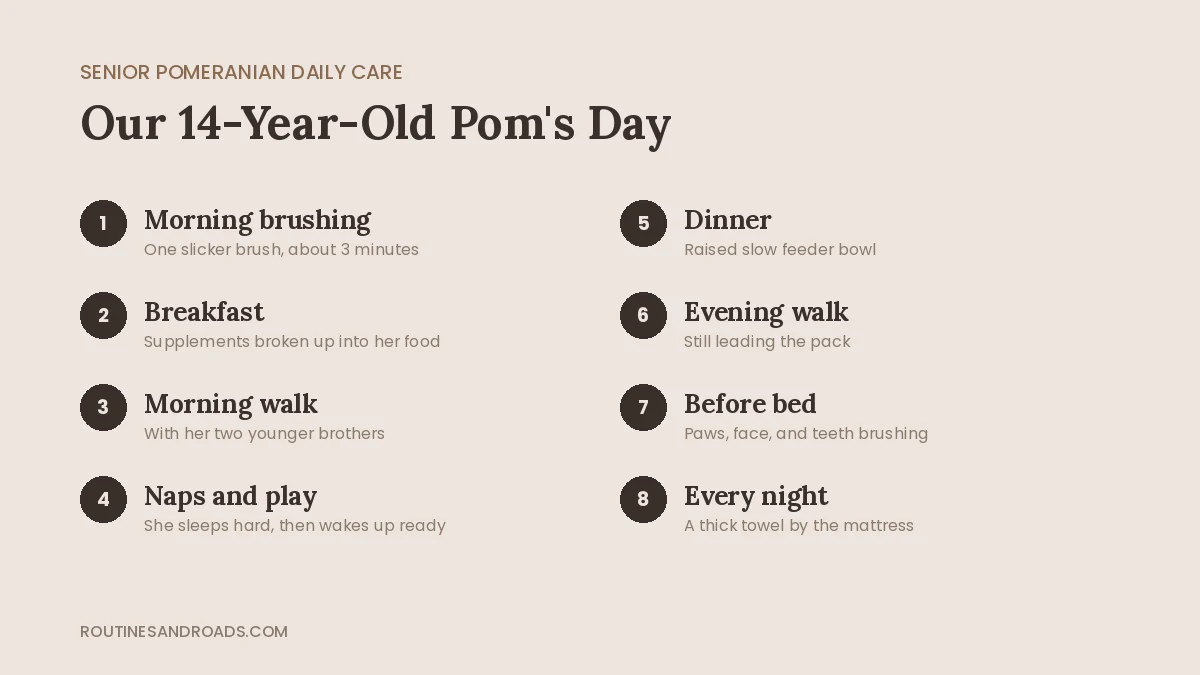
All three dogs run on the same daily routine, with a few extras for her:
- Brushing in the morning
- Breakfast, with her supplements mixed in
- Morning walk
- Naps and play during the day
- Dinner
- Evening walk
- Paw washing, a face wipe, and teeth brushing before bed
Stairs and mats. She hurt herself jumping off the sofa once, so there are pet stairs next to it now, and we keep puzzle mats down where she jumps and climbs. If you’re deciding between stairs and a ramp, here are the signs your senior dog needs a ramp.
Weight. My husband watches her weight closely. If she looks heavier, the treats stop and the walks get longer.
What She Eats and Takes at 14
She eats homemade fresh food mixed with a prescription kibble from her vet, Hill’s Prescription Diet i/d Low Fat, at about 70% homemade and 30% kibble. It’s the same way I describe in homemade dog food for senior dogs.
She has always been a fast eater, so she eats from a slow feeder. A few months ago we switched her to a raised slow feeder for her food and water, because we didn’t want her neck to be uncomfortable bending all the way down. I explained how we decided in signs your senior dog needs a raised bowl.
Her supplements go into breakfast. I break the chews into pieces and mix them into her food, because there are days she’s full and won’t take a chew on its own. Mixed in, she cleans the bowl every time. The only one she gets separately is Clean Breath, right before dinner. The full lineup for all three dogs is in our daily dog supplement routine.
For treats, plain sweet potato wins, steamed or baked with nothing added. It’s soft, which matters with her teeth, and honestly, she’ll wake up from a nap if we just say the word. I shared how I make it in how to cook sweet potato for dogs.
Grooming a Senior Pomeranian
Her coat is the most work out of the three dogs, and here’s our routine for it:
- Brushing: every morning with one slicker brush, about 3 minutes. The gray undercoat that comes out is always hers. I explained the whole thing in how to deshed a dog.
- Baths: every two weeks, and I wipe her eyes and ears every time. Then I blow-dry her all the way.
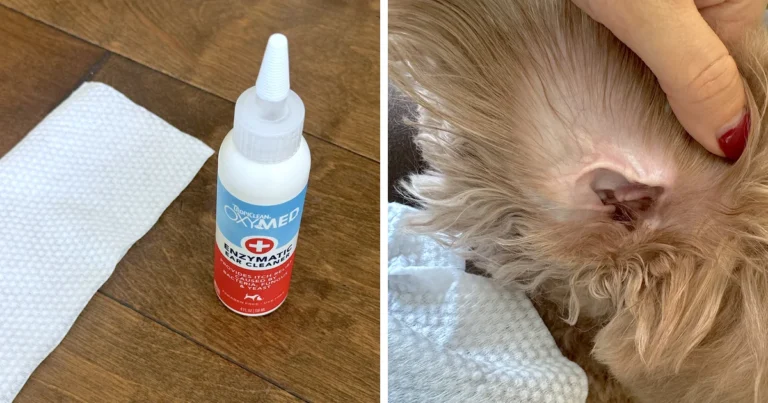
- Ears: I put an enzymatic ear cleaner on a dry wipe and use a fresh wipe for each ear, on bath days and whenever her ears smell a little funky. The steps are in how to clean dog ears at home.
- Groomer: every 6 to 8 weeks.
- In between: about a month after a grooming visit, I trim the hair on her paw pads and her sanitary area with mini clippers after a bath, and take a little off her nails. Short paw pad hair also helps her not slip on our floors. More on that in keeping a dog clean between grooming appointments.
She’s a bit of a drama queen about being handled, so I go slow and gentle with her. We stopped calming her with treats a long time ago, because it was adding up on the scale.
Traveling and Camping With Our 14-Year-Old
Being 14 hasn’t stopped her from coming along. On car outings and trips, her stroller comes with us, and we lift her into the car almost every time.
When we camp, we pack a few blankets and a donut bed from home for the dogs to sleep on. I wrote about the rest of our setup in tent camping with dogs. For quick cleanups on the road, we use dog wipes instead of her usual sink paw wash.
How Often a Senior Pom Sees the Vet
Our vet’s office texts us when a shot is coming due. Her vaccines are on different schedules, so between all the reminders, we end up there every two to three months. Every time we go, I bring up anything I’ve noticed at home, which honestly works out well for an older dog.
She also gets a dental cleaning once a year. With how few teeth she has left, we don’t skip it.
If you’re not sure how often your senior should go, ask your vet to set a schedule with you. Ours basically does it for us with those texts.
Pomeranian Health Problems to Know About
The AKC lists the conditions responsible breeders screen Poms for: luxating patellas (kneecaps that slip out of place), hypothyroidism, collapsing tracheas, congestive heart failure, seizures, and alopecia X. Our girl has dealt with her back leg and her teeth, which I covered above.
I’m not a vet, so if you see anything that worries you, that’s a vet visit, not a Google search.
What We Do to Help Her Live a Long, Comfortable Life
I can’t promise any of this adds years. It’s just what we do because it keeps her comfortable and helps us catch things early:
- Keep her weight in check, with fewer treats and longer walks when she needs it
- Brush her teeth every night and keep up with the yearly dental cleaning
- Support her joints with a senior supplement, pet stairs, and mats on slippery spots
- Go to every vet visit and bring up the small stuff
- Keep her walking every day with her brothers
Frequently Asked Questions
If you have a Pom who’s getting up there, the two things I’d focus on are her teeth and her weight. Those are the two we watch most closely with our girl, along with never skipping a vet visit.
I also wrote up how big maltipoos actually get, with our 3-year-old boy as the example. How old is your Pom? Tell me in the comments, I’d love to hear about the senior Poms out there. And if your older dog is starting to slow down, here’s how often I brush our dogs’ teeth, since that’s the habit I’d start first.