How to Get Rid of Dog Dandruff: The Bath Day Routine That Helped Our 14-Year-Old Pom

Our oldest is a 14-year-old black Pomeranian, and a black coat hides nothing. Every little white flake sits on her coat like powdered sugar on a brownie. So when people ask me how to get rid of dog dandruff, I want to be honest right away: hers isn’t 100% gone. But it’s a lot better than it used to be, and the biggest change came from something our vet suggested a while back, an oatmeal shampoo. That shampoo has been the center of our bath days for over two years now, along with a short list of signs that would send me to the vet instead of the tub.
We have three small dogs and three completely different coats, and all three get bathed together in the same tub. So this isn’t a list of ten home remedies. It’s exactly what I do: the oatmeal shampoo, the funny duck foam pump, the warm “spa soak” that sometimes puts them to sleep, how long I rinse and dry each dog, and what helps on the 13 days in between.
Quick Look: How We Handle Dog Dandruff at Home
| Our dogs | 3 small dogs: a 14-year-old black Pomeranian (the one with dry, flaky skin), a 3-year-old mini goldendoodle and a 3-year-old maltipoo |
| Bath | Every 2 weeks, all three in the tub together |
| Shampoo | earthbath Oatmeal & Aloe, Vanilla & Almond, 16 oz. I paid about $22 on Amazon (earthbath.com lists it at $19.99, October 2026) |
| Why this one | Our vet suggested an oatmeal shampoo for her flakes, and we’ve used this one for over 2 years |
| How I lather | Shampoo and water in a duck foam pump (about $17 on Amazon), roughly 1 part shampoo to 4 to 9 parts water |
| Water | Comfortably warm to my hand, never hot. A little foam goes in the water first, like a spa soak |
| Wash and rinse | More than 5 minutes per dog, rinsed all the way down to the skin |
| Conditioner | Not anymore. The shampoo leaves their coats soft enough |
| Drying | Dyson hair dryer, high airflow and the lowest warm heat: about 15 minutes per dog, about 20 for our Pom |
| How it’s going | Her flakes are a lot better than before we switched, but there’s still a little, all over |
| Between baths | A 3-minute slicker brush every morning, paws washed after every walk |
| From the inside | A skin and coat chew every day, homemade food for 3 years |
| Vet first if | Flakes show up suddenly, look like they move, or come with itching, redness, sores or bald patches |
| Best for / Good to know | Best for small dogs with mild, dry-skin flakes. Good to know: if the flakes are new, heavy or itchy, call your vet first. |
Prices checked October 2026 on earthbath.com. I’m a dog mom sharing what we do at home, not a vet, so please run anything new past yours.
What Dog Dandruff Looks Like on Our Black Pom
Dog dandruff is just dead skin coming off in small white or grayish flakes. On our two brown boys a flake would be hard to spot. On our black girl you see it from across the room.
On her, it isn’t one spot. There’s a little bit all over, scattered through the coat instead of in one patch. Before we switched shampoos it was a lot more noticeable, and with a couple of the shampoos we tried, the flakes actually stood out more.
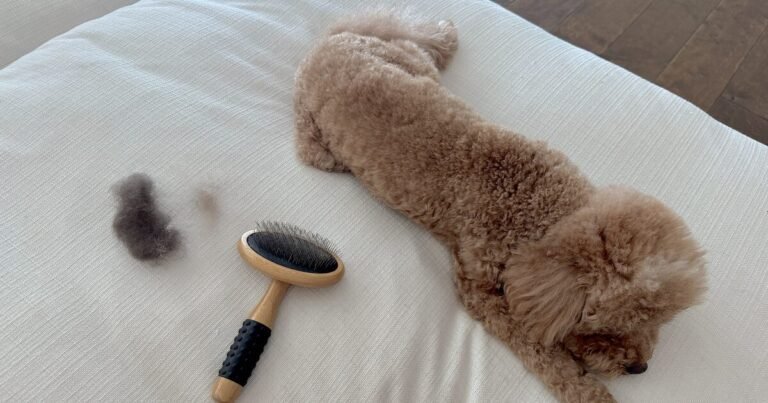
Brushing is usually when I notice it. I brush all three with one slicker brush for about three minutes each, and on her black coat the flakes lift up to the surface where you can actually see them. Brushing helps me notice it. It doesn’t fix it. Her nose gets dry too, so she gets a nose balm. She’s simply an older girl with dry skin who gets a little extra care.
Why Does My Dog Have Dandruff?
I can’t tell you why your dog has flakes, and I’m careful about guessing with mine. What I can tell you is what vet clinics list again and again, because it changed how I think about it:
- Dry skin and dry air. We live in a hot, dry climate, and wet paws air-dry here in minutes. Skin dries out fast too.
- Too many baths or harsh products. Washing too often can strip the skin, which is why more baths was never my fix.
- Shampoo left in the coat. A thick coat holds onto product unless you really rinse it out.
- Parasites. One kind of mite causes what people call “walking dandruff,” flakes that actually move. That’s a vet visit, not a shampoo problem.
- Allergies, skin infections and other health issues. Only your vet can sort these out.
For our oldest, my best guess is plain dry skin on a 14-year-old dog in a dry climate, and that’s the part a bath routine can actually help with. If you read that list and something other than dry skin sounds like your dog, skip ahead to the vet section first.
How to Get Rid of Dog Dandruff: Our Bath Day, Step by Step
This is our bath day from start to finish. All three go in together every two weeks, and the order never changes. Their monthly flea treatment never goes on bath day. It goes on about a week later, and I wrote out how long after flea treatment you can bathe your dog, brand by brand.
- Brush first, while the coat is dry. One pass with the slicker brush takes out loose undercoat and small tangles before any water touches them. A tangle that gets wet only gets tighter.
- Fill the tub with warm water. I don’t measure the temperature. It should feel comfortably warm on my hand, nowhere near as hot as a bath I’d take myself. All three of ours love warm water.
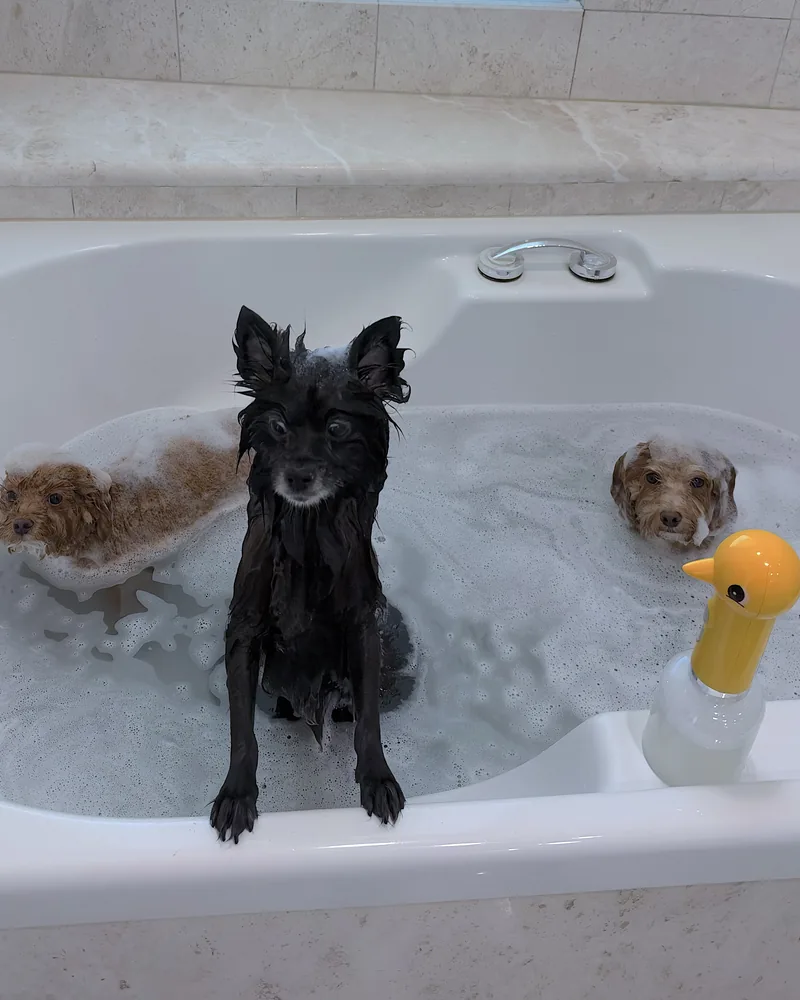
- Spa soak first. Before anyone gets scrubbed, I pump some foam into the bath water and more over their backs, and let them just sit in it for a bit. It’s honestly a little dog spa. Some days one of them starts dozing off.
- Work it down to the skin. I use my fingertips and keep working the foam in until it’s all the way down in the coat. Foam sitting on top of a Pomeranian coat never reaches the skin, and the skin is where the flakes start.
- Rinse more than you think. I rinse until there’s no foam left anywhere, lifting the coat so the water gets all the way down. Between lathering and rinsing, each dog takes me more than five minutes.
- Towel first, then blow-dry. Each dog gets a towel on the floor, then I dry them one at a time until they’re dry right down to the skin. No conditioner in between.
- Wipe eyes and ears. Every bath, all three. I wrote up our ear routine in how to clean dog ears at home.
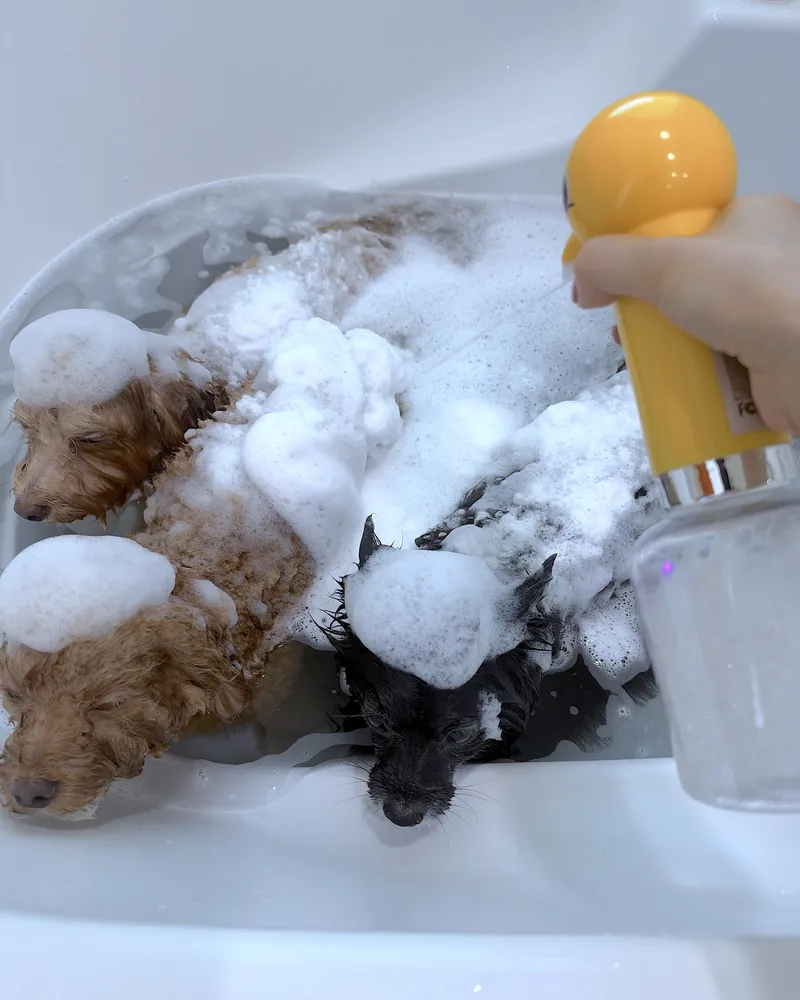
Step four is the one I’d tell anyone with a fluffy dog not to rush, and I want a lot of foam for it, really bubbly. A double coat can look soaked and sudsy on top while the skin underneath stays almost dry. So I keep working it in with my fingers, especially along her back, around her neck ruff and on the fluffy part of her back legs, where her coat is thickest.
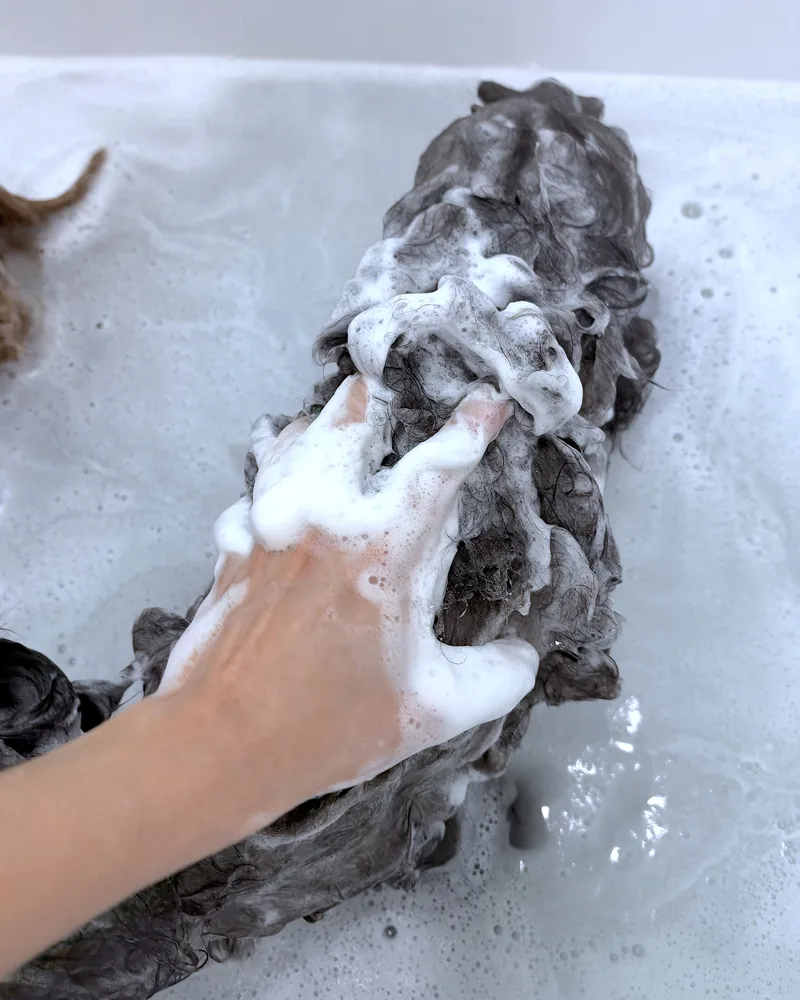
Bathing three dogs at once sounds like chaos, and some days it is. Our maltipoo is the most dramatic about being handled, so he gets the most “good boy” talk. Our oldest isn’t a fan either, so I go slow with her. The goldendoodle just stands there like it’s a spa day.
The Oatmeal Shampoo I Use (and What the Label Says)
We use earthbath Oatmeal & Aloe Shampoo in Vanilla & Almond for all three dogs, and we’ve used it for over two years. A while back I asked our vet about our oldest girl’s flakes, and the suggestion was to try an oatmeal shampoo and conditioner. That’s how this bottle ended up in our bathroom.
Before that I’d tried a few other shampoos. Some left the coat feeling stiff. With a couple of them, her flakes actually looked more noticeable. This one was different, and her flakes got a lot better after we switched. Now it’s the only shampoo in our house, for full baths and for the leg and paw wash after every walk.
Here’s what’s actually on the bottle and the brand’s site, so you can compare it with whatever you’re using:
- Label: “Helps Relieve Itching & Dry Skin,” ultra-concentrated, sulfate and paraben free, 16 fl oz (473 ml)
- Key ingredients: colloidal oatmeal, organic aloe vera and vitamin A
- Price: $19.99 for 16 oz on earthbath.com (checked October 2026)
- Dilution: earthbath says the 16 oz bottle can be diluted up to 10:1, and a diluted mix should be used within 24 hours
- How often: earthbath notes most dogs don’t need a bath more than once a week. We do every two weeks.
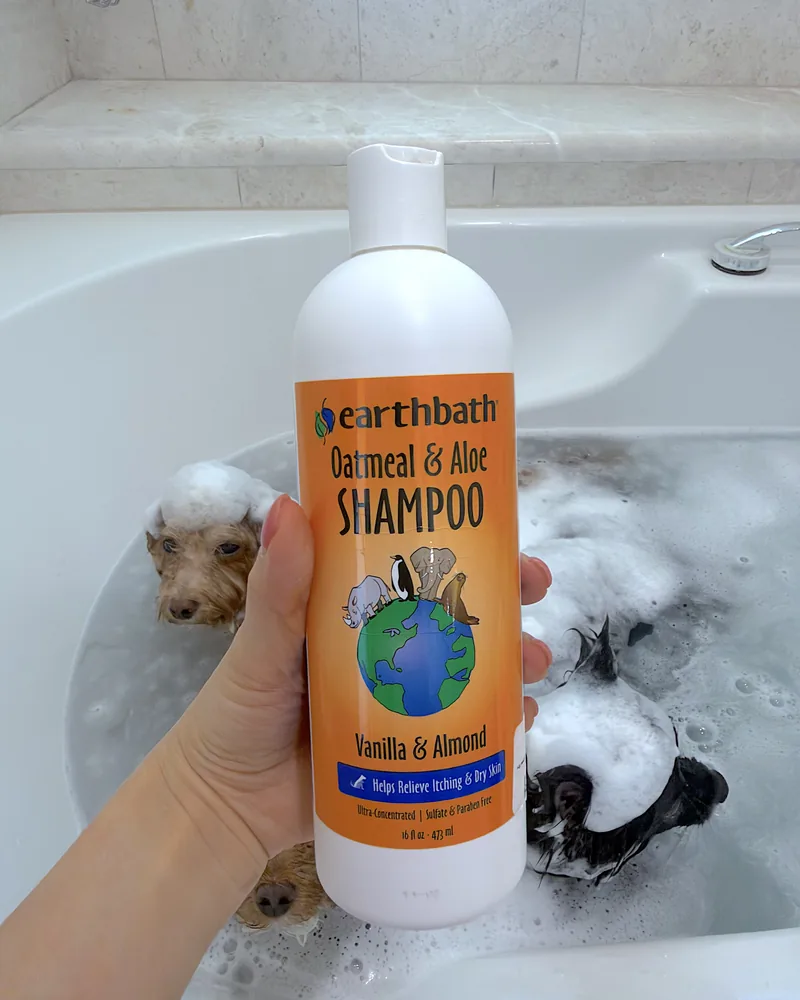
What I like about it after two years:
- Soft coats, not stiff ones. That was the first thing I noticed compared to what we used before.
- Her flakes are a lot better. Not gone, but nothing like before.
- One shampoo for everything. Baths every two weeks plus daily paw washes, for three dogs with three different coats.
- It’s concentrated. For baths it always goes into the foam pump with water, never straight from the bottle.
We used the matching earthbath oatmeal conditioner for a while too, since our vet had mentioned both. I’ve stopped. The shampoo is gentle enough that their coats come out soft without it, and I just don’t feel the need anymore. I bought both the shampoo and the foam pump on Amazon.
Good to know: human dandruff shampoo is made for human skin, so I stick to a shampoo made for dogs and leave anything medicated to the vet.
Why I Lather With a Foam Pump
The yellow duck in these photos is a foam pump bottle I got on Amazon for about $17. I put shampoo and water in the clear bottle, roughly 1 part shampoo to 9 parts water, sometimes closer to 2 parts shampoo to 8. I’m not precise about it at all. Press the duck’s head and it pumps out thick foam instead of runny liquid.
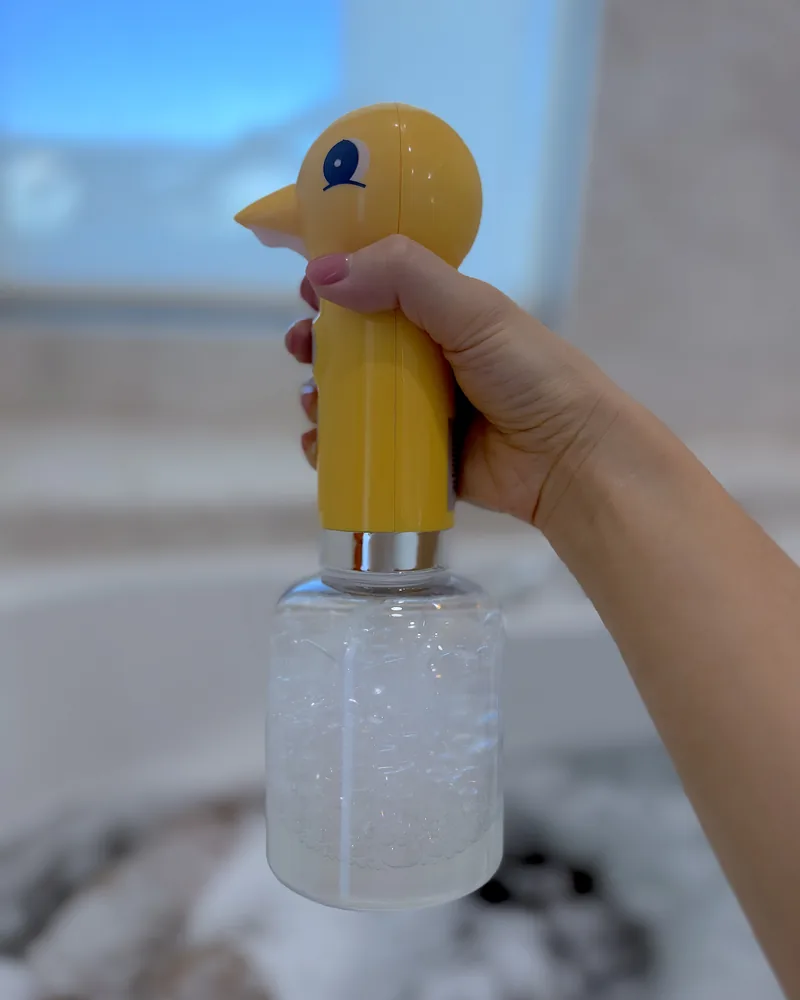
That foam is how I get the big, bubbly lather I like, and it’s also what I use for the spa soak, a few pumps in the bath water and over their backs before the real washing starts. My eyeballed mix sits inside the up-to-10:1 dilution earthbath mentions, and since they say to use a diluted mix within 24 hours, I’d only mix what you’ll use that day.
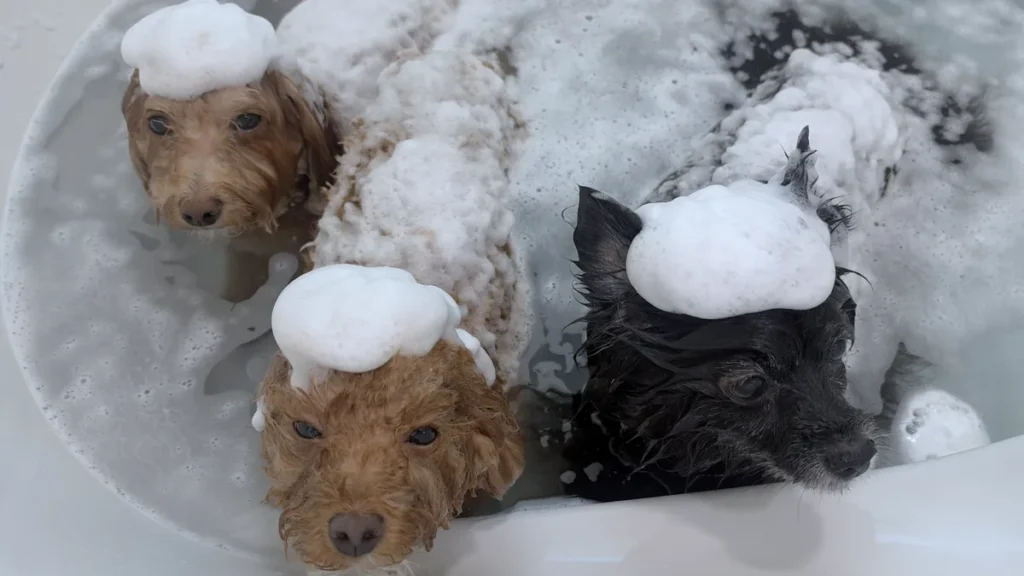
And yes, the foam hats in the first photo were completely on purpose. A little blob of foam on each head is the only way I get all three of them to look at the camera at the same time.
How to Dry a Dog After a Bath (the Step I Never Skip)
After a walk, I wash their paws in the sink and let them air-dry, and in our dry weather that takes minutes. A full bath is different. A double coat like our Pomeranian’s holds water much longer than you’d think, so after every bath she gets blow-dried until she’s completely dry, all the way down to the skin. Not damp. Not “mostly dry.”
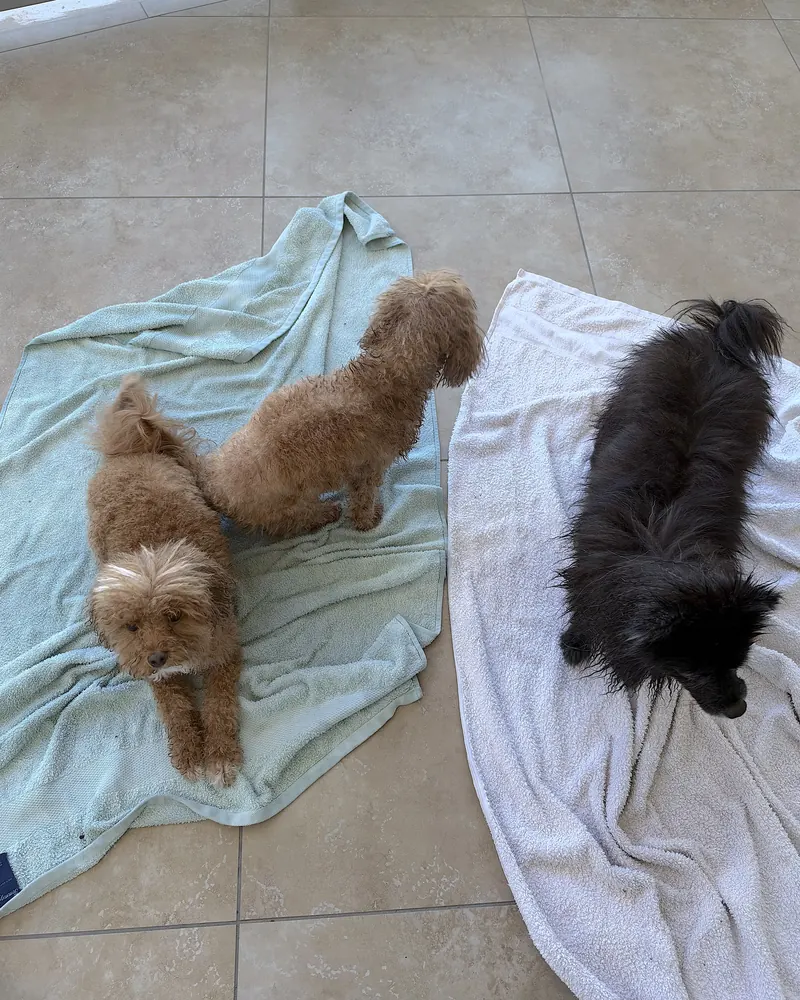
Each dog gets a towel first. Then I use my Dyson hair dryer with the airflow turned all the way up and the heat on the lowest warm setting. I tried cool air only, and it takes way too long. Drying alone is about 15 minutes per dog.
Our oldest takes the longest by far, about 20 minutes, because she has the longest coat and so much of it. Add the spa soak, five-plus minutes of washing per dog and all that drying, and bath day for the three of them easily runs over an hour.
What Helps Between Baths
A bath every two weeks is only one day out of fourteen. The rest of the time, this is what’s on our list:
- A 3-minute slicker brush every morning. Brushing moves the flakes and loose undercoat out of the coat before they land on the couch. I broke down our whole routine in how to deshed a dog at home.
- Paws washed after every walk. In the sink, one dog at a time, with the same oatmeal shampoo, so the full bath can stay at every two weeks. More on that in keeping a dog clean between grooming appointments.
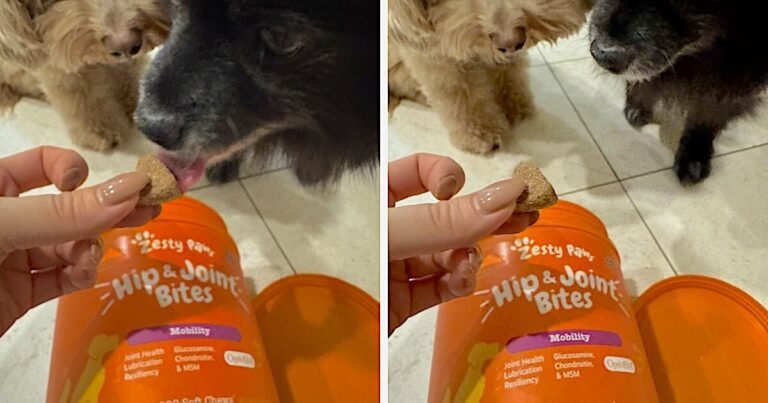
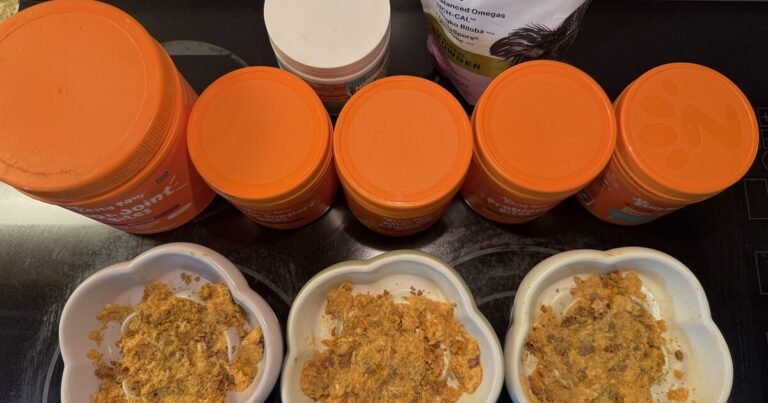
- A skin and coat chew every day. All three get a Zesty Paws skin and coat chew, broken up into their meals, and the two younger boys also get a fish oil blend. The full lineup is in our daily dog supplement routine. I can’t promise any chew fixes flakes. It’s simply part of what we do.
- Homemade food. They’ve eaten homemade food for three years. Our oldest has her own version in homemade dog food for senior dogs.
- Not bathing more to fix it. Two weeks is our rhythm, flaky day or not, because extra baths can dry skin out even more.
When Dog Dandruff Is a Vet Visit, Not a Bath Problem
A bath routine is for ordinary dry-skin flakes. These are the signs I’d stop and call the vet about instead:
- Flakes that show up suddenly, or a lot more than usual
- Flakes that seem to move (that can be mites, and they can spread to your other pets and to people)
- Constant scratching, licking or chewing at one spot
- Red skin, bumps, scabs, sores or a bad smell
- Bald or thinning patches
- Greasy, yellowish flakes instead of dry white ones
- Any change in appetite, energy or weight along with the skin changes
With three dogs who sleep, play and lick each other all day, anything contagious isn’t a one-dog problem. If one of ours had moving flakes or sudden itching, all three would be going in.
Our dogs see the vet every two to three months for their shots anyway, and I bring up anything I’ve noticed at those visits. That’s actually how this whole routine started: I asked about her flakes, and the answer was an oatmeal shampoo and conditioner.
Mistakes I Try Not to Make
- Lathering only the top of the coat. On a thick coat the shampoo never reaches the skin.
- Rushing the rinse. Leftover shampoo in a thick coat is one of the things that can dry skin out.
- Letting a full bath air-dry. Paws, fine. A whole double coat, never.
- Bathing every few days to chase the flakes. More baths can strip the skin even more.
- Using my own shampoo. Dog shampoo only.
- Sticking with a shampoo that isn’t working. If a shampoo leaves the coat stiff or the flakes look worse, that’s your sign. Both happened to us before we switched.
- Guessing when something looks off. If it’s new, itchy or moving, the vet sees it before I try anything else.
Frequently Asked Questions
If you only take two things from this: ask your vet about a gentle oatmeal shampoo, and then do the boring parts well. Get the lather all the way down to the skin, rinse until there’s no foam left, and dry a thick coat completely instead of letting it air-dry. And anything new, itchy or moving goes to the vet before it goes in the tub.
Next up in our pet care series, I’m sharing the chicken jerky I’ve been making for the dogs in our new food dehydrator. Does your dog get flaky too, or are you dealing with something else entirely? Tell me in the comments. And if you’re living with a senior Pom too, here’s what 14 years looks like on our girl.