Signs Your Senior Dog Needs a Ramp (And the $30 Steps We Bought Instead)
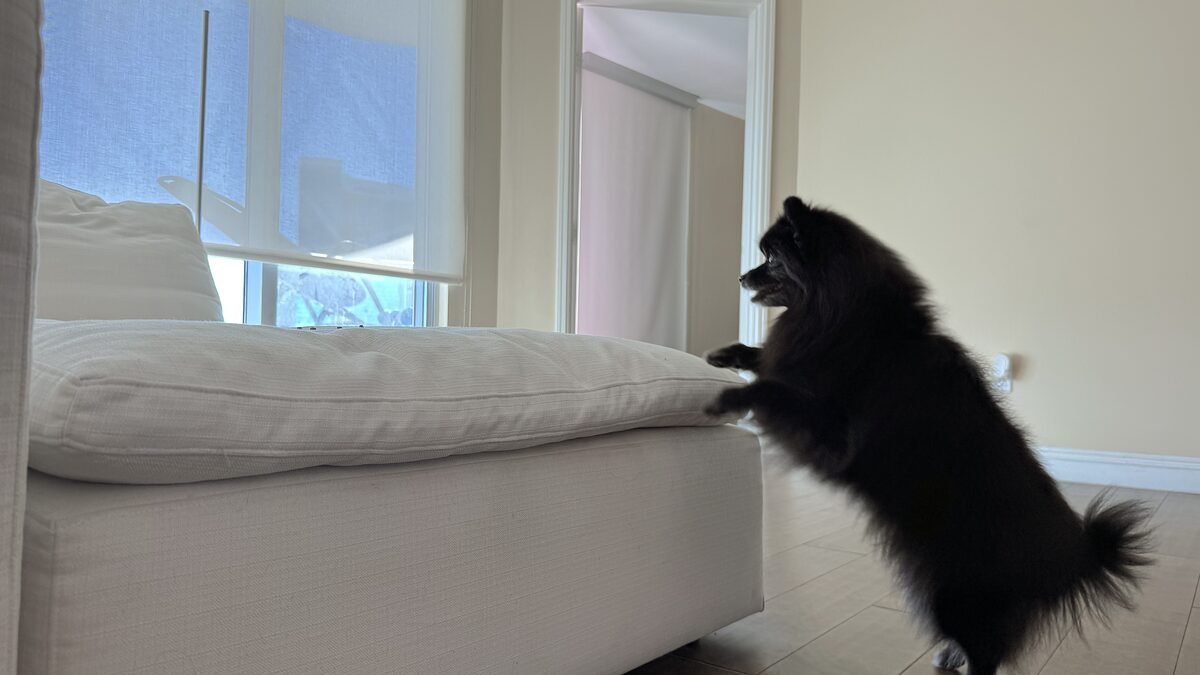
For about six months I read the signs your senior dog needs a ramp as personality. She had gotten clingy, I thought. She wanted to be carried. It was cute. Then I watched her take three run ups at the couch, give up, and go lie on the floor underneath it instead, and the whole thing rearranged itself in my head.
I want to be straight with you about how this ended, because these posts are usually written by somebody who already bought the nice thing. We did not. After measuring every surface in the house and reading more product listings than I want to admit, we ended up with a $29.99 three step foam set instead of the adjustable wood ramp I had been eyeing, and the reason comes down to one number that almost every listing buries.
So this is the whole story: the eight signs we saw, what we did for free while we worked it out, the numbers I shopped with, and what we actually bought. I am a dog owner and not a vet, so anything that looks like pain gets an appointment, not a gadget.
Quick Look: Signs Your Senior Dog Needs a Ramp
| Our dog | 14-year-old Pomeranian, 12 to 13 lb |
| Heights we needed to solve | Couch seat 16 in. Car hatch about 33 in |
| Slope to aim for | About 20 to 25 degrees |
| Rule instead of math | Ramp length about 2.5 to 3 times the height |
| Minimum width | 14 to 16 inches |
| Surface | Full grip, not a carpet strip down the middle |
| What we did before buying | Lifted her, and kept a floor bed under the couch |
| What we bought | A 3 step foam set, 15.7 in tall, 22.4 in deep, 15.7 in wide, $29.99 |
| What we passed on | A folding wood ramp, fixed 33 in board, 5 height settings, about $60 |
| Days to her first climb on her own | 2 to 3 days, with treats |
| Biggest surprise | She now goes up without a second of hesitation |
| The sign I misread longest | Asking to be picked up |
The 8 Signs We Saw, Roughly in Order
1. A pause before the jump
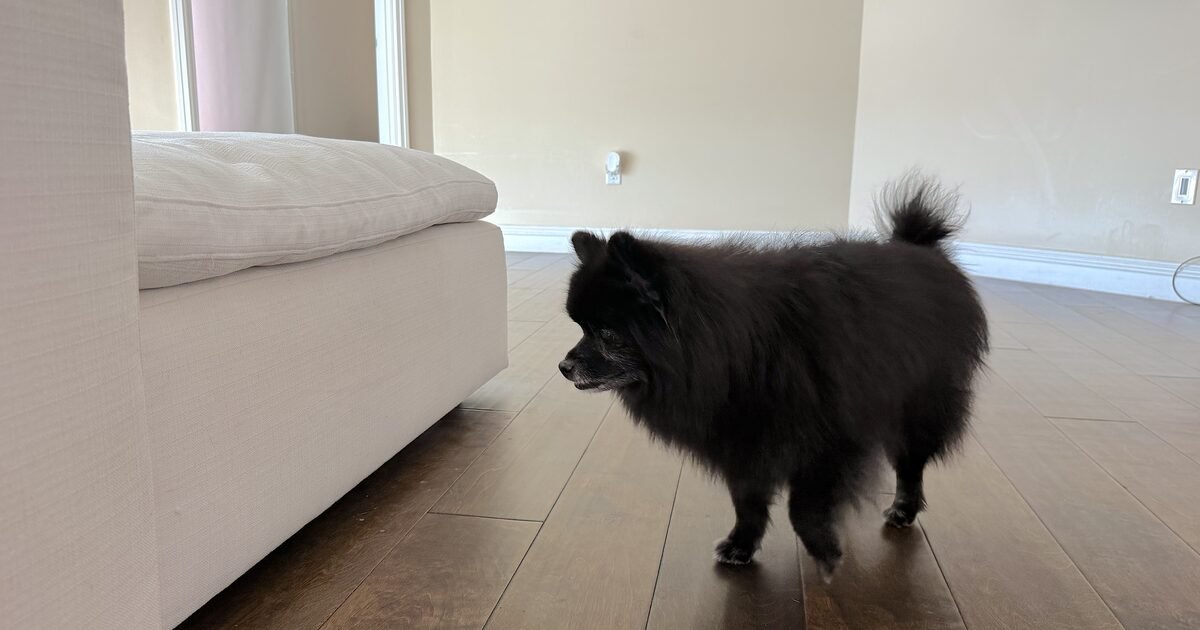
She stands square in front of the couch and just looks at it. Two seconds, sometimes five. Young dogs do not deliberate. That pause is a dog running a risk assessment.
2. The run up
Backing up to get a few steps of momentum for a jump she used to make from standing. It reads as enthusiasm. It is compensation.
3. Refusing to come down
This one surprised me. Down is harder than up, because landing takes the whole impact through the front legs and shoulders. She gets onto the couch fine and then stands at the edge waiting for somebody to notice her.
4. Landing hard
A thump instead of a step. You hear it before you see it. Our three-year-olds land almost silently.
5. Asking to be picked up
The sign I got wrong for months. I read it as affection. She was outsourcing the jump.
6. Stiffness the morning after a big day
Slower on the first walk after an evening spent hopping on and off furniture. Nothing dramatic, just a few minutes of moving like the joints need to warm up. If that sounds familiar, here are the early signs of arthritis in dogs I watch for.
7. Picking a new spot
She started sleeping on a floor bed under the couch instead of on it. Dogs do not usually downgrade their own furniture for fun.
8. Hesitating at the car
Our hatch sits about 33 inches off the ground, roughly three times her height at the shoulder. It is the tallest thing she deals with, and it is the first place she stopped trying altogether. That is what finally got me measuring things.
What We Did Before We Bought Anything
None of this cost a cent, and doing it for a few weeks is what told us the problem really was height and not something else.
- Lifted her, which works right up until you are carrying groceries, and which teaches her to wait for a person instead of moving herself.
- Moved the target lower where we could, so there was always somewhere comfortable she could reach on her own. A floor bed under the couch, right where she was already choosing to lie.
- Sat through one whole evening counting how many times she actually needed to get up or down. It was more than I would have guessed, and that number is what made this feel urgent instead of optional.
If you are at the same stage, do that last one first. It is free, it takes one evening, and it answers the question a product page cannot: is your dog happy to climb when the climb is reasonable? Ours was. That is what turned this from an indulgence into an obvious purchase.
The Numbers I Shopped With
The mistake I nearly made was buying by the photo. A short ramp against a tall target is a slide, and dogs will not use a slide. The slope is the entire product.
Aim for roughly 20 to 25 degrees. No protractor needed: measure the height you are climbing and multiply by 2.5 to 3, and buy that ramp length. A 1 in 3 slope is about 19 degrees and a 1 in 2.5 slope is about 24, so anything in that band works. Our 16 inch couch seat wants roughly a 40 to 48 inch ramp. A shorter ramp against the same couch is a 30 degree climb, and that is the version that ends up behind the couch unused.
Width is the one nobody mentions. An old dog drifts sideways when she is tired, so I was looking at 14 to 16 inches minimum, with low side rails. And the surface has to have grip across the whole width, not a carpet strip down the middle, because the grip has to be under a foot that is already long haired and slippery.
The Types, and What Each One Is Actually For
This is the comparison I had to assemble myself, so here it is in one place.
| Foam | Light, soft edges, washable cover, looks fine in a living room. Best for couch and bed with a small dog. |
| Solid wood | Sturdy and furniture-like, good for one fixed spot. Heavy, and the height is usually not adjustable. |
| Folding plastic | Cheap and strong, made for cars. Many have slick surfaces, and it looks like gear in a living room. |
| Telescoping | Adjustable length for a car hatch. Usually narrower, which matters for a senior who drifts sideways. |
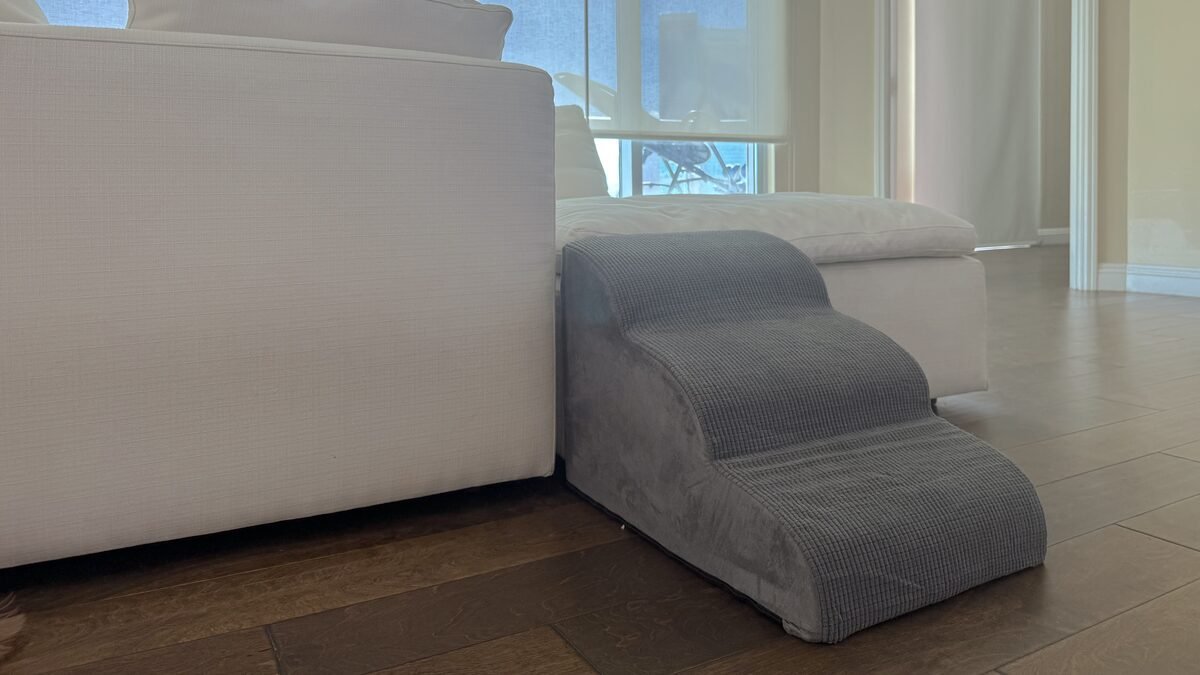
| Stepped foam | What we ended up with. Shallow crests with curved slopes between them, so there are no flat treads and no vertical risers. Takes about a third of the floor space a real ramp needs. |
| Hard stairs | The one I would avoid for a stiff senior. Every step is still a push up and a landing, which is the movement you are trying to remove. |
The couch was the problem she faced a dozen times a day, so that is the one we solved. The car is a different animal. Our car is a big SUV with a cargo floor about 33 inches off the ground, more than twice the height of anything sold as couch stairs, and on this model the air suspension can drop the rear a few inches with a button, which helps. A 12 pound dog is also easy to lift in. I would rather say that plainly than pretend one product covers a couch and a hatch.
Why the $30 Foam Set Beat the $60 Ramp
I narrowed it to two, and running the numbers on them is what taught me the length rule in the first place. I am describing the shapes rather than the brands, because the geometry is the part that transfers to whatever is on the shelf when you read this.
What we bought is a three step foam set. It is 22.4 inches deep, 15.7 inches wide, 15.7 inches tall, light enough to slide across the room with one hand, and it is one solid piece of foam under a grey corduroy cover. It is sold as a ramp and it is really a rippled staircase: three shallow crests with curved slopes between them, no flat treads and no vertical risers. The average incline works out to about 35 degrees, but the dog never walks that plane. She takes three steps of roughly 5 inches each onto crests that are close to level. It was $29.99.
What I passed on was a folding wood ramp with five height settings from 9.8 to 20.5 inches, around $60. The important detail, and it took me a while to find it, is that the board is a fixed 33 inches long at every setting. Raising the height does not lengthen the run, it only steepens the same board. So the angles come out at 17 degrees at the lowest setting, 25 at the second, and 38 at the top.
That last number is the whole decision. At any real couch height that ramp is past 30 degrees, which is well outside the 20 to 25 I was aiming for. It is also 12.5 inches wide with no side rails and bare finished wood along both edges of the carpet strip, and the most repeated complaint on it is some version of “too narrow, my dog would not use it.” For a tired 14-year-old who drifts sideways, with long hair between her toes, that was the wrong combination at twice the price.
The foam set is steeper on paper and better in practice for our specific dog, because she is never on a sustained slope, the full 15.7 inch width is walkable, the edges are soft, and there is nothing to fall off. Its one real weakness is that foam scoots on hard floors, which a rug underneath fixes. And at 15.7 inches tall it leaves a gap if your couch seat is higher than that, so measure the seat before you order. Ours is 16 inches, so the top crest sits about a third of an inch below the cushion, and she has never noticed.
If you do want a proper low angle ramp, the lesson is that the board has to get longer, not the legs taller. A roughly 39 inch board at around 15 inches of height lands near 22 degrees, which is inside target. Thirty three inches cannot get there at couch height no matter what the listing says.
The First Few Days With It
I set it up against the couch and waited for her to figure it out. She did not. Day one she sniffed it all over, clearly had no idea what it was for, and would not put a paw on it.
So I switched to treats. One small piece on the first crest, then the second, then the top, and the same thing coming back down, a few short rounds at a time with no lifting and no pushing from behind. By the second or third day she was using it on her own, and the run up at the couch stopped completely.
The part I did not expect is how different she looks going up. The pause, the backing up, the staring at the cushion, all of it is gone. She walks to the steps and goes straight up without a second of hesitation, like it was never a question. Watching that the first time, my honest reaction was that I should have bought these months ago.
What a Ramp Will Not Do
A ramp removes impact. It does not treat whatever makes the impact hurt. Ours is on a joint supplement and has been for a while, and I compared the two formats in joint supplement chews versus powder for senior dogs. The full morning stack is in our daily dog supplement routine.
It also does not solve distance. Furniture and car access are one problem, and getting tired halfway through a walk is a different one. That is the signs your senior dog needs a stroller post. Dinner is its own version of the same story, and I wrote that one up as the signs your senior dog needs a raised bowl.
And if you travel with dogs, do not forget the car. The hatch is the tallest jump most seniors face, and they do it when they are already tired. Some of what we learned the slow way is in car camping with three dogs and staying somewhere with multiple dogs.
Frequently Asked Questions
If you take two things from this, take the length formula and the tape measure. Height times 2.5 to 3 is the ramp length you need, and anything that cannot reach that length at your couch height is not really a ramp, whatever the listing calls it. That one check is what stopped us from spending twice as much on something she would have walked past.
I also wrote up how we get supplements into three dogs every morning without double dosing anybody, which turned into a much bigger mess than I expected. If your senior has started hesitating at the couch, tell me in the comments which sign you noticed first. I want to know whether the run up is as universal as I think it is.