Chinese Zodiac Calculator: Find Your Animal by Birthday (Lunar New Year and Korean Saju Rules)
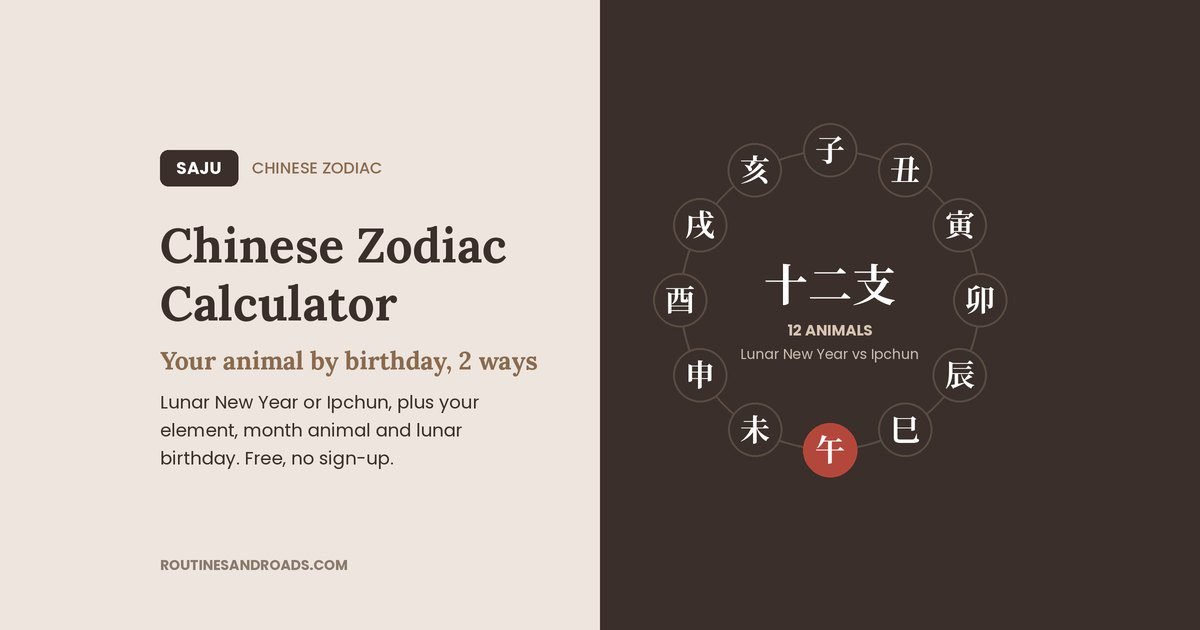
This Chinese zodiac calculator finds your animal from your birthday the two ways people actually use: the Lunar New Year rule most US charts follow, and the Korean saju rule, where the new year starts at Ipchun around February 4. For most birthdays the two agree. If you were born in January or February, they can hand you two different animals, and that’s the part I want to clear up for you.
I’m Emily, a Korean living in the US with my husband and three dogs, and I’ve been reading saju, the Korean four pillars, on my own for years. The two animals question even comes up in my own house. My husband tells people he’s a Dragon, because that’s the animal for the year on his birth certificate. He was born a few weeks before Ipchun, though, so in saju he’s a Rabbit, and Lunar New Year charts would call him a Rabbit too.
Chinese Zodiac Calculator
Pop in your birthday and I’ll show you your animal both ways: the Lunar New Year way most charts use, and the Korean saju way, where the year starts at Ipchun around February 4. You also get your element, your Korean color name, your month animal and your lunar birthday. Birth time is optional, but it matters if you were born right on a cutoff day.
Everything is worked out right in your browser. Nothing you type gets sent anywhere.
Under the calculator you'll find a table of every year from 1950 to 2030 with its Lunar New Year date and the exact Ipchun time in US Eastern and Pacific time, a cheat sheet for your element, and the month animal hiding in your birthday, which most zodiac charts never mention.

| What you need | Your birthday. Birth time and birthplace only matter on a cutoff day |
| Rule 1: Lunar New Year | Moves between January 21 and February 20. Most US charts and apps use it |
| Rule 2: Ipchun (입춘) | February 3 or 4 in US time zones. Korean saju and Chinese bazi use it |
| When the two can differ | Birthdays from January 21 to February 20 |
| Your element | Last digit of your birth year: 0 to 1 Metal, 2 to 3 Water, 4 to 5 Wood, 6 to 7 Fire, 8 to 9 Earth |
| Your month animal | Changes between the 3rd and 8th of each month, not on the 1st |
| 2027 starts | Ipchun on Feb 3, 2027 (8:46 PM Eastern, 5:46 PM Pacific). Lunar New Year on Feb 6, 2027 |
| Best for / Good to know | Best for anyone born in January or February, or anyone who's been told two different animals. Good to know: the calculator runs in your browser, and your animal is just one of the eight characters in a full saju chart |
How to Use This Chinese Zodiac Calculator
It takes about ten seconds. Here's what each box does and why it's there:
- Birthday: the only box you really need. The calculator covers birthdays from 1900 to 2100.
- Birth time (optional): leave it blank if you don't know it. It only matters if you were born on a cutoff day, like Ipchun day itself, and the calculator tells you when that's the case.
- Where were you born: pick the time zone you were born in, not the one you live in now. Ipchun happens at one moment for the whole world, so it lands on a different clock time, and sometimes a different date, depending on where you are.
Then tap Find my animal. Here's how to read what comes back:
- Saju (Korean four pillars): your animal counted from Ipchun, plus its element and whether it's a yin or yang year. This is the answer a Korean saju reader or a Chinese bazi chart would use.
- Lunar New Year charts: your animal counted from Lunar New Year, the way most zodiac charts, restaurant placemats and greeting cards do it.
- In Korea: your year's Korean color name, like baengmal-tti (백말띠) for the white horse of 1990. Koreans love naming years by color.
- Your month animal: the second animal in your birthday, from your month pillar.
- Signs you tend to click with: your three harmonies and your secret friend, the classic Korean compatibility shortcut.
- Your next year: when your animal's year comes around again, with both start dates.
- Your lunar birthday: your birthday on the lunar calendar, plus the Lunar New Year date and Ipchun time for the year you were born.
Everything runs right in your browser. Your birthday never leaves your screen, and there's nothing to sign up for. I worked out the Ipchun times from the sun's actual position, the same way a Korean manseryeok (만세력) calendar does, and double-checked them and the lunar dates against an open-source perpetual calendar library.
The first thing I did after building it was run my dog Mocha through it, and he turned out to be the perfect example of why the birth time box exists. Mocha, my 3-year-old mini goldendoodle, was born on February 3, 2023. Lunar New Year had already come on January 22 that year, so Lunar New Year charts make him a Water Rabbit. But February 3, 2023 was Ipchun day in every US time zone (6:42 PM Pacific, 9:42 PM Eastern), so in saju he's a Water Tiger if he arrived before that moment and a Water Rabbit if he came after. Without his exact birth hour, the calculator shows me both sides, which is exactly what it should do. If you came for the dogs, here are the homemade chicken nugget treats I make for my three.
What Is My Chinese Zodiac? Why One Birthday Can Have Two Answers
Your Chinese zodiac animal comes from your birth year. There are 12 animals in a fixed order: Rat, Ox, Tiger, Rabbit, Dragon, Snake, Horse, Goat, Monkey, Rooster, Dog and Pig. Each year gets the next one, and every 12 years the cycle starts over. That part everybody agrees on.
The real question is when the year starts, and there are actually three answers floating around:
- January 1. This is the shortcut a lot of people use, my husband included, when they go by the year on their birth certificate. It works for anyone born after February 20, but it isn't the rule in Chinese or Korean tradition.
- Lunar New Year. The first day of the lunar calendar, which moves around between January 21 and February 20. Most zodiac charts and apps in the US go by this.
- Ipchun (입춘). The first of the 24 solar terms, the moment the sun reaches 315 degrees along its yearly path and spring begins on the traditional calendar. It lands on February 3 or 4 in US time zones. Korean saju and Chinese bazi both start the year here.
Lunar New Year is the celebration. It follows the moon, so its date slides around by up to a month. Ipchun follows the sun, so it barely moves. Saju is built on the solar terms, which is why a Korean saju reader will always count your year from Ipchun, even though Seollal, the Korean Lunar New Year, is the big holiday everyone in Korea goes home for.
Here's what that looks like in real years:

- 2026: Ipchun came on February 3 in the US, but Lunar New Year didn't come until February 17. A baby born February 10, 2026 is a Fire Horse in saju and a Wood Snake on most charts.
- 2027: Ipchun comes on the evening of February 3 in the US, and Lunar New Year on February 6. A baby born February 5, 2027 is a Fire Goat in saju and still a Fire Horse on most charts.
- 2028: Lunar New Year comes early, on January 26, and Ipchun not until February 3 or 4. A baby born January 30, 2028 is an Earth Monkey on most charts and still a Fire Goat in saju.
So which one is right? Both, honestly. They're two traditions answering slightly different questions. If you want the animal on the placemat at your favorite Chinese restaurant, go with Lunar New Year. If you want the animal a saju or bazi reader will work with, go with Ipchun. The calculator shows both, so you never have to guess which rule a chart is using.
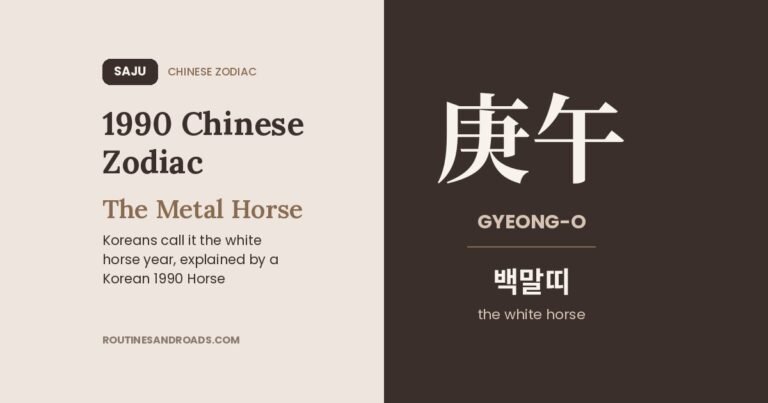
For me it's simple. I was born in the fall of 1990, long after both cutoffs, so every rule agrees I'm a Metal Horse, or a white horse as we say in Korea. My 1990 Chinese zodiac guide has the whole story on that year.
What Chinese Zodiac Am I If I Was Born in January or February?
If your birthday is anywhere from late February to December, you can relax. Both rules give you the animal for your birth year, and the calculator will just confirm it. January and early February birthdays are the ones to check. Here's the quick version for anyone born in the US:
- January 1 to January 20: you're the previous year's animal by both traditional rules. Lunar New Year never lands before January 21, and Ipchun is still a couple of weeks away.
- January 21 to February 2: in saju you're still the previous year's animal. On Lunar New Year charts it depends on whether Lunar New Year had already come that year, so check the table below.
- February 3 to 4: your birthday might be Ipchun day itself. Put in your birth time and birthplace and the calculator will tell you which side you landed on.
- February 5 to February 20: in saju you're the new year's animal. On Lunar New Year charts it again depends on the year.
- February 21 or later: you're your birth year's animal, whichever rule you use.
Born outside the US? The dates shift a little. In Korea, for example, Ipchun usually falls on February 4, sometimes the 3rd or 5th. Pick your birthplace in the calculator and it does the time zone math for you.
Koreans even have a name for people born in January and February: ppareun nyeonsaeng (빠른 년생), the early birds who used to start school a year ahead of everyone else born the same year. I explain it in my 1990 guide, and my 1991 Chinese zodiac guide walks through what an early February birthday does to your animal, with the exact cutoff times.
Chinese Zodiac by Birthday: Every Year From 1950 to 2030
Here's every year from 1950 to 2030 with its animal and element, the Lunar New Year date most charts use, and the exact moment of Ipchun in US Eastern and Pacific time. If your birthday falls before the cutoff you're going by, you belong to the year above.
| Year | Animal and element | Lunar New Year (most charts) | Ipchun, US Eastern (saju) | Ipchun, US Pacific |
|---|---|---|---|---|
| 1950 | Metal Tiger (庚寅) | Feb 17 | Feb 4, 4:21 AM | Feb 4, 1:21 AM |
| 1951 | Metal Rabbit (辛卯) | Feb 6 | Feb 4, 10:13 AM | Feb 4, 7:13 AM |
| 1952 | Water Dragon (壬辰) | Jan 27 | Feb 4, 3:53 PM | Feb 4, 12:53 PM |
| 1953 | Water Snake (癸巳) | Feb 14 | Feb 3, 9:46 PM | Feb 3, 6:46 PM |
| 1954 | Wood Horse (甲午) | Feb 3 | Feb 4, 3:31 AM | Feb 4, 12:31 AM |
| 1955 | Wood Goat (乙未) | Jan 24 | Feb 4, 9:18 AM | Feb 4, 6:18 AM |
| 1956 | Fire Monkey (丙申) | Feb 12 | Feb 4, 3:12 PM | Feb 4, 12:12 PM |
| 1957 | Fire Rooster (丁酉) | Jan 31 | Feb 3, 8:55 PM | Feb 3, 5:55 PM |
| 1958 | Earth Dog (戊戌) | Feb 18 | Feb 4, 2:49 AM | Feb 3, 11:49 PM |
| 1959 | Earth Pig (己亥) | Feb 8 | Feb 4, 8:42 AM | Feb 4, 5:42 AM |
| 1960 | Metal Rat (庚子) | Jan 28 | Feb 4, 2:23 PM | Feb 4, 11:23 AM |
| 1961 | Metal Ox (辛丑) | Feb 15 | Feb 3, 8:22 PM | Feb 3, 5:22 PM |
| 1962 | Water Tiger (壬寅) | Feb 5 | Feb 4, 2:17 AM | Feb 3, 11:17 PM |
| 1963 | Water Rabbit (癸卯) | Jan 25 | Feb 4, 8:08 AM | Feb 4, 5:08 AM |
| 1964 | Wood Dragon (甲辰) | Feb 13 | Feb 4, 2:05 PM | Feb 4, 11:05 AM |
| 1965 | Wood Snake (乙巳) | Feb 2 | Feb 3, 7:46 PM | Feb 3, 4:46 PM |
| 1966 | Fire Horse (丙午) | Jan 21 | Feb 4, 1:38 AM | Feb 3, 10:38 PM |
| 1967 | Fire Goat (丁未) | Feb 9 | Feb 4, 7:31 AM | Feb 4, 4:31 AM |
| 1968 | Earth Monkey (戊申) | Jan 30 | Feb 4, 1:07 PM | Feb 4, 10:07 AM |
| 1969 | Earth Rooster (己酉) | Feb 17 | Feb 3, 6:59 PM | Feb 3, 3:59 PM |
| 1970 | Metal Dog (庚戌) | Feb 6 | Feb 4, 12:46 AM | Feb 3, 9:46 PM |
| 1971 | Metal Pig (辛亥) | Jan 27 | Feb 4, 6:25 AM | Feb 4, 3:25 AM |
| 1972 | Water Rat (壬子) | Feb 15 | Feb 4, 12:20 PM | Feb 4, 9:20 AM |
| 1973 | Water Ox (癸丑) | Feb 3 | Feb 3, 6:04 PM | Feb 3, 3:04 PM |
| 1974 | Wood Tiger (甲寅) | Jan 23 | Feb 4, 1:00 AM | Feb 3, 10:00 PM |
| 1975 | Wood Rabbit (乙卯) | Feb 11 | Feb 4, 5:59 AM | Feb 4, 2:59 AM |
| 1976 | Fire Dragon (丙辰) | Jan 31 | Feb 4, 11:39 AM | Feb 4, 8:39 AM |
| 1977 | Fire Snake (丁巳) | Feb 18 | Feb 3, 5:33 PM | Feb 3, 2:33 PM |
| 1978 | Earth Horse (戊午) | Feb 7 | Feb 3, 11:27 PM | Feb 3, 8:27 PM |
| 1979 | Earth Goat (己未) | Jan 28 | Feb 4, 5:12 AM | Feb 4, 2:12 AM |
| 1980 | Metal Monkey (庚申) | Feb 16 | Feb 4, 11:09 AM | Feb 4, 8:09 AM |
| 1981 | Metal Rooster (辛酉) | Feb 5 | Feb 3, 4:55 PM | Feb 3, 1:55 PM |
| 1982 | Water Dog (壬戌) | Jan 25 | Feb 3, 10:45 PM | Feb 3, 7:45 PM |
| 1983 | Water Pig (癸亥) | Feb 13 | Feb 4, 4:40 AM | Feb 4, 1:40 AM |
| 1984 | Wood Rat (甲子) | Feb 2 | Feb 4, 10:19 AM | Feb 4, 7:19 AM |
| 1985 | Wood Ox (乙丑) | Feb 20 | Feb 3, 4:12 PM | Feb 3, 1:12 PM |
| 1986 | Fire Tiger (丙寅) | Feb 9 | Feb 3, 10:08 PM | Feb 3, 7:08 PM |
| 1987 | Fire Rabbit (丁卯) | Jan 29 | Feb 4, 3:52 AM | Feb 4, 12:52 AM |
| 1988 | Earth Dragon (戊辰) | Feb 17 | Feb 4, 9:43 AM | Feb 4, 6:43 AM |
| 1989 | Earth Snake (己巳) | Feb 6 | Feb 3, 3:27 PM | Feb 3, 12:27 PM |
| 1990 | Metal Horse (庚午) | Jan 27 | Feb 3, 9:14 PM | Feb 3, 6:14 PM |
| 1991 | Metal Goat (辛未) | Feb 15 | Feb 4, 3:08 AM | Feb 4, 12:08 AM |
| 1992 | Water Monkey (壬申) | Feb 4 | Feb 4, 8:48 AM | Feb 4, 5:48 AM |
| 1993 | Water Rooster (癸酉) | Jan 23 | Feb 3, 2:37 PM | Feb 3, 11:37 AM |
| 1994 | Wood Dog (甲戌) | Feb 10 | Feb 3, 8:31 PM | Feb 3, 5:31 PM |
| 1995 | Wood Pig (乙亥) | Jan 31 | Feb 4, 2:13 AM | Feb 3, 11:13 PM |
| 1996 | Fire Rat (丙子) | Feb 19 | Feb 4, 8:08 AM | Feb 4, 5:08 AM |
| 1997 | Fire Ox (丁丑) | Feb 7 | Feb 3, 2:02 PM | Feb 3, 11:02 AM |
| 1998 | Earth Tiger (戊寅) | Jan 28 | Feb 3, 7:57 PM | Feb 3, 4:57 PM |
| 1999 | Earth Rabbit (己卯) | Feb 16 | Feb 4, 1:57 AM | Feb 3, 10:57 PM |
| 2000 | Metal Dragon (庚辰) | Feb 5 | Feb 4, 7:40 AM | Feb 4, 4:40 AM |
| 2001 | Metal Snake (辛巳) | Jan 24 | Feb 3, 1:29 PM | Feb 3, 10:29 AM |
| 2002 | Water Horse (壬午) | Feb 12 | Feb 3, 7:24 PM | Feb 3, 4:24 PM |
| 2003 | Water Goat (癸未) | Feb 1 | Feb 4, 1:05 AM | Feb 3, 10:05 PM |
| 2004 | Wood Monkey (甲申) | Jan 22 | Feb 4, 6:56 AM | Feb 4, 3:56 AM |
| 2005 | Wood Rooster (乙酉) | Feb 9 | Feb 3, 12:43 PM | Feb 3, 9:43 AM |
| 2006 | Fire Dog (丙戌) | Jan 29 | Feb 3, 6:27 PM | Feb 3, 3:27 PM |
| 2007 | Fire Pig (丁亥) | Feb 18 | Feb 4, 12:18 AM | Feb 3, 9:18 PM |
| 2008 | Earth Rat (戊子) | Feb 7 | Feb 4, 6:00 AM | Feb 4, 3:00 AM |
| 2009 | Earth Ox (己丑) | Jan 26 | Feb 3, 11:50 AM | Feb 3, 8:50 AM |
| 2010 | Metal Tiger (庚寅) | Feb 14 | Feb 3, 5:48 PM | Feb 3, 2:48 PM |
| 2011 | Metal Rabbit (辛卯) | Feb 3 | Feb 3, 11:33 PM | Feb 3, 8:33 PM |
| 2012 | Water Dragon (壬辰) | Jan 23 | Feb 4, 5:22 AM | Feb 4, 2:22 AM |
| 2013 | Water Snake (癸巳) | Feb 10 | Feb 3, 11:13 AM | Feb 3, 8:13 AM |
| 2014 | Wood Horse (甲午) | Jan 31 | Feb 3, 5:03 PM | Feb 3, 2:03 PM |
| 2015 | Wood Goat (乙未) | Feb 19 | Feb 3, 10:58 PM | Feb 3, 7:58 PM |
| 2016 | Fire Monkey (丙申) | Feb 8 | Feb 4, 4:46 AM | Feb 4, 1:46 AM |
| 2017 | Fire Rooster (丁酉) | Jan 28 | Feb 3, 10:34 AM | Feb 3, 7:34 AM |
| 2018 | Earth Dog (戊戌) | Feb 16 | Feb 3, 4:28 PM | Feb 3, 1:28 PM |
| 2019 | Earth Pig (己亥) | Feb 5 | Feb 3, 10:14 PM | Feb 3, 7:14 PM |
| 2020 | Metal Rat (庚子) | Jan 25 | Feb 4, 4:03 AM | Feb 4, 1:03 AM |
| 2021 | Metal Ox (辛丑) | Feb 12 | Feb 3, 9:59 AM | Feb 3, 6:59 AM |
| 2022 | Water Tiger (壬寅) | Feb 1 | Feb 3, 3:51 PM | Feb 3, 12:51 PM |
| 2023 | Water Rabbit (癸卯) | Jan 22 | Feb 3, 9:42 PM | Feb 3, 6:42 PM |
| 2024 | Wood Dragon (甲辰) | Feb 10 | Feb 4, 3:27 AM | Feb 4, 12:27 AM |
| 2025 | Wood Snake (乙巳) | Jan 29 | Feb 3, 9:10 AM | Feb 3, 6:10 AM |
| 2026 | Fire Horse (丙午) | Feb 17 | Feb 3, 3:02 PM | Feb 3, 12:02 PM |
| 2027 | Fire Goat (丁未) | Feb 6 | Feb 3, 8:46 PM | Feb 3, 5:46 PM |
| 2028 | Earth Monkey (戊申) | Jan 26 | Feb 4, 2:31 AM | Feb 3, 11:31 PM |
| 2029 | Earth Rooster (己酉) | Feb 13 | Feb 3, 8:20 AM | Feb 3, 5:20 AM |
| 2030 | Metal Dog (庚戌) | Feb 3 | Feb 3, 2:08 PM | Feb 3, 11:08 AM |
Born in another time zone? The calculator covers 24 of them. The Lunar New Year dates here follow the Chinese lunar calendar, the one zodiac charts online use.
A few years in this table are worth a second look:
- 1966: Lunar New Year came on January 21, about as early as it ever gets. Anyone born from January 21 to early February 1966 is a Fire Horse on most charts and a Wood Snake in saju.
- 1985: Lunar New Year came on February 20, about as late as it ever gets. Anyone born from Ipchun on February 3 to February 19, 1985 is a Wood Ox in saju and still a Wood Rat on most charts.
- 2026: a late Lunar New Year (February 17) means almost two weeks of February babies with two animals, Fire Horse in saju and Wood Snake on most charts.
What Chinese Element Is My Birthday?
Your element comes from the same place as your animal: the year. Every year on the traditional calendar has two characters. The second one is the animal, called an earthly branch. The first one is a heavenly stem, and that's where your element comes from. There are ten stems, two for each of the five elements, one yang and one yin.
The easy trick is the last digit of your birth year:
| Year ends in | Element | Yin or yang | Korean color | Example years |
|---|---|---|---|---|
| 0 | Metal | yang | white | 1980, 1990, 2000 |
| 1 | Metal | yin | white | 1981, 1991, 2001 |
| 2 | Water | yang | black | 1982, 1992, 2002 |
| 3 | Water | yin | black | 1983, 1993, 2003 |
| 4 | Wood | yang | blue | 1984, 1994, 2024 |
| 5 | Wood | yin | blue | 1985, 1995, 2025 |
| 6 | Fire | yang | red | 1986, 1996, 2026 |
| 7 | Fire | yin | red | 1987, 1997, 2027 |
| 8 | Earth | yang | yellow (golden) | 1988, 1998, 2008 |
| 9 | Earth | yin | yellow (golden) | 1989, 1999, 2019 |
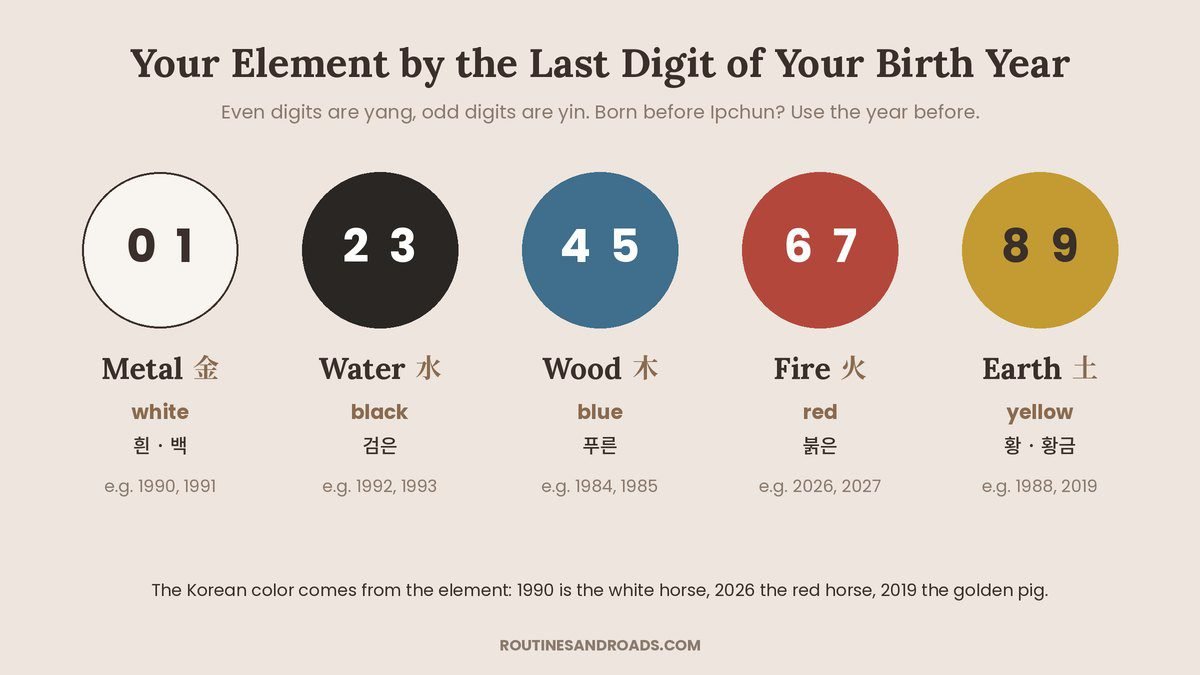
Just remember the same January and February catch. If you were born before Ipchun (or before Lunar New Year, if that's the rule you're going by), use the year before. Someone born on January 15, 1990, for example, belongs to 1989, so they're an Earth Snake, not a Metal Horse.
In Korea, the element is also where a year's color comes from. Wood is blue (푸른), fire is red (붉은), earth is yellow (황), metal is white (흰 or 백) and water is black (검은). That's why 1990 is the year of the white horse, 2026 is the year of the red horse, and 2019 got so much buzz as the golden pig year. Earth's yellow gets dressed up as gold, and a pig already stands for wealth in Korea, so a golden pig sounded like the luckiest baby year there could be.
Your year element is a fun shortcut, but in saju it's only one of eight characters. A full chart has four pillars, year, month, day and hour, and each one has an element of its own. If you want to see your whole balance of wood, fire, earth, metal and water, my free bazi calculator lays it all out.
Your Month Animal: The Second Animal Hiding in Your Birthday
Here's the part most zodiac charts leave out. In saju, your birthday doesn't just have a year animal. Your birth month has one too, and it sits in your month pillar, the second of your four pillars.
The catch is that saju months don't start on the 1st. They start at the 12 jeolgi (절기), the solar terms that open each month, and those land somewhere between the 3rd and the 8th. The Tiger month begins at Ipchun in early February, the Rabbit month in early March, and so on around the year:
| Month animal | Starts at (solar term) | Usually starts (US Eastern) |
|---|---|---|
| Tiger 寅 | Ipchun, start of spring (입춘) | Feb 3 to 4 |
| Rabbit 卯 | Gyeongchip (경칩) | Mar 4 to 6 |
| Dragon 辰 | Cheongmyeong (청명) | Apr 4 to 5 |
| Snake 巳 | Ipha, start of summer (입하) | May 4 to 6 |
| Horse 午 | Mangjong (망종) | Jun 4 to 6 |
| Goat 未 | Soseo, minor heat (소서) | Jul 6 to 7 |
| Monkey 申 | Ipchu, start of autumn (입추) | Aug 6 to 8 |
| Rooster 酉 | Baengno, white dew (백로) | Sep 6 to 8 |
| Dog 戌 | Hallo, cold dew (한로) | Oct 7 to 8 |
| Pig 亥 | Ipdong, start of winter (입동) | Nov 6 to 8 |
| Rat 子 | Daeseol, major snow (대설) | Dec 6 to 7 |
| Ox 丑 | Sohan, minor cold (소한) | Jan 4 to 6 |

So two people born on June 3 and June 10 share a birth month on the calendar but not a month animal. June 3 is usually still the Snake month, and the Horse month starts around June 4 to 6. If your birthday lands right on one of these start days, the calculator tells you the exact time your month switched.
Korean saju readers pay a lot of attention to the month pillar, because it's the season you were born into. The month's element changes every year too, so the calculator shows your full month pillar, something like 甲午 (gap-o), a Wood Horse month, and not just the animal.
Why the Calculator Asks Where You Were Born
Ipchun isn't really a date. It's a moment, the instant the sun reaches that 315 degree point, and the whole world hits it at the same time. The clock on the wall just says different things. In 2027, Ipchun arrives at 10:46 AM on February 4 in Korea, which is 8:46 PM on February 3 in New York and 5:46 PM on February 3 in Los Angeles.
So picture two babies born at exactly 6:00 PM on February 3, 2027. The one born in Los Angeles arrives after Ipchun and is a Fire Goat in saju. The one born in New York arrives before it and is still a Fire Horse. Same date, same clock time, different animal. That's why the calculator asks where you were born and not where you live now. It also takes care of daylight saving time for whichever place you pick.
If you really want to get into it, some Korean readers go one step further and adjust for local solar time, based on how far east or west your birth city sits in its time zone. That only changes your year animal if you were born within an hour or so of Ipchun, and my bazi calculator does that adjustment if you'd like to see it.
2027 Chinese Zodiac: When the Fire Goat Year Starts
With 2026 almost over, here's the cutoff a lot of people will be looking up soon. 2027 is a 丁未 (jeong-mi) year, the Fire Goat, which Koreans call the year of the red goat (붉은 양의 해).
- Ipchun 2027: February 3 at 8:46 PM Eastern, 7:46 PM Central, 6:46 PM Mountain and 5:46 PM Pacific (February 4 at 10:46 AM in Korea).
- Lunar New Year 2027: Saturday, February 6.
- Two animals window: babies born after Ipchun on February 3 through February 5, 2027 are Fire Goats in saju and still Fire Horses on Lunar New Year charts.
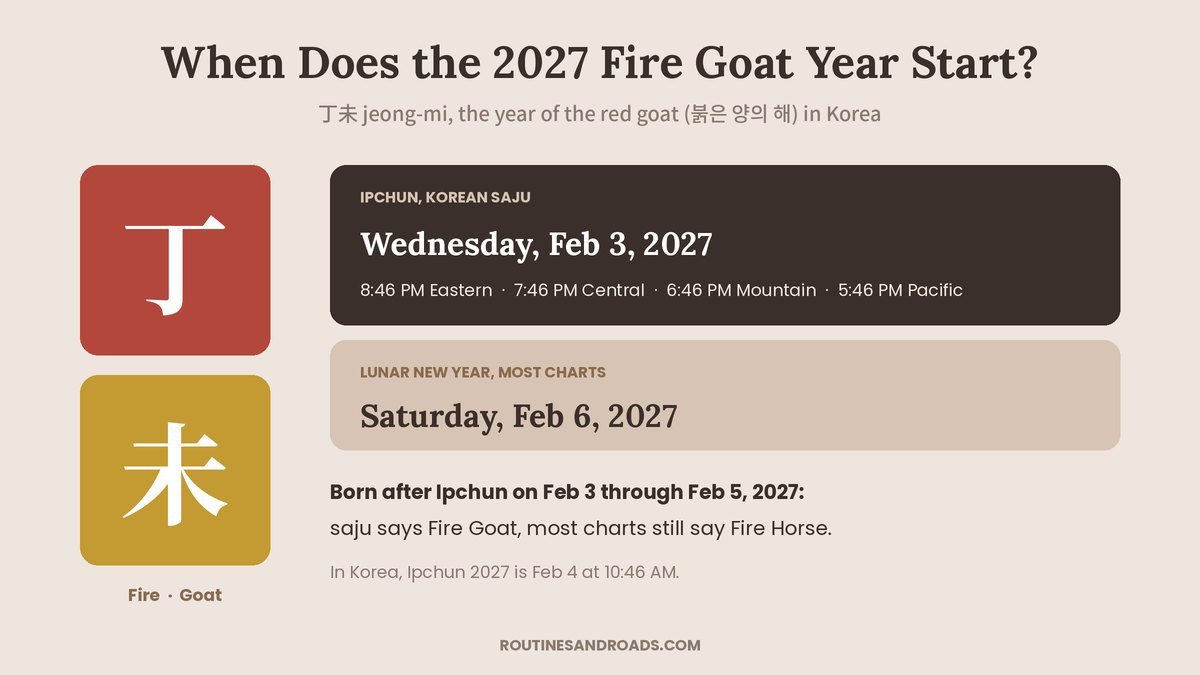
If you're expecting a baby around then, that's the window where you might hear two different animals from relatives, and both of them will be right.
And a small personal note: 丁未, jeong-mi, is my own day pillar, the Fire Goat day I wrote about in my 1990 guide. So 2027 is a year written with the same two characters as my day. It's a fun coincidence, and I'll admit I'm curious to see what the year feels like.
How Koreans Use Their Zodiac Animal
In Korea, your zodiac animal is everyday conversation more than astrology. Here's where it shows up:
- Guessing age politely. Asking someone 무슨 띠예요? (museun tti-yeyo, what's your animal?) is a gentle way to figure out how old they are without asking straight out. Once you know their animal and roughly how old they look, the math does itself.
- Tti-donggap (띠동갑). Two people with the same animal are exactly 12 years apart, or 24, or 36. Couples, coworkers and in-laws love pointing it out.
- Naming the year by color. 2026 is the year of the red horse, byeong-o-nyeon (병오년), and 2027 will be the year of the red goat, jeong-mi-nyeon (정미년). New Year's greetings in Korea are full of it.
- Saju at the turn of the year. My first reading was at a saju reader's office about seven years ago, set up through someone I knew. Ever since, I sit down with my own chart at the end or start of every year to get ready for the year ahead, and plenty of Koreans get a reading around Seollal for the same reason.
- Compatibility. Older relatives still check animal compatibility for couples, starting with the three harmonies and the clashes. I went through all 12 pairings for my own sign in my Horse compatibility guide.
I see saju as something closer to a study of patterns than fortune-telling, and the year animal is just the first letter of it. It's a fun place to start, and if it gets you curious about the rest, my guide to what saju is covers how a Korean reading actually works, and bazi vs saju explains how the Chinese and Korean versions line up.
Frequently Asked Questions
If you take one thing from this post, make it this: when someone tells you your animal, ask which rule they used. For anyone born from late February on, it's the same animal either way. For January and February birthdays, Lunar New Year and Ipchun can disagree, and on Ipchun day itself, your birth time and birthplace decide it.
My Chinese zodiac compatibility calculator is up now too. It checks two birthdays the Korean way, including wonjin, a pairing Korean readers always look at. Tell me in the comments which animal you got and whether it surprised you. And if you're a Horse like me, my Horse compatibility guide is a good next stop.