Bazi vs Saju: What’s the Difference? (A Korean Explains the Four Pillars Both Ways)

Bazi (八字) is the Chinese name for the four pillars of destiny, and saju (사주) is the Korean name for the same system. Put the same birth date, time and place into a good bazi calculator and a Korean saju app, and you’ll get the same eight characters. What changes is the language, a few habits around birth time, and the culture of how people actually use their charts.
I’m Emily, a Korean living in the US with my husband and three dogs. In Korea, nobody says bazi. We say saju, or palja (팔자) when we’re talking about life in general. I only started seeing the word bazi once I looked for English resources on the system I’d grown up hearing about, and I’ve been studying it on my own for a few years now.
So this is the comparison I wanted when I first saw both words: where bazi and saju are exactly the same, and the four places they really do differ. If you just want your chart, my free bazi calculator does it the Korean way.
| What bazi means | 八字, “eight characters” in Chinese |
| What saju means | 四柱, “four pillars” in Korean (saju palja when both are used) |
| Is the chart the same? | Yes. The same birth details give the same eight characters |
| When the year starts | Ipchun (Lichun in Chinese), around February 4, in both |
| Where they differ | Birth time habits, vocabulary, the culture around readings and a few zodiac animals |
| Other names | Four Pillars of Destiny, the Ziping method, shichu suimei (Japan), tu tru (Vietnam) |
| Best for / Good to know | Best for anyone who’s seen both words and wondered which one to use. Good to know: if two tools give you different charts, it’s almost always a birth time setting, not the tradition. |
What Does Bazi Mean?
Bazi (八字, bāzì) means eight characters. The longer Chinese name is shengchen bazi (生辰八字), the eight characters of your birth time, and the study itself is called sizhu mingli (四柱命理), four pillars destiny reading. The eight characters come from four pillars, the year, month, day and hour you were born, each written as a heavenly stem on top of an earthly branch.
The system took its current shape in China over several centuries. The Tang dynasty scholar Li Xuzhong is credited with reading a person’s fate from three pillars: year, month and day. In the Song dynasty, Xu Ziping added the hour pillar and made the day stem the center of the chart, the day master. His influence was so big that the system is still called the Ziping method, and the classic text Yuanhai Ziping is still studied today.
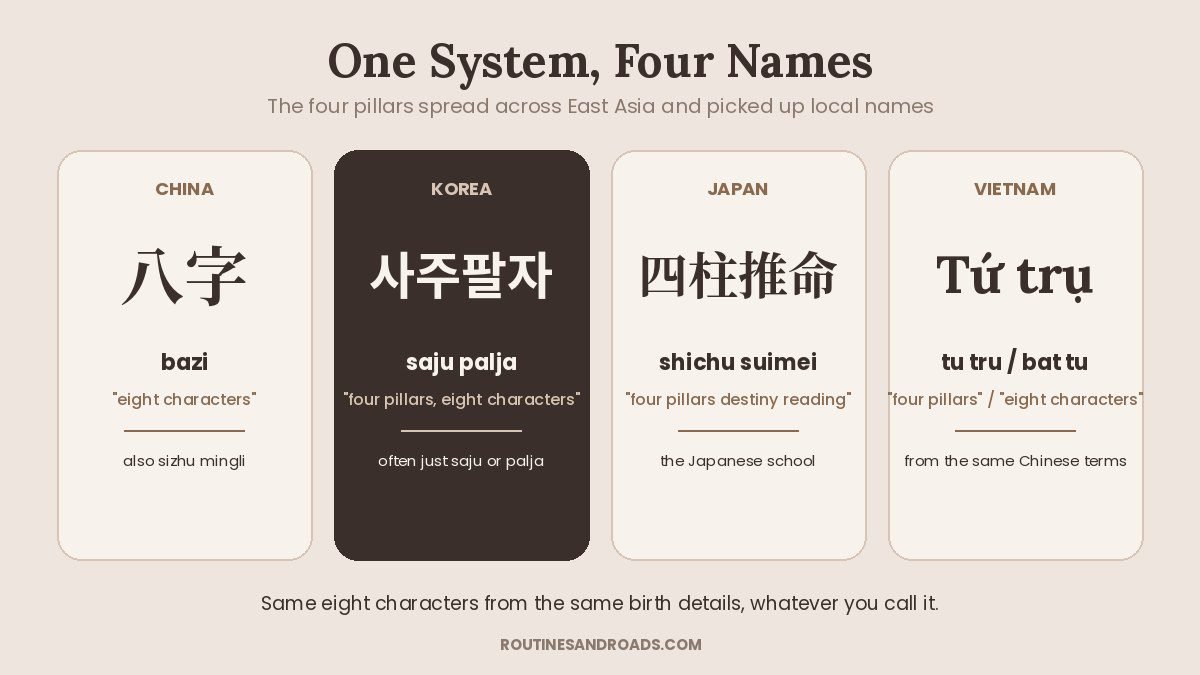
From China, the system spread across East Asia. Korea calls the study myeongnihak (명리학, the study of fate and its principles) and the chart saju palja. Japan calls it shichu suimei (四柱推命). In Vietnam it’s tu tru (four pillars) or bat tu (eight characters), read from the same Chinese terms.
In Korea, this wasn’t only a folk practice. In the Joseon dynasty, the royal astronomy office, the Gwansanggam (관상감), had three departments: astronomy, geography and myeonggwahak (명과학), the fate department, whose job was choosing good dates and times. Its officials were picked through a state exam. That history is one reason saju still feels less like a party trick in Korea and more like a respectable old study, even to people who don’t believe in it.
Is Bazi the Same as Saju?
For the chart itself, yes. Both use the same 10 heavenly stems, the same 12 earthly branches, the same 60-step cycle, the same solar terms for the months and the same Ipchun start for the year. A chart is calendar math, and the math doesn’t change at the border.
Take the made-up sample birthday I use in my calculator post: March 15, 1988, at 2:30 PM in Los Angeles. A Chinese bazi calculator and a Korean saju calculator will both give you 戊辰 for the year, 乙卯 for the month, 己巳 for the day and 辛未 for the hour. The only difference you’ll see is how the characters are pronounced. A Chinese site says ji si for the day pillar, and a Korean site says gi-sa.
So when you see bazi and saju pages that seem to disagree, don’t assume the traditions do. Look at these four things first.
The 60 Pairs Behind Every Bazi Chart
Every pillar in a bazi or saju chart is one of 60 stem and branch pairs. You’d expect 120 (10 stems times 12 branches), but yang stems only pair with yang branches and yin stems with yin ones, so the cycle runs through 60 pairs before it repeats. It starts at 甲子 and ends at 癸亥. The same 60-step cycle counts years, months, days and hours, which is why one system covers all four pillars.
This is also where you’ll notice the pronunciation difference most, because Koreans use these pair names every day for years. Korean news names each new year by its pair, so you’ll hear things like byeong-o-nyeon (병오년, the 丙午 year) on New Year’s Day. Here’s how the next few years read in each language:
| Year | Pillar | Chinese (pinyin) | Korean | Animal |
|---|---|---|---|---|
| 2024 | 甲辰 | jiachen | gapjin | Wood Dragon |
| 2025 | 乙巳 | yisi | eulsa | Wood Snake |
| 2026 | 丙午 | bingwu | byeong-o | Fire Horse |
| 2027 | 丁未 | dingwei | jeongmi | Fire Goat |
| 2028 | 戊申 | wushen | musin | Earth Monkey |
| 2029 | 己酉 | jiyou | giyu | Earth Rooster |
| 2030 | 庚戌 | gengxu | gyeongsul | Metal Dog |
Because the cycle is 60 steps long, your exact birth-year pair only comes back when you turn 60. That’s the reason behind hwangap (환갑), the big 60th birthday Koreans celebrate: it’s the year your pillar returns.
Difference 1: How Each Side Handles Birth Time
Bazi and saju both care about the sun’s time, not just the clock’s, and this is where the two countries’ clocks make a real difference.
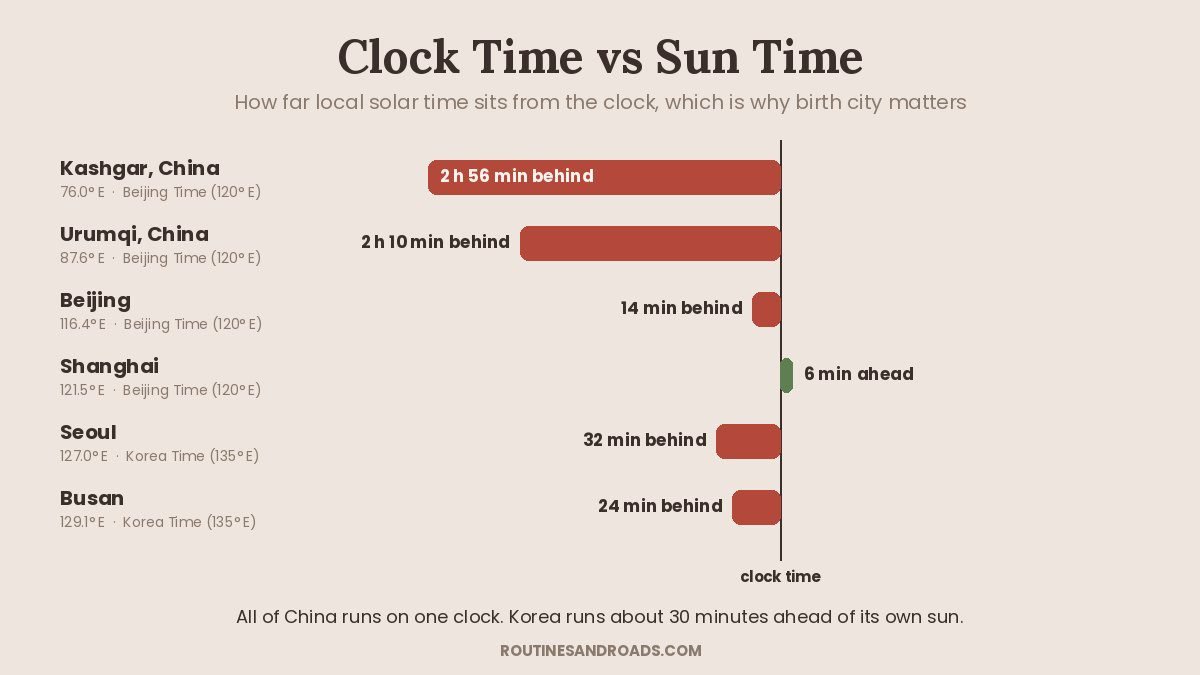
China uses one time zone, Beijing Time, across a country that’s about 60 degrees of longitude wide. In Beijing, the clock and the sun are only about 14 minutes apart. Out west in Urumqi, local solar time is more than two hours behind the clock, and in Kashgar it’s almost three. That’s why Chinese bazi discussions spend so much time on true solar time (真太阳时, zhen taiyang shi): for a birth in western China, the clock hour can be completely wrong for the chart.
Korea has the opposite situation in miniature. The whole country is small, but its clock is set for 135° east while Seoul sits at about 127° east, so the sun runs about 32 minutes behind the clock everywhere you go. Korean saju practice builds that in. Many Korean apps and charts shift the two-hour blocks by about 30 minutes, so the Rat hour runs from 11:30 PM to 1:30 AM instead of 11 PM to 1 AM, or they correct for the birth city’s longitude, which is what my calculator does.
Both traditions also share an old debate about the hour that straddles midnight, 11 PM to 1 AM. Chinese books call the two halves early and late rat hour (早子时 and 夜子时), and Korean readers call them jojasi and yajasi (조자시, 야자시). The question is the same on both sides: does the new day start at 11 PM or at midnight? Neither country has one official answer.
Difference 2: The Words
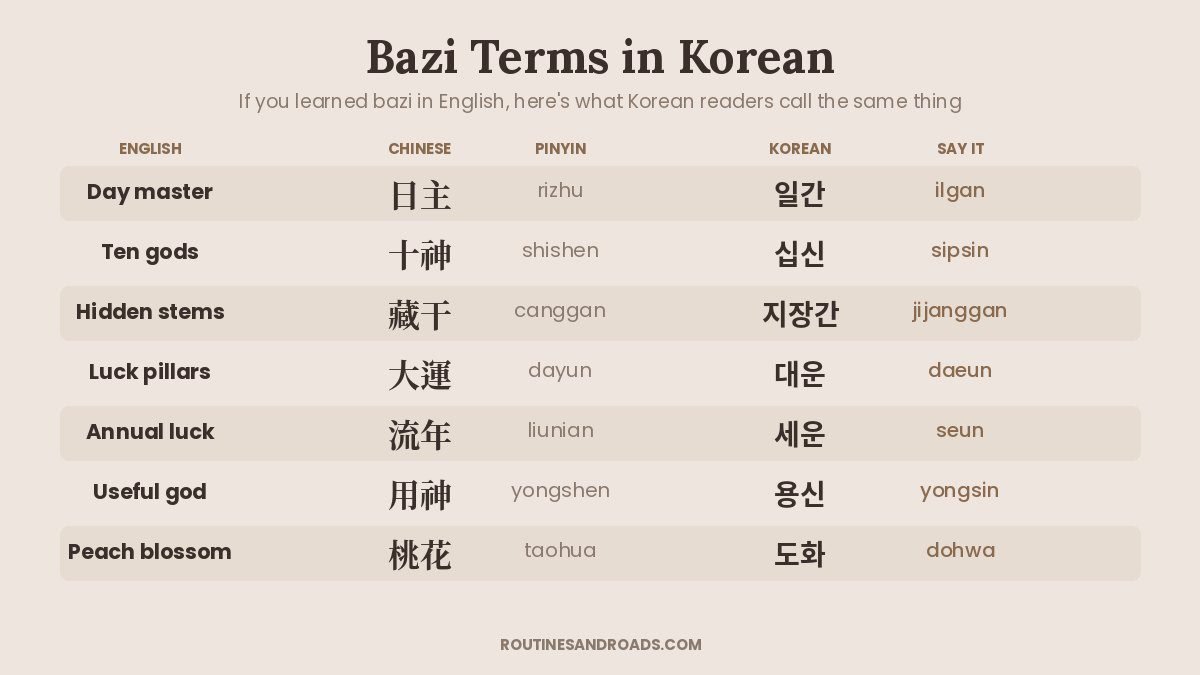
The ideas are the same, but if you learned bazi from English or Chinese sources, Korean readings can sound like a different system until you match up the words:
| English | Chinese | Korean |
|---|---|---|
| Four pillars | 四柱 sizhu | 사주 saju |
| Eight characters | 八字 bazi | 팔자 palja |
| Day master | 日主 rizhu (or 日元) | 일간 ilgan |
| Ten gods | 十神 shishen | 십신 sipsin (or 십성) |
| Hidden stems | 藏干 canggan | 지장간 jijanggan |
| Luck pillars | 大运 dayun | 대운 daeun |
| Annual luck | 流年 liunian | 세운 seun |
| Useful god | 用神 yongshen | 용신 yongsin |
| Symbolic stars | 神煞 shensha | 신살 sinsal |
| Clash | 冲 chong | 충 chung |
| Combination | 合 he | 합 hap |
| Peach blossom | 桃花 taohua | 도화 dohwa |
One thing I love about the Korean side is how these terms leak into everyday talk. Korean saju fans online throw around phrases like mugwan saju (무관사주, a chart with no officer star) or mujae saju (무재사주, a chart with no wealth star) the way people elsewhere talk about their Myers-Briggs type. If you want to see how the ten gods work on a real chart, I walked through one in my post on what saju is.
The ten gods in Chinese and Korean
The ten gods are where English bazi names sound the most dramatic, so it helps to see them next to the Korean ones. Seven Killings, for example, sounds alarming in English, but most Korean readers just call it pyeongwan, the indirect officer, and treat it as drive and pressure rather than danger:
| Relationship to you | Chinese (English name) | Korean |
|---|---|---|
| Same element, same polarity | 比肩 (Friend) | 비견 bigyeon |
| Same element, opposite polarity | 劫財 (Rob Wealth) | 겁재 geopjae |
| You produce it, same polarity | 食神 (Eating God) | 식신 siksin |
| You produce it, opposite polarity | 傷官 (Hurting Officer) | 상관 sanggwan |
| You control it, same polarity | 偏財 (Indirect Wealth) | 편재 pyeonjae |
| You control it, opposite polarity | 正財 (Direct Wealth) | 정재 jeongjae |
| It controls you, same polarity | 七殺 (Seven Killings) | 편관 pyeongwan |
| It controls you, opposite polarity | 正官 (Direct Officer) | 정관 jeonggwan |
| It produces you, same polarity | 偏印 (Indirect Resource) | 편인 pyeonin |
| It produces you, opposite polarity | 正印 (Direct Resource) | 정인 jeongin |
My own day master is a candle, yin fire, and the eating god star sits under it in my day pillar. In English that sounds like a snack habit. In Korean, siksin is the star of talent, taste and taking care of people, which is a much nicer way to put it.
Hidden Stems: The Layer Most Calculators Skip
Hidden stems are one of the places where beginners and experienced readers see a chart very differently, in both traditions. Each earthly branch holds one to three heavenly stems inside it, a main one and sometimes one or two smaller ones. They’re why a chart that looks like it’s missing an element can still have it tucked inside a branch.
| Branch | Animal | Hidden stems (main first) |
|---|---|---|
| 子 | Rat | 癸 |
| 丑 | Ox | 己, 癸, 辛 |
| 寅 | Tiger | 甲, 丙, 戊 |
| 卯 | Rabbit | 乙 |
| 辰 | Dragon | 戊, 乙, 癸 |
| 巳 | Snake | 丙, 庚, 戊 |
| 午 | Horse | 丁, 己 |
| 未 | Goat | 己, 丁, 乙 |
| 申 | Monkey | 庚, 壬, 戊 |
| 酉 | Rooster | 辛 |
| 戌 | Dog | 戊, 辛, 丁 |
| 亥 | Pig | 壬, 甲 |
This is the common short version, and it’s worth knowing that books differ a little here. Many Korean textbooks use a longer table that also lists the leftover element from the season before, and gives each hidden stem a share of the month in days. Either way, the main hidden stem is what most readers start from, and it’s why my calculator’s simple element count is a starting point rather than the full picture.
Difference 3: How People Use Their Charts
This is the biggest difference you’ll actually feel. The chart is the same, but the culture around it isn’t.
In the Chinese-speaking world, bazi often sits next to feng shui and the Chinese almanac, the Tong Shu (通勝), which people check to pick good days for weddings, moves and openings. Professional bazi consultants are a familiar part of business life in places like Hong Kong, Singapore and Malaysia, and a lot of English bazi content comes from that world, which is why it’s often written for career and business decisions.
In Korea, saju is more of an everyday, social thing. People go to a cheolhakgwan (철학관, a saju reader’s office), try a saju cafe with friends, check apps, look up their New Year fortune and compare charts before a wedding, which we call gunghap (궁합). Some families still have a baby’s name chosen at a naming office so the characters balance the baby’s chart. I wrote about my own reading, and all of these habits, in my post on what saju is.
Reading styles vary more by school and by reader than by country. Every school, in both places, uses the same toolbox: the day master, the season, the element balance, the ten gods and the luck pillars. Two Korean readers can disagree with each other more than a Korean reader and a Chinese one do.
Difference 4: The Animals (and When They Change)
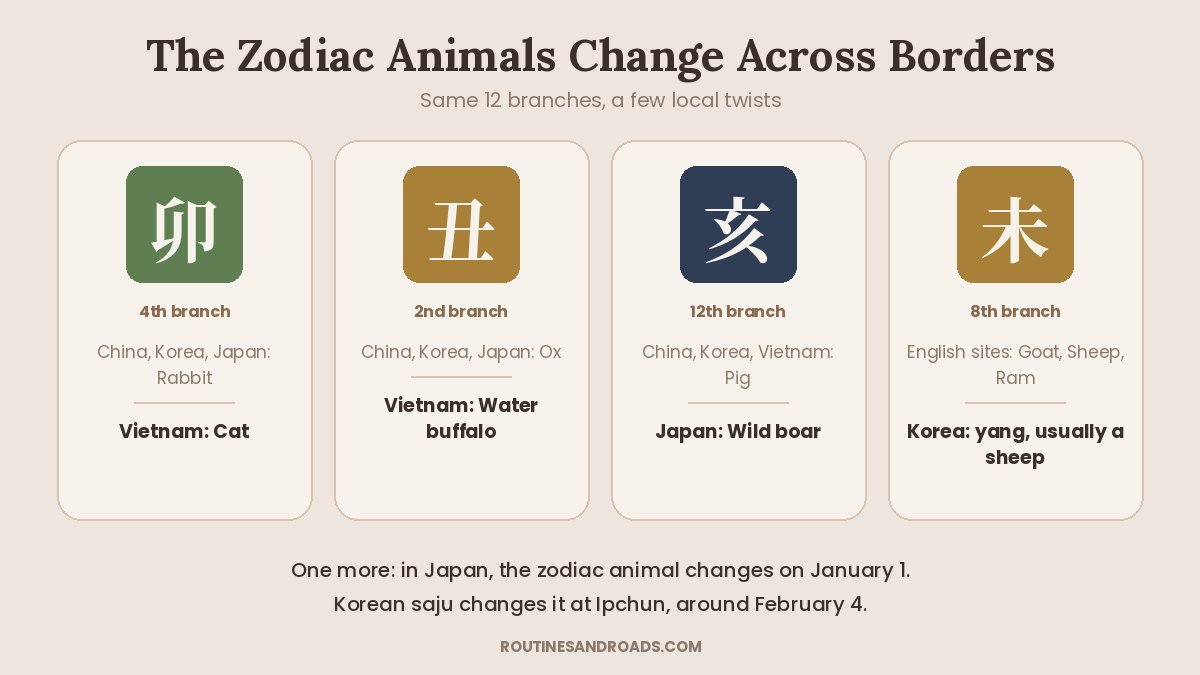
The 12 earthly branches are the same everywhere, but the animals attached to them shift a little across borders:
| Branch | China | Korea | Japan | Vietnam |
|---|---|---|---|---|
| 丑 (2nd) | Ox | Ox | Ox | Water buffalo |
| 卯 (4th) | Rabbit | Rabbit | Rabbit | Cat |
| 未 (8th) | Goat or sheep (羊) | Sheep (양) | Sheep | Goat |
| 亥 (12th) | Pig | Pig | Wild boar | Pig |
The date the animal changes varies too. Japan switched its zodiac to the solar calendar, so the Japanese zodiac year turns over on January 1. Most Chinese zodiac charts change on Lunar New Year. Bazi and saju both change the year at Ipchun, around February 4, and Korean news starts talking about the new animal from January 1 even though, technically, it hasn’t arrived yet. If you were born in late January or early February, I show what that means for one birth year in my 1991 Chinese zodiac post.
What Can Bazi Tell You?
Whether you call it bazi or saju, a reader uses the chart for four kinds of questions:
- Who you are: your day master and the elements around it, read as temperament and natural strengths.
- What you’re good at: the ten gods, read as the kinds of work, study and relationships that come easily to you.
- When things happen: your 10-year luck pillars and each year’s pillar, read as the seasons of your life.
- How you fit with others: two charts side by side, for partners, family or business.
What it can’t do is make decisions for you. There’s no scientific evidence that a birth chart predicts your life, and I’d be wary of any reader, Chinese or Korean, who says you should let it decide. I use my own chart the way some people use a journal, to think about my strengths and to look at the year ahead with a plan.
How Do I Interpret My Bazi Chart?
Here’s the order I follow when I look at a chart, and it works the same in bazi and saju:

- 1. Find your day master. The top character of your day pillar. It stands for you.
- 2. Check your season. The bottom of your month pillar tells you which element is strongest at your birth.
- 3. Count your elements. All eight characters, and the hidden stems inside each branch if you can.
- 4. Name the relationships. For each character, ask: does it feed me, match me, come from me, get controlled by me or control me? Those are the ten gods.
- 5. Look at the timing. Which 10-year luck pillar you’re in, and how this year’s pillar meets your chart.
Steps 1 to 3 come straight out of a calculator, and my bazi calculator post walks through a full sample chart. Steps 4 and 5 are where reading starts, and where it’s worth learning slowly or talking to a reader you trust.
Five Bazi and Saju Myths, Cleared Up
These come up again and again when people first run into the four pillars, on both the Chinese and Korean side:
- “It runs on the lunar calendar.” It doesn’t. Bazi and saju run on the 24 solar terms, which follow the sun. A lunar birthday is only a way of writing your date, and it gets converted before the chart is built.
- “Your zodiac animal is your bazi sign.” Your animal is one of eight characters, the bottom of your year pillar. When someone asks about your bazi, the most useful answer is your day master.
- “Korean saju gives you a different chart.” Same birth details, same chart. If two tools disagree, look at the time zone, daylight saving and solar time settings.
- “A missing element is bad luck.” A simple count leaves out hidden stems and the season. Plenty of strong, happy charts are missing an element on the surface.
- “Your chart decides your fate.” Readers in both traditions talk about tendencies and timing. Even the Korean word palja, which can mean fate, gets used with a shrug in everyday talk more often than as a verdict.
What to Ask a Bazi or Saju Reader
If you do book a reading, Chinese or Korean, in person or online, these questions get you much more than “tell me my future”:
- Which element does my chart need most? This is the useful god (yongshen, 용신). It’s the reader’s key judgment, and it shapes everything else.
- Which 10-year luck pillar am I in, and when does the next one start? This gives you the big rhythm of your life right now.
- How does this year’s pillar meet my chart? For 2026 that’s 丙午, the Fire Horse, and for 2027 it’s 丁未, the Fire Goat.
- What kind of work suits my chart? Readers answer this through the ten gods, and it’s often the most practical part of a reading.
- Is there a better or worse time for the decision I’m facing? Bring the decision, not a request for the answer.
A good reader can explain how they got to each answer from your eight characters, so don’t be shy about asking how they read it.
Bazi or Saju: Which Should You Use?
Since the chart is the same, the real choice is about what kind of reading you want.
- For the chart itself: either. Pick a calculator that asks for your birth city and handles time zones and daylight saving, because that matters far more than the name on the page.
- For learning in English: you’ll find more material under bazi, often with Chinese terms. The Korean words in the table above will help you follow Korean sources too.
- For the Korean experience: saju. Cheolhakgwan readings, saju cafes, gunghap and New Year fortunes are a whole culture, and they’re a fun way to see the same chart through Korean eyes.
And if you were born in 1990 or 1991, I’ve written about what those years mean in both traditions: the 1990 Metal Horse and the 1991 Metal Goat.
Frequently Asked Questions
If you take one thing from this post, let it be this: bazi and saju are the same chart, so when two tools disagree, check the birth time settings before anything else. Your birth city, daylight saving and the 11 PM rule cause almost every difference people run into.
I’ll keep adding to this series as questions come in, so tell me in the comments which birth year or saju topic you’d like me to cover next. And if you’ve had both a Chinese bazi reading and a Korean saju reading, I’d love to hear how they compared. If you haven’t seen your own chart yet, start with my free bazi calculator.