Chinese Zodiac Compatibility Calculator: Check Two Birthdays the Korean Way (With a 12-Sign Chart)
This Chinese zodiac compatibility calculator checks two birthdays the way a Korean saju reader would. Most charts stop at your two year animals. In Korea, that’s only the outward match. Readers also check wonjin, a pairing you’ll rarely see on an English chart, and then they look past the animals altogether, at your day pillars.
I learned that last part from my own marriage. When my husband and I first started dating, we were both strong-willed and we fought a lot. I hadn’t looked at his chart at all until we got our compatibility read, and the first thing that jumped out wasn’t our animals. It was that we share the same day stem, 丁 (jeong), yin fire. Reading his chart next to mine, so much suddenly made sense, and we’ve fought a lot less since.
Chinese Zodiac Compatibility Calculator
Pop in two birthdays and I’ll check them the way a Korean saju reader would: your year animals (the outward match), the Korean wonjin pairing, and your day pillars, the inner match most charts never look at. It works for partners, friends, parents and kids. Birth time is optional.
You
Them (partner, friend or kid)
Everything is worked out right in your browser. Nothing you type gets sent anywhere.
Under the calculator you'll find a compatibility chart for all 12 signs, what each Korean pairing actually means, the old Korean verse behind wonjin, and how to read your day pillar match.
| What you need | Two birthdays. Birth times only matter if someone was born on Ipchun day |
| What it checks | Year animals (the outward match), wonjin, and your day stems and day branches (the inner match) |
| Best matches | Three harmonies (same triangle, usually 4 years apart) and secret friends (six natural pairs) |
| Pairs that take more work | Opposites (6 years apart) and wonjin: Rat and Goat, Ox and Horse, Tiger and Rooster, Rabbit and Monkey, Dragon and Pig, Snake and Dog |
| Year starts at | Ipchun, around February 4, the Korean saju rule |
| Works for | Couples, friends, parents and kids, coworkers |
| Best for / Good to know | Best for couples who want more than a year-animal chart. Good to know: Korean readers treat compatibility as a conversation starter, not a verdict, and a full reading looks at all eight characters in both charts |
How This Chinese Zodiac Compatibility Calculator Works
It runs three checks, in the same order a Korean reader goes through them:
- Year animals, the outward match (겉궁합, geot-gunghap). This is what every zodiac chart shows. Besides the famous three harmonies, secret friends and opposites, it also checks the quieter pairings most charts leave off: harm, punishment, break and same season.
- Wonjin (원진). The pairing Korean readers always look for. The calculator checks it between your year animals and again between your day branches.
- Day pillars, the inner match. In saju, your day stem (일간, ilgan) is you, and your day branch (일지, ilji) sits in what's called the spouse palace. The calculator compares both.
Every result ends with two short lists, where you click and where it takes a little more work. I left out a percentage score on purpose. Korean readers don't add pairings up into one number, and two couples with the same score could have completely different reasons behind it.
A few details worth knowing. Year animals count from Ipchun, the start of spring around February 4, because that's the saju rule. So if one of you was born in January or early February, a Lunar New Year chart might show a different animal, and the calculator tells you when that happens. If you're not sure which animal you are, my Chinese zodiac calculator shows it both ways, along with your element and lunar birthday.
Your day pillar follows the date you were born, midnight to midnight, in the place you were born. Some readers start the new day at 11 PM, so if someone was born in that last hour, the calculator flags it. And like all my calculators, it runs right in your browser, so neither birthday gets sent anywhere.
Chinese Zodiac Compatibility Chart: All 12 Signs at a Glance
If you just want the quick version, here's every sign with its best matches, its opposite and its wonjin pair. The best matches are the two other signs in its harmony triangle plus its secret friend.
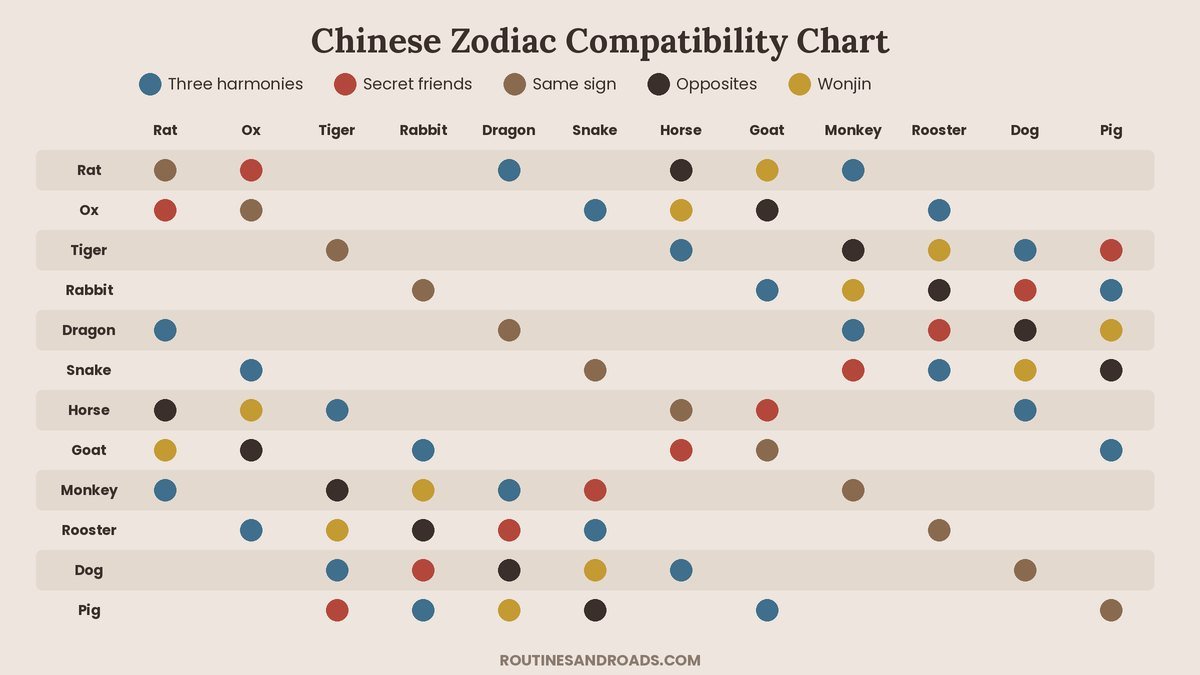
| Sign | Best matches | Opposite (clash) | Wonjin pair |
|---|---|---|---|
| Rat 子 | Monkey, Dragon (three harmonies), Ox (secret friends) | Horse | Goat |
| Ox 丑 | Snake, Rooster (three harmonies), Rat (secret friends) | Goat | Horse |
| Tiger 寅 | Horse, Dog (three harmonies), Pig (secret friends) | Monkey | Rooster |
| Rabbit 卯 | Pig, Goat (three harmonies), Dog (secret friends) | Rooster | Monkey |
| Dragon 辰 | Monkey, Rat (three harmonies), Rooster (secret friends) | Dog | Pig |
| Snake 巳 | Rooster, Ox (three harmonies), Monkey (secret friends) | Pig | Dog |
| Horse 午 | Tiger, Dog (three harmonies), Goat (secret friends) | Rat | Ox |
| Goat 未 | Pig, Rabbit (three harmonies), Horse (secret friends) | Ox | Rat |
| Monkey 申 | Rat, Dragon (three harmonies), Snake (secret friends) | Tiger | Rabbit |
| Rooster 酉 | Snake, Ox (three harmonies), Dragon (secret friends) | Rabbit | Tiger |
| Dog 戌 | Tiger, Horse (three harmonies), Rabbit (secret friends) | Dragon | Snake |
| Pig 亥 | Rabbit, Goat (three harmonies), Tiger (secret friends) | Snake | Dragon |
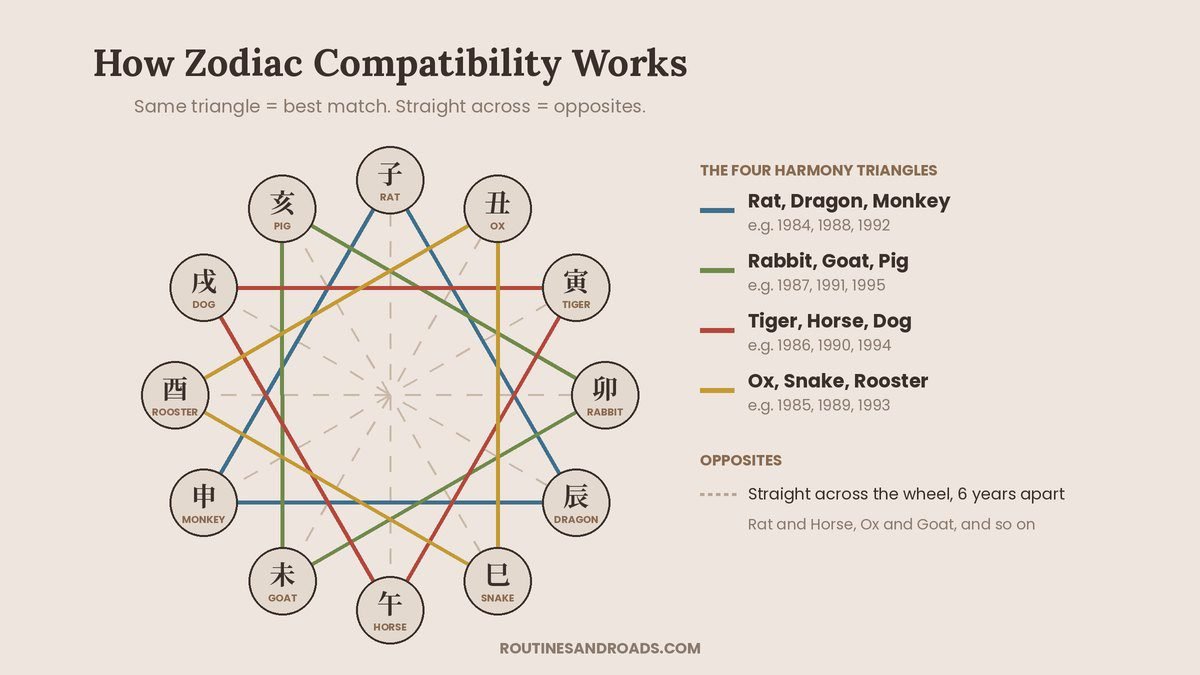
Here's something fun you can spot in that chart. Signs in the same harmony triangle are always four years apart, like 1986, 1990 and 1994, and opposites are always six years apart. That's where the Korean saying comes from: ne sal chai-neun gunghapdo an bonda (네 살 차이는 궁합도 안 본다), "with a four-year age gap, you don't even need a reading." Couples who are 12 years apart share the same animal, which Koreans call tti-donggap (띠동갑).
Once you know the pattern, the age gap alone tells you a lot:
- 4 or 8 years apart: always three harmonies.
- 6 years apart: always opposites.
- 12 years apart: always the same sign.
- 5 or 7 years apart: where all six wonjin pairs live. Not every 5- or 7-year gap is wonjin, but every wonjin pair is 5 or 7 years apart.
That only works when both birthdays fall after Ipchun, so for anyone born in January or early February, run the calculator instead of doing the math in your head.
Three Harmonies, Secret Friends, Clashes and Wonjin
Korean readers have a name for every kind of pairing. Here's what each one means, from the classic best matches down to the gentle ones that just take a little care:
| Pairing | Which signs | What Korean readers say |
|---|---|---|
| Three harmonies (samhap, 삼합) | Rat, Dragon, Monkey / Ox, Snake, Rooster / Tiger, Horse, Dog / Rabbit, Goat, Pig | Same triangle, four years apart. The classic best match |
| Secret friends (yukhap, 육합) | Rat and Ox, Tiger and Pig, Rabbit and Dog, Dragon and Rooster, Snake and Monkey, Horse and Goat | A natural pair that fills in each other's gaps |
| Same season (banghap, 방합) | Tiger, Rabbit, Dragon (spring) / Snake, Horse, Goat (summer) / Monkey, Rooster, Dog (autumn) / Pig, Rat, Ox (winter) | A shared rhythm |
| Same sign (tti-donggap, 띠동갑) | Any two people with the same animal | Same age or 12 years apart. Quick to understand each other |
| Opposites (chung, 충) | Rat and Horse, Ox and Goat, Tiger and Monkey, Rabbit and Rooster, Dragon and Dog, Snake and Pig | Six years apart. Lots of spark, different paces |
| Wonjin (원진) | Rat and Goat, Ox and Horse, Tiger and Rooster, Rabbit and Monkey, Dragon and Pig, Snake and Dog | Small hurt feelings can pile up. Say the little things |
| Harm (hae, 해) | Rat and Goat, Ox and Horse, Tiger and Snake, Rabbit and Dragon, Monkey and Pig, Rooster and Dog | Small misunderstandings |
| Punishment (hyeong, 형) | Tiger, Snake, Monkey / Ox, Dog, Goat / Rat and Rabbit | Pride and control. Clear roles help |
| Break (pa, 파) | Rat and Rooster, Ox and Dragon, Tiger and Pig, Rabbit and Horse, Snake and Monkey, Goat and Dog | The gentlest one. Plans shift around |
Some pairs carry two labels at once. Tiger and Pig, for example, are secret friends and a break pair, and Rat and Goat are both wonjin and harm. In my experience, readers give a harmony more weight than a break, so the calculator shows you every label and lets you see the whole picture.
Wonjin: The Korean Compatibility Check Most Charts Leave Out
Wonjin (원진, 怨嗔) translates to something like resentment and anger, which sounds a lot more dramatic than it is. Older Koreans still check wonjin before a wedding, and it comes from an old verse that pairs each sign with one it just can't quite get comfortable with. Here's my loose translation:
- Rat and Goat: the Rat minds the Goat's horns.
- Ox and Horse: the Ox resents the Horse for never plowing the field.
- Tiger and Rooster: the Tiger can't stand the Rooster's short beak.
- Rabbit and Monkey: the Rabbit resents the Monkey for never sitting still.
- Dragon and Pig: the Dragon dislikes the Pig's dark face.
- Snake and Dog: the Snake startles every time the Dog barks.

If you look closely, every complaint is about something small and everyday, a beak, a bark, a habit. That's exactly how Korean readers explain wonjin. These pairs tend to collect little hurt feelings that never get said out loud, so the classic advice is simple: say the small things before they pile up. It's a heads-up, not a red light.
As a Horse, my wonjin sign is the Ox. I went through what that means, and how the Horse does with all 12 signs, in my Horse compatibility guide.
Why Koreans Look Past the Year Animal: The Day Pillar Match
Your year animal is shared with everyone born in the same year. Your day pillar is much more personal, and in saju it's the pillar that stands for you. The top character, your day stem, is your core nature. The bottom character, your day branch, sits in the spouse palace, the spot readers look at for marriage and close partnerships.
For the day stems, readers look for one of the five stem combinations, called cheongan-hap (천간합). These are pairs that pull toward each other:
- 甲 and 己 (gap and gi): yang wood and yin earth
- 乙 and 庚 (eul and gyeong): yin wood and yang metal
- 丙 and 辛 (byeong and sin): yang fire and yin metal
- 丁 and 壬 (jeong and im): yin fire and yang water
- 戊 and 癸 (mu and gye): yang earth and yin water
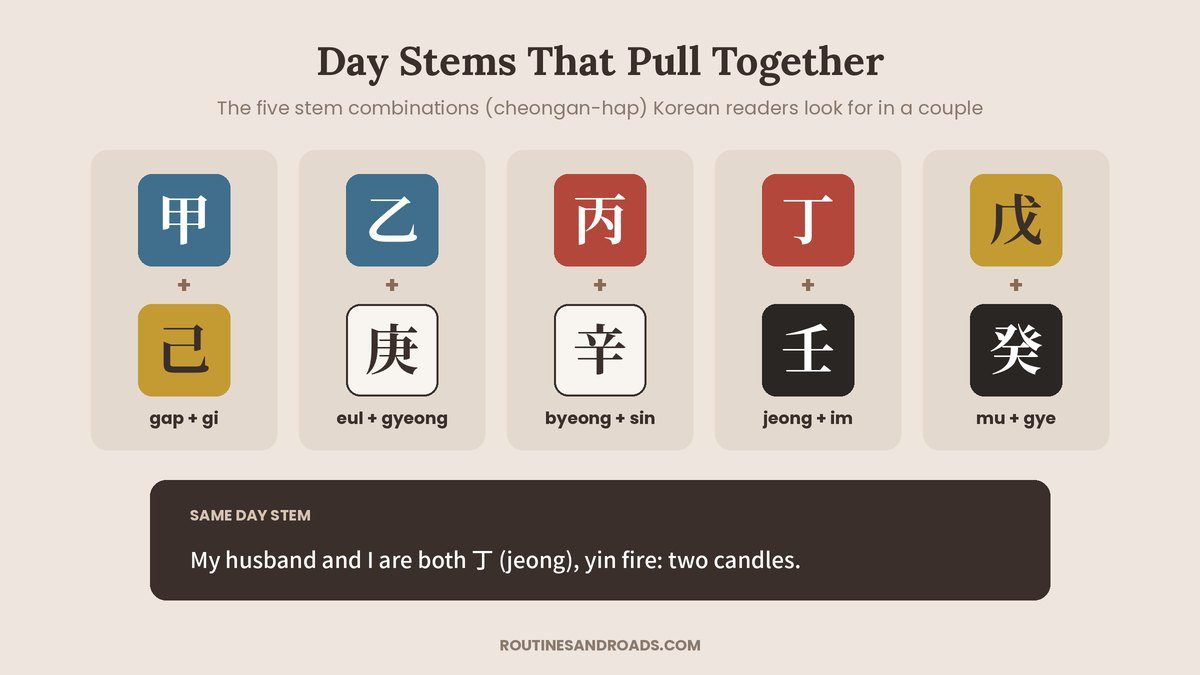
If your stems don't combine, the calculator tells you how your elements meet in the five elements cycle instead. One of you might feed the other (fire feeds earth, earth feeds metal, metal feeds water, water feeds wood, wood feeds fire), or one might shape the other (wood shapes earth, earth shapes water, water shapes fire, fire shapes metal, metal shapes wood), or you might share an element.
My husband and I are the last kind, taken all the way: we have the exact same day stem, 丁. Jeong fire is often compared to a candle, so I like to say we're two candles. That explained a lot about our early fights. Two people with the same day stem understand each other fast, and they also tend to both want to be the one steering. Once we saw that on paper, it was a lot easier to laugh about it.
For the day branches, the calculator uses the same pairings as the year animals, three harmonies, secret friends, wonjin and so on. A harmony in the spouse palace is something Korean readers love to see, even when the year animals are a neutral pair.
How to Read Your Result: Three Example Couples
Here's what the calculator says for three made-up couples, so you can see how the three checks play off each other. These are sample birthdays, not real people.
- July 6, 1988 and June 10, 1994: a Dragon and a Dog, which are opposites on the year animals. But the day stems are 壬 (im) and 丁 (jeong), one of the five stem combinations, and the day branches are a Dog and a Rabbit, which are secret friends. A chart that only looks at years would call this a tough match. A Korean reader would call it a couple with a lot pulling them together.
- July 24, 1989 and March 4, 1985: a Snake and an Ox, which share a harmony triangle, so on the outside it's a classic match. Inside, the day branches are a Rooster and a Tiger, a wonjin pair. A reader would say this couple gets along easily day to day and does best when neither one lets small things slide without saying them.
- November 22, 1992 and October 10, 1985: a Monkey and an Ox, a neutral pair on the year animals. Both day stems are 壬 (im), yang water, and the day branches are a Tiger and a Horse, which share a harmony triangle. Neutral on the outside, close on the inside. This is the kind of match a year-only chart never shows you.
Notice that in all three, the day pillars changed the story. That's why Korean readers never stop at the animals.
What Chinese Zodiacs Go Well Together?
The classic answer is the three harmonies, four triangles of signs that are four years apart:
- Rat, Dragon and Monkey: for example 1984, 1988 and 1992
- Ox, Snake and Rooster: for example 1985, 1989 and 1993
- Tiger, Horse and Dog: for example 1986, 1990 and 1994
- Rabbit, Goat and Pig: for example 1987, 1991 and 1995
Then there are the six secret friend pairs, the natural partners: Rat and Ox, Tiger and Pig, Rabbit and Dog, Dragon and Rooster, Snake and Monkey, and Horse and Goat. Those years are only for people born after Ipchun. If your birthday is in January or early February, check your animal first, since you might belong to the year before.
Pairs That Take a Little More Work: Opposites and Wonjin
The six opposite pairs sit directly across the zodiac wheel, six years apart: Rat and Horse, Ox and Goat, Tiger and Monkey, Rabbit and Rooster, Dragon and Dog, and Snake and Pig. Korean readers call this chung (충), a clash, but it's really about two very different paces. There's a lot of spark in these pairs, and they do best when you talk things through instead of assuming the other person sees it your way.
Wonjin pairs are the other ones Korean readers point out, and as you saw above, the advice there is to keep the little things from piling up. Neither one decides a relationship on its own. A clash between your year animals can sit right next to a stem combination between your day pillars, and readers weigh the whole chart.
2026 and 2027 Chinese Zodiac Compatibility
Each year has an animal too, and Korean readers sometimes check how a couple sits with the year itself. It's an extra layer on top of how the two of you match.
- 2026, the Fire Horse year (丙午): the Tiger and the Dog share the Horse's harmony triangle, and the Goat is its secret friend, so those signs are said to ride this year easily. The Rat sits across from the Horse, so readers usually suggest a steadier pace for Rats. In saju the Horse year runs until Ipchun on February 3, 2027 in US time.
- 2027, the Fire Goat year (丁未): the Rabbit and the Pig share the Goat's triangle, and the Horse is its secret friend. The Ox sits across from the Goat, and the Rat is its wonjin sign, so Korean readers would tell those two to take the year a little slower.
If you're planning a wedding in 2027, this is also the year a lot of Korean families will be looking at dates with a saju reader, since taegil, picking an auspicious day, is still something many Korean families do before a wedding.
Parents, Kids, Friends and Coworkers
The calculator isn't just for couples. In Korea, parents and grandparents love checking a baby's animal against everyone else's, and the same pairings apply. A parent and child in the same harmony triangle are said to get along easily, and secret friends are a sweet match too. Siblings 12 years apart share an animal, and friends who are exactly four years apart are a classic.
And yes, I couldn't resist putting in my own birthday and Mocha's, my 3-year-old mini goldendoodle. Our day stems came out as 丁 and 壬, one of the five stem combinations. He was born on Ipchun day itself, so if he arrived before that evening's cutoff, he's a Tiger, which puts him right in my Horse harmony triangle. I'll take it. If you're a dog person too, here's how I keep all three of mine clean between grooming appointments.
If you're expecting, the year animal is the first thing relatives will ask about. 2027 is a Fire Goat year, and the cutoff dates are a little tricky this time around, so I put the exact Ipchun times in my Chinese zodiac calculator post.
What a Full Korean Compatibility Reading Looks At
The calculator covers the first two layers. When you sit down with a saju reader for gunghap (궁합), the Korean word for compatibility, they keep going. In my readings, these are the layers that came up:
- Year animals: the outward match, including wonjin.
- Day pillars: the day stems and the spouse palace.
- Five elements balance: whether one person has plenty of an element the other is missing. A chart that's low on water next to a chart that's full of it is seen as a good fit.
- Timing: where each person is in their ten-year luck cycles (daeun, 대운), and for couples who are getting married, picking a good wedding date (taegil, 택일).
For the elements, my free bazi calculator shows each person's balance of wood, fire, earth, metal and water, so you can put two charts side by side yourself. I went deeper into the full reading, layer by layer, in my Horse compatibility guide.
How Accurate Is Chinese Zodiac Compatibility?
I see saju as something closer to a study of patterns than fortune-telling, and compatibility is the same. I've done it every way there is: at a saju reader's office, in apps, and on my own. What helped us wasn't a verdict. It was a vocabulary. Instead of "why are you like this," it became "oh, that's the two candles thing again."
So here's how I'd use it. Treat the year animals as the fun part, the wonjin as a heads-up, and the day pillars as the part worth a real conversation. Korea even has an old saying that women born in white horse years are too strong-willed for marriage. I'm a 1990 white horse myself, and I take that one with a big smile.
Frequently Asked Questions
If you take one thing from this post, let it be this: look past the year animals. A clash or a wonjin pair on the outside can sit right next to a beautiful day pillar match on the inside, and Korean readers always weigh both before they say anything.
Next, I'm putting together a Korean age calculator, since that's the question every Korean asks right after your animal. Tell me in the comments which pairing you got and whether it sounds like the two of you. And if you haven't checked your own animal both ways yet, start with my Chinese zodiac calculator.