Bazi Calculator: Find Your Four Pillars the Korean Saju Way (Free, No Sign-Up)

This bazi calculator finds your four pillars the way Korean saju does it. Enter your birthday, your birth time if you know it and the city you were born in, and you’ll get all eight characters of your chart, your day master and your five elements balance in a couple of seconds. It’s free, there’s no sign-up, and nothing you type leaves your browser.
I’m Emily, a Korean living in the US with my husband and three dogs, and saju (사주) is something I’ve been studying on my own for a few years. The first time I wanted to look at my own chart without a reader, I did what a lot of Koreans do: I typed manseryeok (만세력), the name of the perpetual calendar saju runs on, into Google and clicked whatever came up. The sites I landed on all asked the same question up front: is your birthday solar or lunar? Out of everything on the page, that question confused me the most.
So for this blog, I kept the calculator simple. You type the birthday on your ID, pick your birth city from a list, and the calculator handles time zones, old daylight saving rules and the exact minute your saju year starts. Under the calculator, I’ll walk you through your result one column at a time, and then through a sample chart from start to finish.
| What you get | Your four pillars (year, month, day and hour), your day master and a count of your five elements |
| What you need | Your birthday, your birth time if you know it, and the city you were born in |
| Calendar it uses | The 24 solar terms, so your saju year starts at Ipchun (around February 4), not on Lunar New Year |
| Birth time | Local solar time for your birth city, on by default, with daylight saving and old time zones taken out |
| Years covered | 1901 to 2100 |
| Cost and privacy | Free, no sign-up, and everything is calculated in your browser |
| Best for / Good to know | Best for anyone born outside Korea who wants their pillars without converting time zones by hand. Good to know: if your birth time is close to a boundary, the calculator adds a note, so read that before you trust that pillar. |
Free Bazi Calculator (Korean Saju Style)
Here’s how to fill it in:
- Birth date: your regular calendar birthday, the one on your ID. If your family only knows your lunar birthday, convert it to a solar date first.
- Birth time: the time on the clock when you were born, as exact as you can get it. If you don’t know it, check “I don’t know my birth time” and you’ll still get three of your four pillars.
- Birth city: the city you were born in, or the closest city on the list. If nothing is close, choose “My city isn’t listed” and pick your time zone instead.
- More options: this is where you can turn local solar time off or start the day at 11 PM instead of midnight. Most people can leave both alone, and I explain both below.
Korean Saju Calculator (Four Pillars)
Enter your birthday, birth time and the city you were born in. You’ll get your four pillars, your day master and your five element balance.
Everything is calculated right here in your browser. Nothing you type is sent anywhere or saved. Solar term times are calculated from the sun’s position for 1901 to 2100.
Your chart shows up right under the button. If there’s a note above it, read that first. It means your birth time sits close to a point where a pillar changes.
How to Read Your Four Pillars Chart
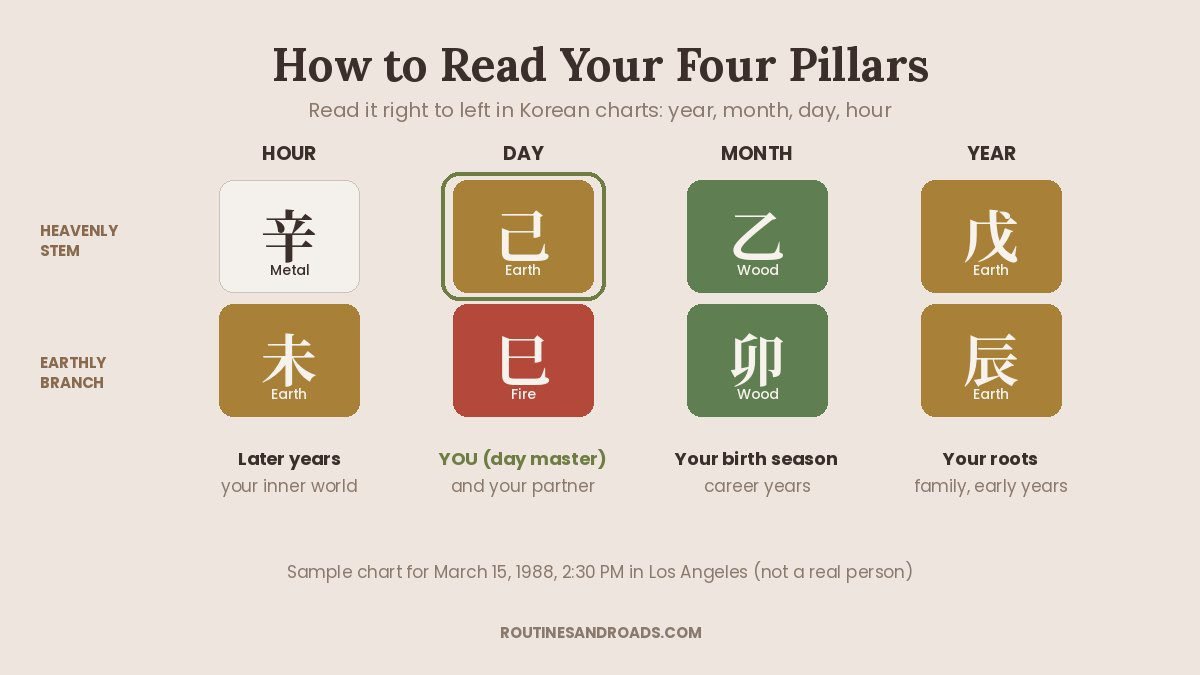
Your chart has four columns. Korean saju charts are read from right to left, so the year is on the far right and the hour is on the far left, and the calculator keeps that order. Each column is one pillar, and each pillar is two characters stacked on top of each other:
- On top, the heavenly stem (천간, cheongan). There are 10 of them, and each one is an element in its yin or yang form.
- On the bottom, the earthly branch (지지, jiji). There are 12 of them, and they’re the 12 zodiac animals.
Four pillars with two characters each gives you eight characters. That’s why the Chinese name is bazi (八字, eight characters) and the Korean name is saju (四柱, four pillars), or saju palja (사주팔자) when we put both ideas together. In the classic reading, each pillar also looks after a different part of your life:
| Pillar | Where it comes from | What it’s read for |
|---|---|---|
| Year | Your birth year, counted from Ipchun | Your roots: family background and early years |
| Month | Your birth month, counted by solar terms | Your birth season, your parents and your working years |
| Day | Your birth day | You (the top character) and your partner (the bottom one) |
| Hour | Your birth time, in two-hour blocks | Your later years, your inner world and your children |
The 10 Heavenly Stems
| Stem | Korean | Mandarin | Element | Yin or yang |
|---|---|---|---|---|
| 甲 | Gap | jia | Wood | Yang |
| 乙 | Eul | yi | Wood | Yin |
| 丙 | Byeong | bing | Fire | Yang |
| 丁 | Jeong | ding | Fire | Yin |
| 戊 | Mu | wu | Earth | Yang |
| 己 | Gi | ji | Earth | Yin |
| 庚 | Gyeong | geng | Metal | Yang |
| 辛 | Sin | xin | Metal | Yin |
| 壬 | Im | ren | Water | Yang |
| 癸 | Gye | gui | Water | Yin |
If you’ve used a Chinese bazi calculator before, the Mandarin column is how the same characters are spelled there. The characters themselves are identical, so you can compare charts across sites by the characters alone.
The 12 Earthly Branches
| Branch | Korean | Animal | Element | Birth hour | Birth month (about) |
|---|---|---|---|---|---|
| 子 | Ja | Rat | Water | 11 PM to 1 AM | Dec 7 to Jan 5 |
| 丑 | Chuk | Ox | Earth | 1 to 3 AM | Jan 6 to Feb 3 |
| 寅 | In | Tiger | Wood | 3 to 5 AM | Feb 4 to Mar 5 |
| 卯 | Myo | Rabbit | Wood | 5 to 7 AM | Mar 6 to Apr 4 |
| 辰 | Jin | Dragon | Earth | 7 to 9 AM | Apr 5 to May 5 |
| 巳 | Sa | Snake | Fire | 9 to 11 AM | May 6 to Jun 5 |
| 午 | O | Horse | Fire | 11 AM to 1 PM | Jun 6 to Jul 6 |
| 未 | Mi | Goat | Earth | 1 to 3 PM | Jul 7 to Aug 7 |
| 申 | Sin | Monkey | Metal | 3 to 5 PM | Aug 8 to Sep 7 |
| 酉 | Yu | Rooster | Metal | 5 to 7 PM | Sep 8 to Oct 7 |
| 戌 | Sul | Dog | Earth | 7 to 9 PM | Oct 8 to Nov 6 |
| 亥 | Hae | Pig | Water | 9 to 11 PM | Nov 7 to Dec 6 |
The month dates move by a day or so from year to year, and the hours are in local solar time, which I’ll get to in a minute. The calculator works both out to the minute, so use this table to read your result, not to replace it.
What Is a Day Master?
Your day master (일간, ilgan) is the top character of your day pillar, and in saju it stands for you. It’s the first thing a saju reader looks at, because every other character in your chart gets read by how it treats your day master: what feeds you, what you feed, what pushes on you and what you push against.
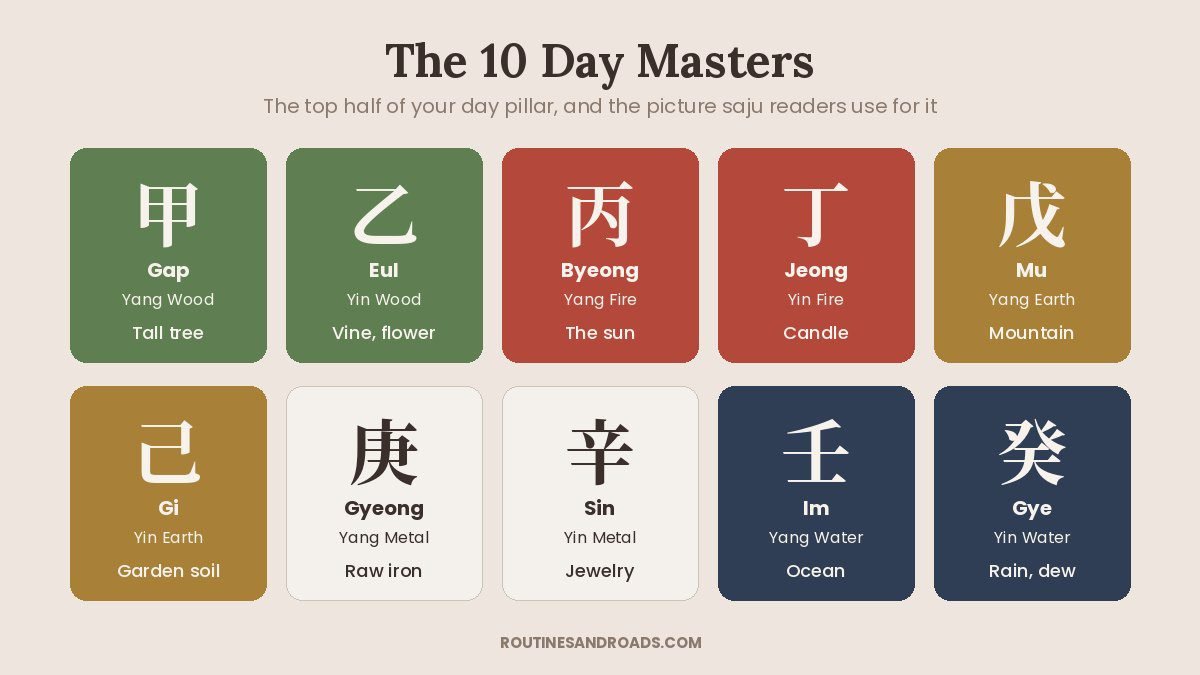
Each of the 10 day masters comes with a picture from nature, and the yin and yang pairs are the key to those pictures. Yang is the big, outward version of an element and yin is the smaller, concentrated one. Yang fire is the sun, which lights up everything at once, and yin fire is a candle, which lights up the room it’s in. Yang metal is raw iron, and yin metal is the same metal after it’s been cut and polished into jewelry. The calculator shows a short description of your own day master, and the card above has all 10.
Mine is 丁 (jeong), yin fire, the candle. I wrote about my whole day pillar, 丁未, in my 1990 Chinese zodiac post.
Is your bazi element your year element or your day master?
This trips up a lot of people. When someone asks for your element in bazi or saju, they usually mean your day master’s element. Zodiac pages give you a different one, your year element, which comes from the top of your year pillar. They’re often not the same. My birth year makes me a Metal Horse, but my day master is fire, and in a saju reading, the fire is the one that describes me.
How to Read Your Five Elements Balance
Under your day master, the calculator counts your five elements: wood, fire, earth, metal and water. It goes through all eight characters (or six if you don’t know your birth time) and tallies each one by element.
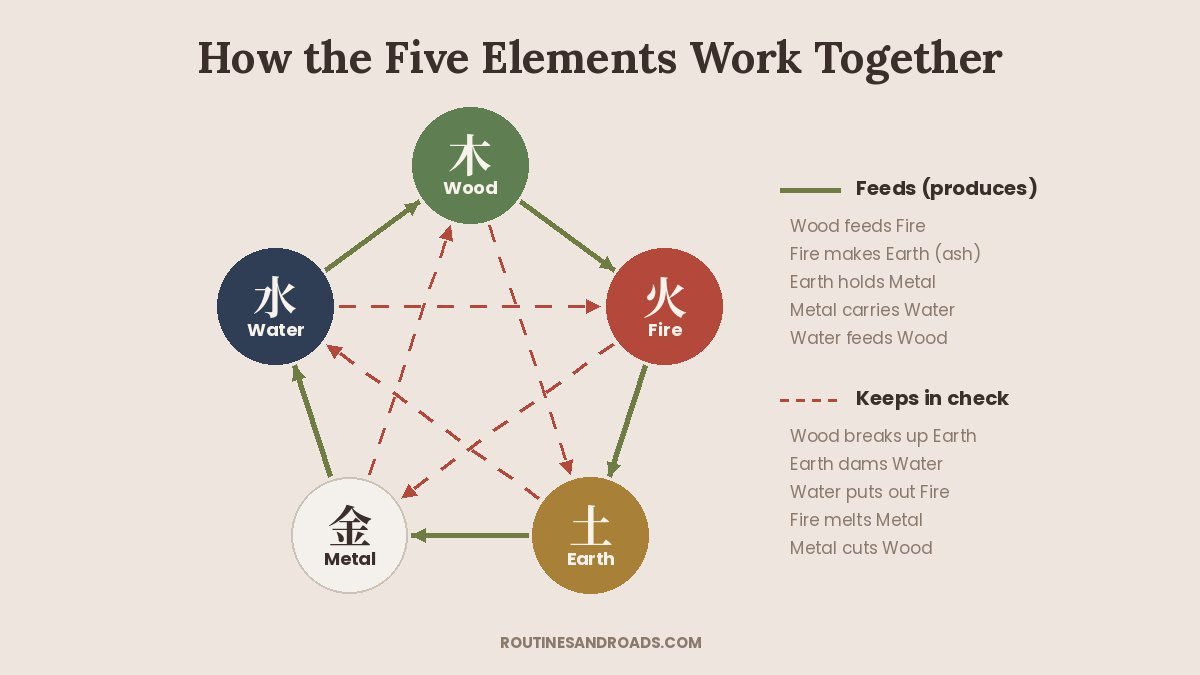
The elements relate to each other in two loops. In the feeding loop, wood feeds fire, fire makes earth (think of ash), earth holds metal, metal carries water (like the drops that form on a cold metal cup) and water feeds wood. In the checking loop, each element keeps another one in line: wood breaks up earth, earth dams water, water puts out fire, fire melts metal and metal cuts wood. Saju doesn’t treat either loop as good or bad. A chart needs both, the way a garden needs water and pruning.
Here’s how each element shows up in a chart, which also helps you spot your elements in the pillars at a glance:
| Element | Season it rules | Traditional Korean color | Stems | Branches |
|---|---|---|---|---|
| Wood | Spring | Blue-green | 甲 乙 | 寅 卯 |
| Fire | Summer | Red | 丙 丁 | 巳 午 |
| Earth | The last month of each season | Yellow | 戊 己 | 辰 未 戌 丑 |
| Metal | Autumn | White | 庚 辛 | 申 酉 |
| Water | Winter | Black | 壬 癸 | 亥 子 |
A few things to keep in mind when you look at your own numbers:
- A zero isn’t a verdict. Lots of charts are missing an element. Saju readers also look at hidden stems, the extra elements tucked inside each branch, and this simple count leaves those out. An element that’s missing in the count often turns up inside a branch.
- Season matters as much as numbers. Two wood characters in a chart born in spring carry more weight than two wood characters in a chart born in autumn, because spring is wood’s season. Your month branch tells you your season.
- Your day master is the anchor. The same count reads differently depending on whether those elements feed your day master, drain it or keep it in check. Four earth characters mean one thing for an earth day master and something else for a water one.
Why Your Birth City Matters: Local Solar Time
This is the setting that makes the biggest difference between calculators, and the one a lot of English bazi calculators skip. Time zones are wide bands, but the sun doesn’t follow them. Every degree of longitude east or west moves solar noon by four minutes, so two babies born at 9:00 AM at opposite ends of the same time zone were born at different times by the sun.
Korea is the classic example. The whole country runs on UTC+9, which is set for 135° east, but Seoul sits at about 127° east. That puts Seoul’s local solar time about 32 minutes behind the clock. Saju hours are two-hour blocks, so half an hour is enough to put you in a different hour pillar. That’s why a lot of Korean saju apps and readers correct for it.
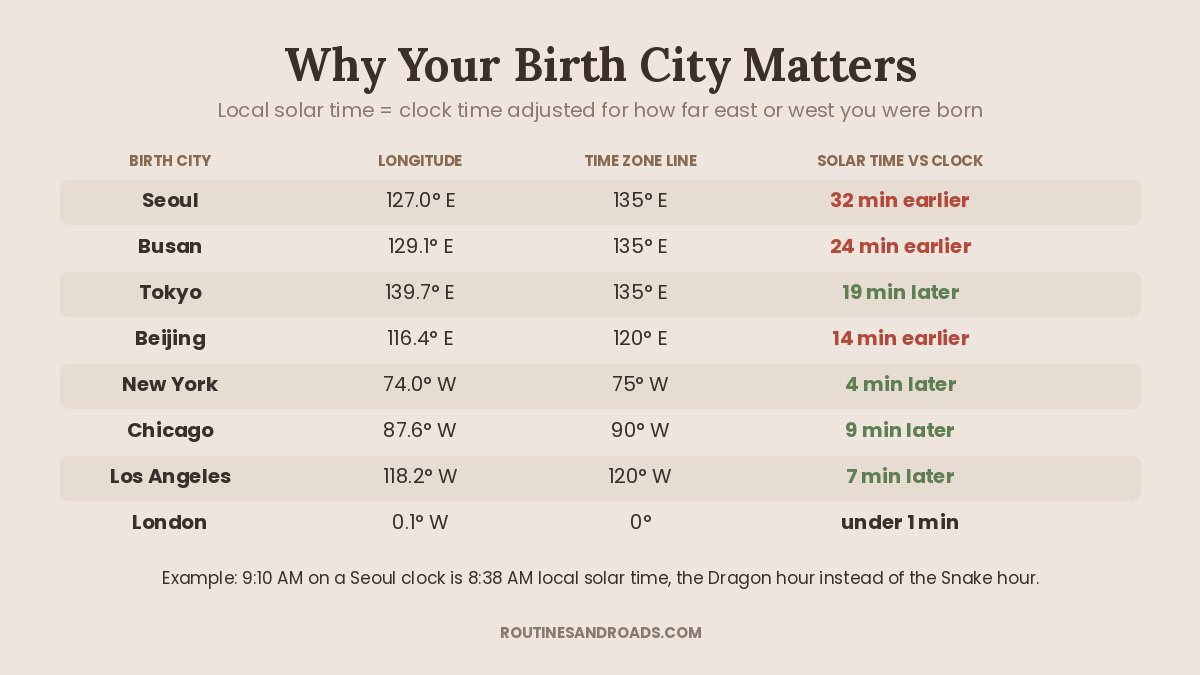
Here’s what that looks like with a real date. Someone born in Seoul at 9:10 AM on July 4, 1995 was born at 8:38 AM local solar time. On the clock, 9:10 falls in the Snake hour (9 to 11 AM), which makes the hour pillar 癸巳. By the sun, 8:38 falls in the Dragon hour (7 to 9 AM), which makes it 壬辰. Same baby, same minute, two different hour pillars.
In the US the gap is usually smaller, because most big cities sit close to the middle of their time zone. Local solar time runs about 4 minutes ahead of the clock in New York, about 9 minutes ahead in Chicago and about 7 minutes ahead in Los Angeles. That only changes your chart if you were born a few minutes before an odd hour (1, 3, 5, 7, 9 or 11 o’clock), because that’s where saju hours change.
The calculator uses local solar time by default, since that’s how I’d read my own chart. If you’d rather match a calculator that uses clock time, open More options and uncheck it.
Is local solar time the same as true solar time?
Not quite, and I’d rather be upfront about it. Local solar time, the version this calculator uses, corrects only for where you were born. True solar time also adds the equation of time, a seasonal wobble caused by Earth’s tilted, oval orbit that can put the sun up to about 16 minutes ahead of or behind its average. Some calculators include it and some don’t, and saju readers don’t all agree on whether they should. If your birth time is within 15 minutes or so of an hour change, compare this result with a calculator that uses true solar time and see whether your hour pillar moves.
Daylight Saving Time and Old Time Zones
Saju works in standard time, so a daylight saving hour has to come off first. That sounds easy until you see how often the rules have changed. A few that catch people out:
- The US in 1974: to save energy, most of the country stayed on daylight saving time through the winter, starting January 6, 1974. A New York baby born at 7:30 AM on January 20, 1974 was really born at 6:30 AM standard time. That moves the hour pillar from the Dragon (壬辰) to the Rabbit (辛卯).
- Korea in 1987 and 1988: Korea used daylight saving time in the summers of 1987 and 1988, the second year partly for the Seoul Olympics. A Seoul birth at 9:20 AM on July 15, 1988 was 8:20 AM standard time, which is the Dragon hour, not the Snake hour.
- Korea from 1954 to 1961: for about seven years, Korea’s standard time was UTC+8:30 instead of UTC+9. Fun fact: that put Seoul’s clocks within about 2 minutes of Seoul’s local solar time.
- Arizona: most of the state doesn’t use daylight saving time at all, so a summer birth in Phoenix needs no correction.
The calculator reads all of this from the time zone database built into your browser, the same kind of record your phone uses to show the right time. You type the time that was on the clock, and it works out whether daylight saving was on that day.
When Does Your Saju Year Start? Ipchun vs Lunar New Year
Most zodiac charts online change your animal on Lunar New Year, which can land anywhere from January 21 to February 20. Saju doesn’t. The saju year starts at Ipchun (입춘), the first of the 24 solar terms and the start of spring. It falls on February 3, 4 or 5, depending on the year and your time zone, and it starts at an exact minute.

If you were born between late January and late February, this is worth checking. Take February 10, 1985. Lunar New Year that year fell on February 20, so most zodiac charts call that baby a Rat. But Ipchun had already passed on February 3, US time, so in saju that baby is an Ox, and the calculator shows 乙丑 for the year pillar. If you only need your animal and element, my Chinese zodiac calculator shows it both ways, with the Ipchun time for every year from 1950 to 2030.
Months work the same way. Your month pillar doesn’t follow lunar months at all. It changes at the solar terms, around the 4th to the 8th of each month. If you want to see what that looks like for one whole birth year, my 1990 Chinese zodiac post lists the start time of every saju month that year.
This is also the answer to the question that confused me most on Korean sites. When a manseryeok site asks whether your birthday is solar or lunar, it’s only asking how you’re typing the date in, since some Koreans, especially older generations, keep their birthdays on the lunar calendar. Either way, the chart itself is built on solar terms. That’s the part I wish I’d understood from the start.
What If You Don’t Know Your Birth Time?
You can still learn a lot from your chart. Without a birth time, you get six of your eight characters: your year, month and day pillars. Your day master doesn’t depend on the hour, so the most important character in the chart is still there.
There are two catches:
- Births near midnight. If you might have been born between about 11 PM and 1 AM, even your day pillar can change, because that’s where one day hands off to the next.
- Births on a solar term day. If your birthday is the day a saju month starts, your month pillar depends on the hour. The calculator warns you when that’s the case.
My own birth time came from my mom. If you can’t ask a parent, families often keep it in a few places: a long-form birth certificate (many US states list the time of birth), hospital records or a baby book. Try not to guess, though. Six characters you trust tell you more than eight where one pillar is a guess.
Why Two Bazi Calculators Can Give You Different Charts
If you’ve tried a few calculators and got a few different answers, it’s almost always one of these settings, not a math mistake:
| Setting | What it can change | This calculator |
|---|---|---|
| Birth time zone | Your hour and day pillars, and your month or year near a boundary | Taken from your birth city |
| Daylight saving | Your hour pillar, sometimes your day | Taken out automatically |
| Local solar time | Your hour pillar, sometimes your day | On by default, can be turned off |
| 11 PM to midnight | Your day pillar | The day changes at midnight by default |
| Year start | Your year pillar if you were born in late January or early February | Ipchun, to the minute |
| Hidden stems | Your five elements numbers | Not counted |
The 11 PM row is an old debate. The Rat hour runs from 11 PM to 1 AM, so it straddles midnight. Some schools start the new day at 11 PM. Others keep the day until midnight and give the 11 PM hour the next day’s stem, which is a common approach in Korea and this calculator’s default. If you were taught that the day starts at 11 PM, check that box under More options. And if you’re curious why Chinese and Korean readers set some of these defaults differently, I compare the two traditions in my bazi vs saju guide.
How I Use My Own Chart
I look at my chart at the end or the start of every year. It’s a habit I picked up after my first reading at a cheolhakgwan (철학관), a saju reader’s office in Korea. Most of what I know beyond my own chart I learned from YouTube, from saju teachers who go through charts character by character. If you want to go further than a calculator, that’s a good place to start.
My birth year is 1990, the Metal Horse, and my day pillar is 丁未 (jeong-mi), the Fire Goat day. Those are the only parts of my chart I share here. When a new year comes around, I put that year’s pillar next to my chart and look at how they meet. The next one is a fun one for me: 2027 is a 丁未 year, the same pillar as my day. I’ll write about that one when it gets closer.
Sample Chart: Reading One Step by Step
Let’s put it all together with a made-up birthday, not a real person: March 15, 1988, at 2:30 PM in Los Angeles. Type that into the calculator and you’ll get this chart:
| Hour | Day (you) | Month | Year | |
|---|---|---|---|---|
| Stem | 辛 Yin Metal | 己 Yin Earth | 乙 Yin Wood | 戊 Yang Earth |
| Branch | 未 Goat (Earth) | 巳 Snake (Fire) | 卯 Rabbit (Wood) | 辰 Dragon (Earth) |
Step 1, the day master. The top of the day pillar is 己, yin earth, the garden soil. The classic picture is nurturing and practical, someone who quietly makes things grow.
Step 2, the season. The month branch is 卯, the Rabbit, the heart of spring. Spring is wood season, and wood is the element that keeps earth in check, the way roots break up soil. So this garden soil was born when the trees are at their strongest, and a reader would note that first.
Step 3, the count. Earth 4, wood 2, fire 1, metal 1, water 0. There’s plenty of earth, and the one fire, the Snake right under the day master, feeds that earth. Water is missing from the count, but here’s a nice example of why a zero isn’t a verdict: in classic saju, the Dragon (辰) carries a little water inside it as a hidden stem. So this chart’s water is tucked into the year pillar.
Step 4, the hour. With local solar time, 2:30 PM in Los Angeles is 2:37 PM, still the Goat hour (1 to 3 PM), so the hour pillar is 辛未. But if this person had been born at 2:55 PM, local solar time would be 3:02 PM. That’s the Monkey hour, and the hour pillar would change to 壬申, while a calculator using clock time would still say 辛未. That’s why the minutes matter.
Frequently Asked Questions
If you only do one thing after you run your chart, look at the top of your day pillar. That’s your day master, the part of the chart saju reads as you. And if you were born near the start of February, near midnight or a few minutes before an odd hour, read the note under your chart before you trust that pillar.
I also wrote about what saju actually is in Korea: how people get readings, what a reader really tells you and why so many Koreans still check their charts every new year. Ran your chart? Tell me your day master in the comments. I’d love to know how many fellow candles are out there. And if you were born in 1990 like me, here’s everything about the 1990 Metal Horse.