What Is Saju? Korean Fortune Telling, Explained by a Korean (and What My Reading Said)

Saju (사주) is the Korean way of reading a person’s life from the moment they were born. You take the year, month, day and hour of your birth, turn each one into a pair of characters, and read those eight characters for your temperament, your strengths and the timing of your life. It’s the same system the Chinese call bazi, and in Korea it’s about as common as horoscopes are in the US.
I’m Emily, a Korean living in the US with my husband and three dogs. I had my saju read for the first time about seven years ago, and I’ve been studying it on my own for the last few years. Growing up in Korea, I heard the word palja (팔자) long before I knew what a saju chart even looked like. It’s part of how Koreans talk about life.
So here’s saju from the inside: what the words mean, what a reader actually looks at, how Koreans use it through the year, and what my own reading told me.
| What it is | A Korean four pillars reading based on the year, month, day and hour you were born |
| The words | Saju (四柱) means four pillars. Palja (八字) means eight characters. Together: saju palja |
| Same as | Chinese bazi. The eight characters come out the same; the reading styles and culture around them differ |
| What you need | Your birth date (and whether it’s solar or lunar), your birth time and where you were born |
| What a reading covers | Personality, strengths and work, money, relationships and timing (10-year and yearly luck) |
| Where Koreans get one | A saju reader’s office, a saju cafe, apps and websites, or a calculator and YouTube to learn on your own |
| Best for / Good to know | Best for anyone curious about the Korean side of their birth chart. Good to know: the chart itself is calendar math, and the reading is one person’s interpretation of it. |
What Does Saju Mean?
Saju (四柱) literally means four pillars. Each pillar stands for one part of your birth: the year, the month, the day and the hour. Each pillar has two characters, a heavenly stem on top and an earthly branch on the bottom, so the whole chart has eight characters. Those eight characters are your palja (八字). When Koreans put the two words together, saju palja (사주팔자), they mean your chart and, in a looser way, your fate.
The eight characters come from a perpetual calendar called manseryeok (만세력), which gives every year, month, day and two-hour block its own pair of characters on a 60-step cycle. The top character of your day pillar, your day master, is the one that stands for you.
Saju vs the Chinese zodiac
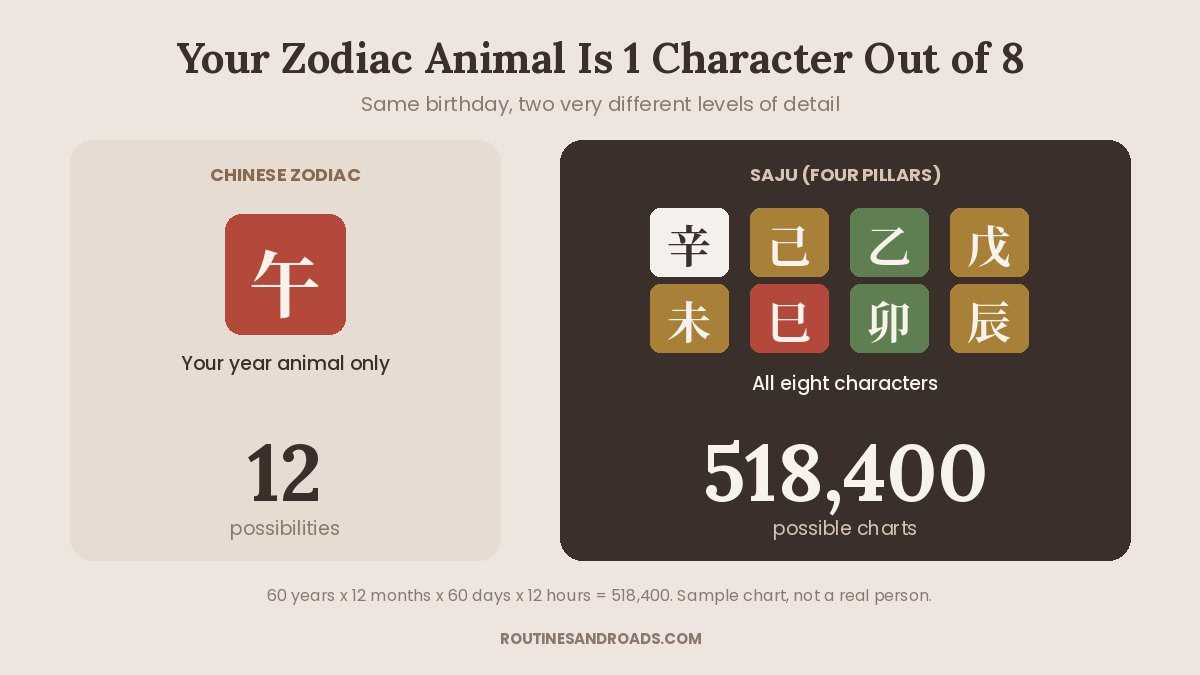
Your zodiac animal is just one of your eight characters: the bottom of your year pillar. That’s why two people born in the same year can have completely different saju. The zodiac gives you 12 possibilities. A full saju chart gives you 518,400, because there are 60 year pillars, 12 month pillars for each year, 60 day pillars and 12 hour pillars for each day. You can find all of yours with my free saju calculator, and if you were born in 1990 like me, my 1990 Chinese zodiac post walks through one birth year in detail.
How Koreans Use Palja in Everyday Life
This is the part I think most English pages miss. Saju isn’t only something you go and get done. The vocabulary is woven into everyday Korean, and most Koreans use these phrases without ever having had a reading:

- Palja-ga jota (팔자가 좋다), “your palja is good”: said half jokingly, half enviously about someone who seems to have an easy life. A friend on a long vacation while you’re at work? Palja-ga jota.
- Palja-reul gochida (팔자를 고치다), “to fix your palja”: a big life upgrade that changes your fortune overnight, like winning the lottery.
- Saju-e eomneun (사주에 없는), “not in my saju”: something so unexpected it couldn’t have been in your chart. Saju-e eomneun hogang (사주에 없는 호강) is a treat or luxury you never expected to get.
- Palja-ryeoni hada (팔자려니 하다), “I’ll take it as my palja”: a shrug, accepting something you can’t change.
So when a Korean says palja, they might mean a chart, or they might just mean life. Context does the work.
What Happens at a Saju Reading
My first reading came through someone I knew, who introduced me to a cheolhakgwan (철학관). The word literally means “philosophy house,” and it’s what Koreans call a saju reader’s office. You give your birth date and time, the reader writes out your eight characters, and the conversation goes from there. My birth time came from my mom.
A reading usually moves from the big picture to the specific. The reader starts with your day master and the overall balance of your chart, talks about your temperament and what you’re naturally good at, then moves to timing: which 10-year luck cycle you’re in and what the coming year looks like for you. After that, it’s your turn to ask about work, money, relationships or a move you’re thinking about. Most people go with one or two questions in mind.
One thing Korean saju sites and readers will almost always ask, besides your birth date and time, is your gender. That surprises people, but there’s a technical reason, which I’ll get to in the luck cycle section.
What a Saju Reader Looks At
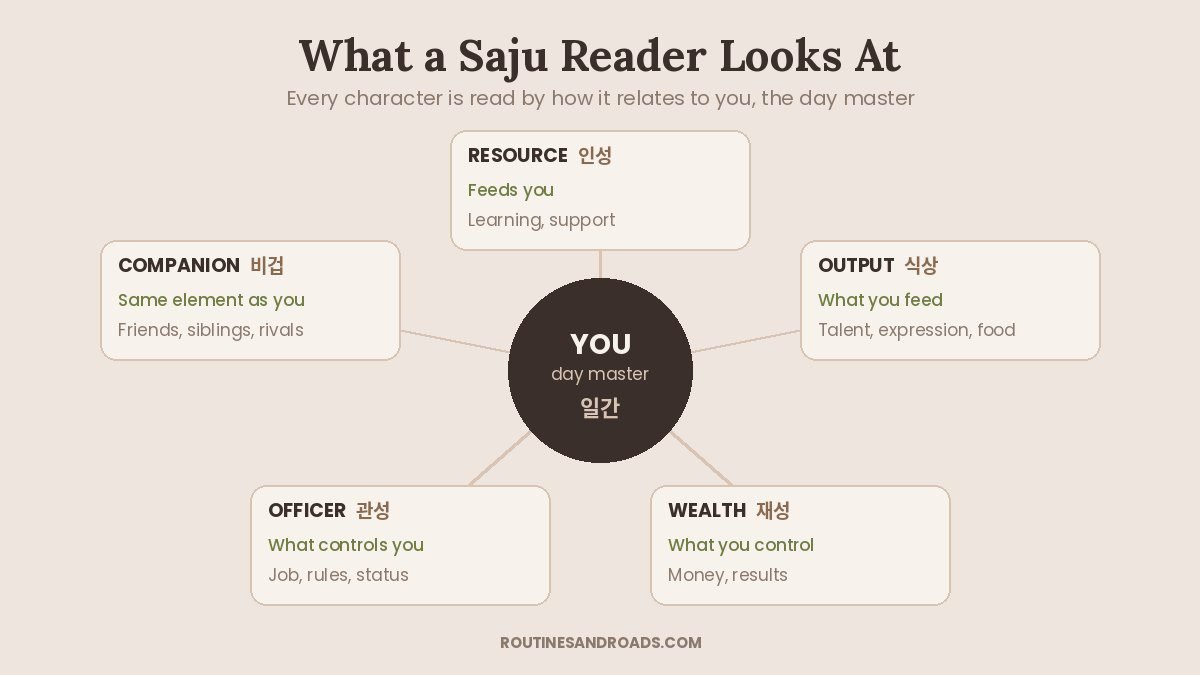
Every character in your chart gets read by how it relates to your day master. There are five possible relationships, and each one has two versions (yin and yang), which is where the name ten gods (십신, sipsin) comes from:
| Group | Korean | How it relates to you | What readers connect it to |
|---|---|---|---|
| Resource | 인성 (inseong) | Feeds you | Learning, support, your mother |
| Companion | 비겁 (bigeop) | The same element as you | Friends, siblings, rivals, independence |
| Output | 식상 (siksang) | What you feed | Talent, expression, food, creating things |
| Wealth | 재성 (jaeseong) | What you control | Money, results, managing things |
| Officer | 관성 (gwanseong) | What controls you | Your job, rules, reputation, status |
On top of that, the reader looks at your five elements balance, the season you were born in (your month branch), and the special pairings and clashes between branches. None of it is read alone. A lot of one element can be a strength or a strain depending on what the rest of the chart is doing, which is why two readers can look at the same chart and lead with different things.
My reading: art, design and making things beautiful
Here’s what my reader told me. My chart leans toward art. Design would suit me, and so would anything where I express something, whether that’s expressing myself or making other people look good. The advice was basically to work with beautiful things, interiors included, and that it didn’t much matter which beautiful things.
Looking at what I do now, writing, sharing what I find and putting together posts like this one, I think that fits me. In saju terms, talent and self-expression belong to the output stars (식상, siksang), the elements your day master feeds. My day master is a candle, yin fire, and one of those output stars sits right under it, hidden inside the Goat of my day pillar. I wrote about that pillar, 丁未, in my 1990 post.
Reading the Ten Gods in a Sample Chart
Here’s how those five groups work on a real chart. I’ll use the made-up sample from my calculator post: March 15, 1988, at 2:30 PM in Los Angeles. Its day master is 己, yin earth. Every other character gets a role depending on its element and whether it’s yin or yang:
| Character | Element | Its role for a 己 day master | Group |
|---|---|---|---|
| 戊 (year stem), 辰 (year branch) | Yang earth | Same element, opposite polarity | Companion |
| 未 (hour branch) | Yin earth | Same element, same polarity | Companion |
| 乙 (month stem), 卯 (month branch) | Yin wood | Wood controls earth | Officer |
| 巳 (day branch) | Fire | Fire feeds earth | Resource |
| 辛 (hour stem) | Yin metal | Earth feeds metal | Output |
| (none) | Water | Earth controls water | Wealth |
Read that way, the chart tells a story before a reader says a word. There’s a lot of companion energy (three earth characters besides the day master), a strong officer pair sitting right in the birth season, one resource feeding the day master from right underneath, one output star in the hour pillar and no visible wealth star. A reader would then ask how strong this earth is for a spring birth and which element the chart is asking for, and that’s where saju turns from counting into reading.
For branches, readers use the main element hidden inside each one, which is why 巳 counts as fire and 辰 counts as earth here. Each branch carries one to three hidden stems in total, so a full reading goes one level deeper than this table.
Daeun, Seun and Samjae: Why Koreans Talk About Good and Bad Years
Your chart doesn’t change, but the years you walk through do, and that’s the timing side of saju. Readers look at three layers:
- Daeun (대운), the 10-year luck pillar. Every 10 years you move into a new pillar that colors that stretch of life. When Koreans say daeun-i deureoonda (대운이 들어온다), “a big luck is coming in,” this is what they mean. Your daeun can run forward or backward through the calendar, depending on whether your birth year is yin or yang and on your gender. That’s the reason saju sites ask for your gender.
- Seun (세운), the year’s luck. Every year has its own pillar, and a reader looks at how it meets your chart. 2026 is 丙午, the Fire Horse, and 2027 is 丁未, the Fire Goat.
- Samjae (삼재), the three-year caution period. This one goes by your zodiac animal alone. Every 12 years, each animal gets a three-year stretch that Koreans treat as a time to be careful: the year it comes in (deul-samjae), the middle year (nul-samjae) and the year it leaves (nal-samjae).
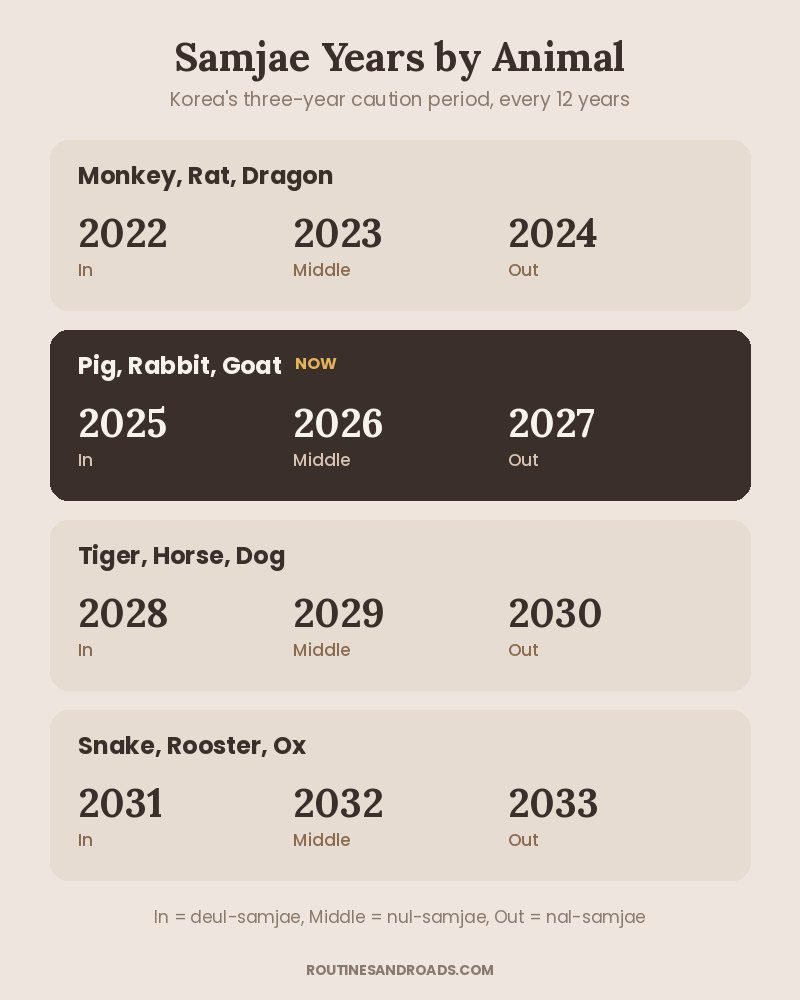
The animals go through samjae in groups of three, so it’s easy to check:
| Your animal | Last samjae | Next samjae |
|---|---|---|
| Monkey, Rat, Dragon | 2022 to 2024 | 2034 to 2036 |
| Pig, Rabbit, Goat | 2025 to 2027 (now) | 2037 to 2039 |
| Tiger, Horse, Dog | 2016 to 2018 | 2028 to 2030 |
| Snake, Rooster, Ox | 2019 to 2021 | 2031 to 2033 |
How seriously people take samjae varies a lot. Some hold off on big moves during those years, some just keep it in the back of their mind, and plenty of Koreans ignore it. Since it looks at one character out of eight, a reader will always weigh it against your whole chart.
When Koreans Check Their Saju
Koreans don’t check their saju at random. There are a few moments in the year, and in life, when it comes up again and again:
- The new year. This is the big one, and it’s when I look at my own chart. The classic New Year fortune is tojeong bigyeol (토정비결), attributed to the Joseon scholar Yi Ji-ham. It uses your lunar birth year, month and day (no hour) and lands you on one of 144 readings for the year ahead.
- Before a wedding. Gunghap (궁합) compares two people’s charts. It used to be something families did before agreeing to a marriage; now a lot of couples do it for fun.
- Naming a baby. Some Korean families have a name made at a jakmyeongso (작명소), a naming office that picks Chinese characters whose elements balance the baby’s chart.
- Picking a date. Taegil (택일) means choosing a good day for a wedding, a move or a grand opening.
- Big decisions. Exam season, a job change, starting a business. These are the moments people book a reading.
Gunghap: How Saju Compatibility Works
Gunghap (궁합) is the saju version of a compatibility check, and it goes a lot further than “Horse and Goat get along.” A reader puts two full charts side by side and looks at a few things:
- The two day masters. Some stem pairs are classic combinations, and the day pillars matter most because they stand for the two people themselves.
- The branches. Pairs of animals can combine or clash, and readers look at all four branches in each chart, not only the birth years.
- The element balance. A good match is often two charts that fill in each other’s gaps, like a chart heavy in fire next to one with plenty of water.
These are the classic pairings readers check first:
| Type | Pairs | What it means |
|---|---|---|
| Stem combinations (천간합) | 甲己, 乙庚, 丙辛, 丁壬, 戊癸 | Two day masters that pull toward each other |
| Branch pairs (육합) | Rat and Ox, Tiger and Pig, Rabbit and Dog, Dragon and Rooster, Snake and Monkey, Horse and Goat | Animals that combine smoothly |
| Three harmonies (삼합) | Monkey, Rat, Dragon / Tiger, Horse, Dog / Snake, Rooster, Ox / Pig, Rabbit, Goat | Three animals that make one strong element together |
| Clashes (충) | Rat and Horse, Ox and Goat, Tiger and Monkey, Rabbit and Rooster, Dragon and Dog, Snake and Pig | Animals sitting opposite each other on the wheel |
A clash isn’t a no. Readers treat it as two different rhythms that take more effort to sync, and it’s one factor among many. My own chart has a Horse year and a Goat day, which is one of those smooth branch pairs, so I’m a little biased toward the Horse and Goat line. If you want to run two birthdays through these tables, my Chinese zodiac compatibility calculator checks the year animals, the two day masters and the two day branches the Korean way.
How to Get a Saju Reading (Even From Outside Korea)
You don’t have to fly to Seoul. Here are the realistic options, from easiest to most involved:
- Build your own chart. A calculator gives you your eight characters, your day master and your elements in seconds. Mine is here, and it handles US time zones.
- Learn the basics. Most of what I know beyond my own chart, I learned on YouTube, from saju teachers who go through charts one character at a time.
- Use an app or a website. Korean apps are popular for quick readings, though many are Korean-only. English options exist too.
- Book a reader. In Korea, that means a cheolhakgwan found by word of mouth, the way I found mine, or a saju cafe if you want something lighter. Some readers also work online.

Whichever you pick, a little prep makes a big difference:
- Know whether your birthday is solar or lunar. Korean sites ask this right away, and honestly, it confused me more than anything else the first time. If your birthday is the one on your ID, it’s solar.
- Get your birth time. Ask a parent first. Mine came from my mom. A long-form birth certificate often has it too.
- Know your birth city. A reader or calculator needs it to get the hour right.
- Write down one or two questions. A reading is more useful when you go in with something specific.
Solar or lunar birthday?
This is worth a few more lines, because it confused me the most when I first looked up my own chart on Korean sites. A lot of Koreans, especially older generations, keep their birthday on the lunar calendar. A lunar birthday lands on a different solar date every year, and the lunar calendar even adds a leap month (윤달, yundal) about seven times every 19 years, so the same lunar date can show up twice in the same lunar year.
That’s why Korean sites ask “solar or lunar?” before anything else. It’s only about how you’re typing the date in. The site converts a lunar date to a solar one, and the chart itself is built on the solar terms either way. If you grew up outside Korea, the birthday on your ID is solar, and you can leave that setting alone.
Saju, Gwansang, Sinjeom: Korea’s Other Ways to Read Fortune
Saju is the most popular way Koreans look into their fortune, but it’s not the only one, and people new to Korea often mix them up. Here’s how they differ:
| Name | What it reads | How it works |
|---|---|---|
| Saju (사주) | Your birth chart | Calendar math, then a reader’s interpretation |
| Gwansang (관상) | Your face | Reading character and luck from facial features. There’s even a hit Korean film about it, The Face Reader (2013) |
| Songeum (손금) | Your palm | Palm reading, often at the same places that do saju |
| Tarot (타로) | Cards | Tarot cafes are a common sight in Korea, especially in college neighborhoods |
| Sinjeom (신점) | A spirit’s message | A reading from a mudang, a shaman. Not based on your birth chart at all |
The big difference is between the first one and the last one. Saju starts from your birth data and a fixed system, so you can check the chart yourself. A sinjeom reading comes from a shaman and doesn’t use a chart. When Koreans say they “got their saju done,” they mean the chart kind.
Is Saju Accurate?
There are two honest answers. The chart itself is accurate in the sense that it’s math: the eight characters come from the calendar and astronomy, so any well-built calculator will give you the same chart from the same birth details. The reading is a different thing. There’s no scientific evidence that a birth chart predicts your life, and two readers can tell you different things from the same eight characters.
Here’s how I see it. Saju is closer to a very old study of patterns than to magic, and I use it the way some people use a journal: as a way to think about my strengths and to look at the year ahead with a plan. I never use it to make a big decision for me, and I’d be wary of anyone who tells you that you should.
Saju Words Worth Knowing
If you start reading about saju or talking to a Korean friend about it, these are the words you’ll hear most:
| Korean | Say it | What it means |
|---|---|---|
| 사주 | saju | Four pillars: your birth chart |
| 팔자 | palja | Eight characters, and in everyday Korean, your lot in life |
| 만세력 | manseryeok | The perpetual calendar charts are built from |
| 일간 | ilgan | Day master, the character that stands for you |
| 일주 | ilju | Your day pillar |
| 오행 | ohaeng | The five elements |
| 십신 | sipsin | The ten gods, the relationships to your day master |
| 대운 | daeun | Your 10-year luck pillar |
| 세운 | seun | The luck of a given year |
| 삼재 | samjae | The three-year caution period by zodiac animal |
| 궁합 | gunghap | Compatibility between two charts |
| 철학관 | cheolhakgwan | A saju reader’s office |
| 토정비결 | tojeong bigyeol | The classic New Year fortune |
Frequently Asked Questions
If you take one thing from this post, let it be this: saju is about all eight characters, not just your animal, and the most important one is the top of your day pillar. Get your birth time from a parent if you can, know whether your birthday is solar or lunar, and you’ll have everything a reader or a calculator needs.
My next post is up too: the 1991 Chinese zodiac, the Metal Goat, and why some people born in February 1991 are Goats in saju but Horses on most zodiac charts. Have you ever had your saju read, in Korea or anywhere else? Tell me what surprised you in the comments. And if you haven’t seen your own chart yet, my free saju calculator will show you your eight characters in a few seconds.