1990 Chinese Zodiac: Are You Really a Metal Horse? (A Korean 1990 Horse Explains)

If you were born in 1990, the 1990 Chinese zodiac says you’re a Horse, and more specifically a Metal Horse. I was born in 1990 too, and in Korea we have our own name for it: baengmal-tti (백말띠), the white horse year. Koreans will also tell you that Horses are stubborn and white horses are the most stubborn of them all. Looking at myself, I honestly can’t argue with that.
But there’s a catch most zodiac pages skip. Depending on your exact birthday, and on whether you go by Lunar New Year or by Korean saju, some people born in early 1990 aren’t Horses at all, and some people born in February 1991 still are. I’ll show you exactly where that line falls, down to the hour in US time zones.
Quick intro: I’m Emily, a Korean living in the US with my husband and three dogs. I had my saju (Korean four pillars of destiny) read for the first time about seven years ago, and for the past few years I’ve been studying it on my own. So this is the 1990 Horse the way a Korean 1990 Horse sees it.
Check Your Chinese Zodiac by Birthday
Pop in your birthday and I’ll show you your animal both ways: the Lunar New Year way most charts use, and the saju way Koreans use, where the year starts at Ipchun around February 4. Birth time is optional, but it matters if you were born right on a cutoff day.
Everything is worked out right in your browser. Nothing you type gets sent anywhere.
Born in a different year, or checking a friend? My full Chinese zodiac calculator works for any birthday from 1900 to 2100.
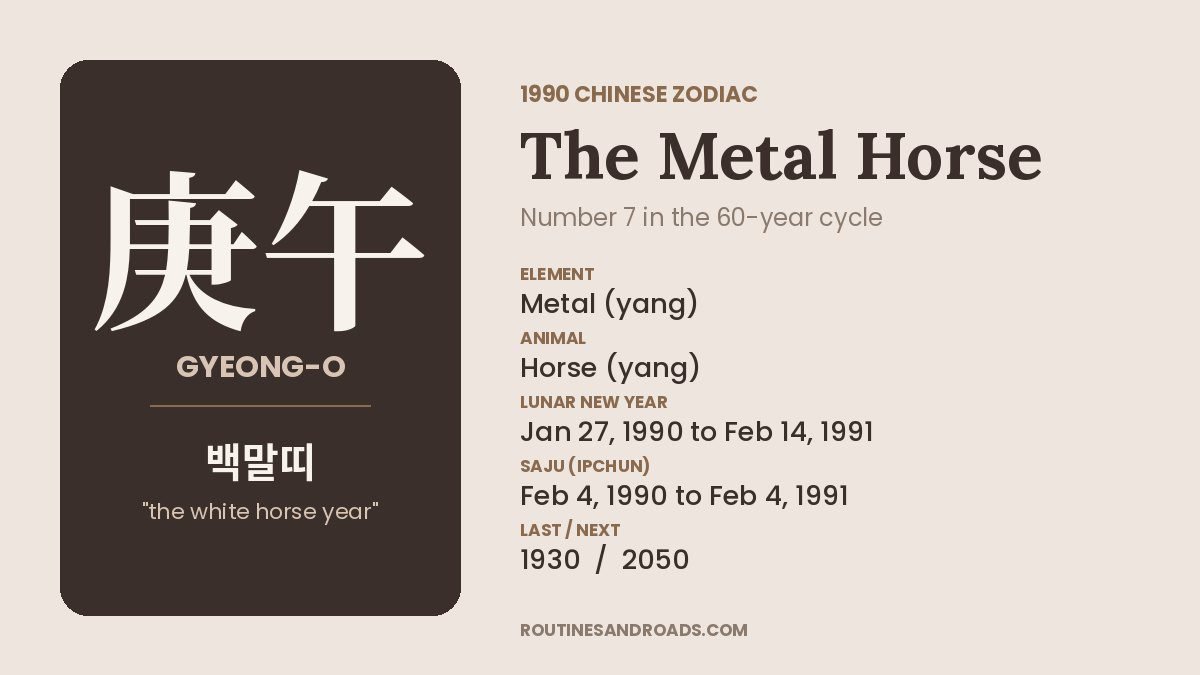
| Birth year | 1990 |
| Zodiac animal | Horse (午, read o in Korean) |
| Element | Metal (庚, read gyeong), yang |
| Full name | Gyeong-o (庚午), the Metal Horse, number 7 in the 60-year cycle |
| Korean nickname | Baengmal-tti (백말띠), the white horse year |
| Horse years | 1942, 1954, 1966, 1978, 1990, 2002, 2014, 2026 |
| Lunar New Year dates | January 27, 1990 to February 14, 1991 |
| Saju dates (Korea time) | February 4, 1990, 11:14 a.m. to February 4, 1991, 5:08 p.m. |
| Saju dates (US Pacific) | February 3, 1990, 6:14 p.m. to February 4, 1991, 12:08 a.m. |
| Last and next Metal Horse | 1930 and 2050 |
| Best for / Good to know | Best for anyone born in 1990 who wants the Korean take. Good to know: if you were born January 27 to February 3, 1990, Lunar New Year charts say Horse, but Korean saju says Snake |
What Type of Horse Is 1990? Meet the Metal Horse
In the Chinese zodiac, and in Korean saju, every year has two parts: an animal and an element. The animal comes from the 12 earthly branches, and the element comes from the 10 heavenly stems. Put them together and you get 60 combinations, which is why the full cycle takes 60 years to come back around.
1990 is 庚午, which Koreans read as gyeong-o. Gyeong (庚) is yang metal, and o (午) is the Horse. That makes 1990 the Metal Horse, number 7 in the 60-year cycle. The last Metal Horse year was 1930, and the next one won't come until 2050.
What Does It Mean to Be a Metal Horse?
The Horse is traditionally described as energetic, independent and quick on its feet, the kind of person who needs room to run. Metal adds a firm, decisive edge. Gyeong metal is often pictured as raw steel or an iron blade, so the Metal Horse is the Horse with the strongest will of the five: direct, hardworking and not easy to talk out of a decision once it's made.
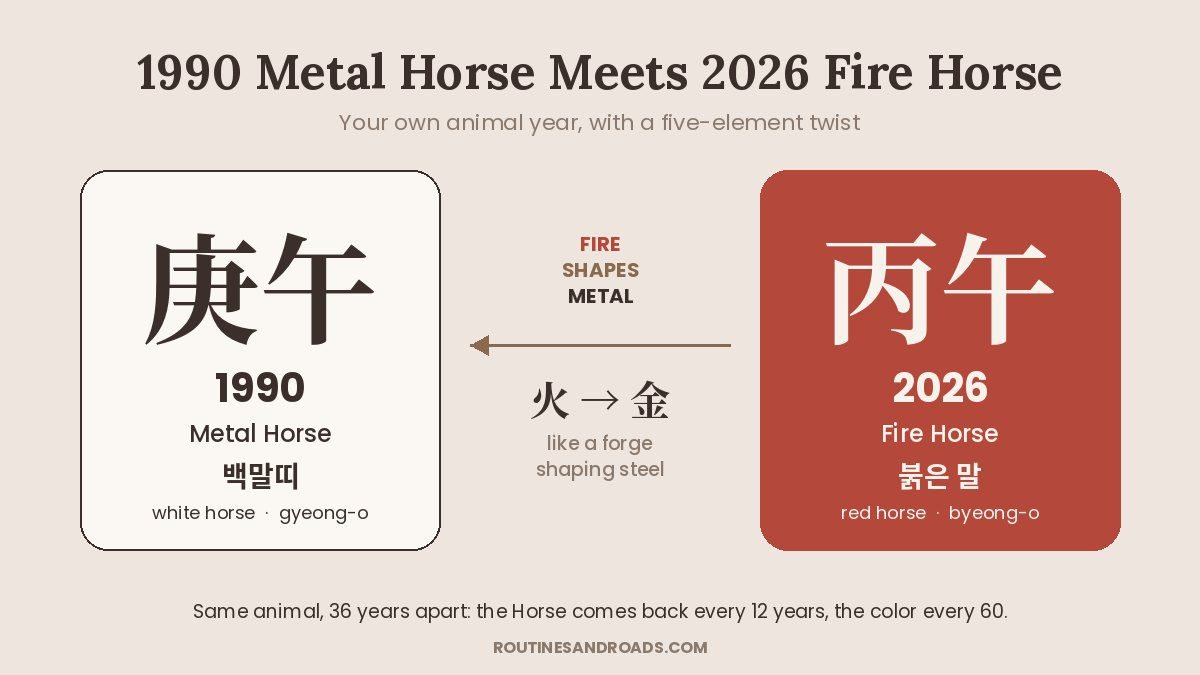
There's one more detail I love about gyeong-o. In saju, the Horse branch holds fire, so 庚午 is metal sitting right on top of fire. Saju readers like to picture it as steel in a forge, since heat is exactly what turns raw metal into something useful. Keep that image in mind, because it comes back when we get to 2026.
All of that is the traditional picture, not a rule for every person born that year. Your year animal is only one of the four pillars in a saju chart, and I'll get to the one that matters most in a minute.
How the Five Kinds of Horses Differ
Every Horse year pairs the Horse with one of the five elements, so there are five kinds of Horses, and each one comes back once every 60 years. Here's how they're traditionally described:
| Horse | Years | Traditional picture |
|---|---|---|
| Wood Horse | 1954, 2014 | Warm, open-minded and good with people |
| Fire Horse | 1966, 2026 | The most intense Horse: passionate, bold and restless |
| Earth Horse | 1978, 2038 | The steady one: practical, patient and dependable |
| Metal Horse | 1930, 1990 | Determined and direct, with the strongest will of the five |
| Water Horse | 1942, 2002 | Quick-witted, adaptable and a natural talker |
Like every zodiac description, these are sketches, not rules. That said, I'm a Metal Horse, and the strongest will part fits me a little too well.
Why Koreans Call 1990 the White Horse Year
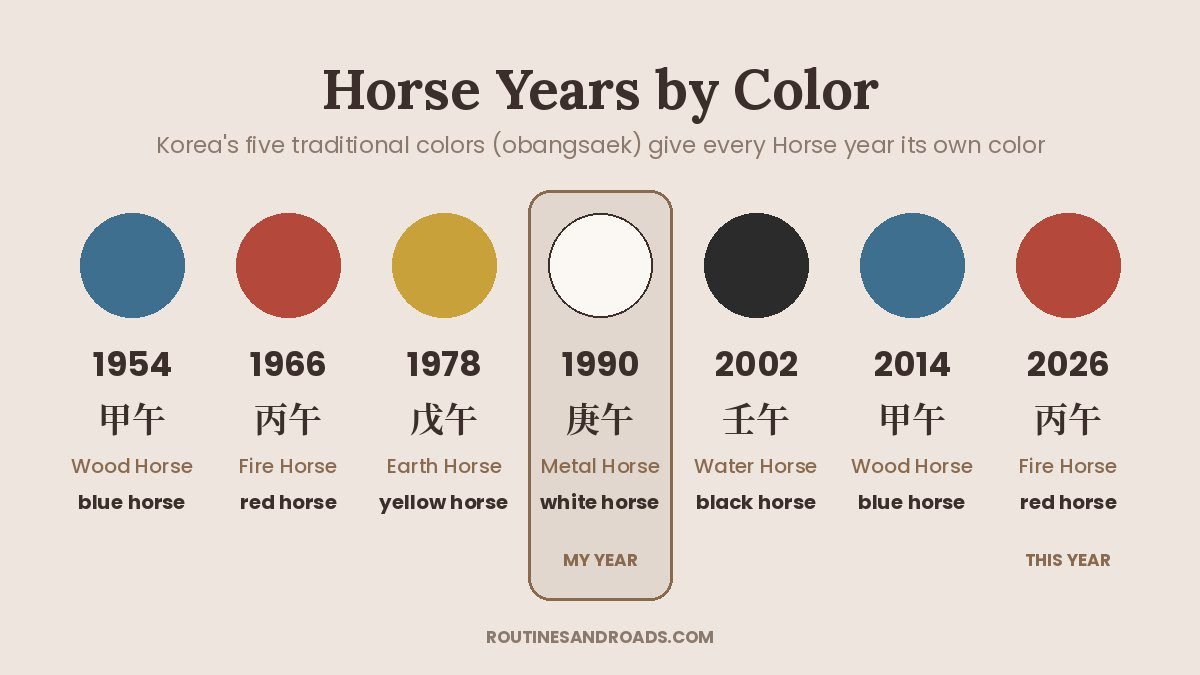
In Korea, we don't just say Metal Horse. We give each element a color from obangsaek, the five traditional colors: wood is blue, fire is red, earth is yellow, metal is white and water is black. So a Metal Horse year becomes a white horse year, baengmal-tti.
It works the same way for every year. 2014 was a blue horse year, and 2026, the year we're in right now, is a red horse year because it's a Fire Horse. Here's how the recent Horse years line up by color:
- 1954: Wood Horse, the blue horse
- 1966: Fire Horse, the red horse
- 1978: Earth Horse, the yellow horse
- 1990: Metal Horse, the white horse
- 2002: Water Horse, the black horse
- 2014: Wood Horse, the blue horse
- 2026: Fire Horse, the red horse
One more fun one: Koreans celebrate hwangap (환갑) at 60, the birthday when your birth year's exact combination comes back around for the first time. For us 1990 white horses, that's 2050.
Are White Horses Really That Stubborn?
Every Korean knows their tti (띠), their zodiac animal. It comes up all the time, and a lot of people believe that people who share the same animal end up with pretty similar personalities.
Horses have a reputation for being strong-willed and seriously stubborn. White horses only come around once every 60 years, and they're supposed to be even more stubborn than regular Horses. That's what people say, anyway. Looking at myself, I think they might be right.
You'll still hear older Koreans say that white horse women in particular are strong. I choose to take it as a compliment: we know what we want, and we don't let go of it easily.
And since Koreans love a good personality system, here's my full stack: I'm blood type B (yes, Korea has blood type personality theories too), a Libra, a Horse and a Jeong-mi day pillar. Reading the classic descriptions of the Horse and of Jeong-mi honestly feels like reading about myself.
When Does the 1990 Chinese Zodiac Year Start? (It Depends Who You Ask)
Here's the part that surprises people. There are two ways to decide when a zodiac year begins:
- Lunar New Year: the date most zodiac websites use, and the day the new year is celebrated. In 1990, Lunar New Year fell on January 27, so by this count the Horse year runs from January 27, 1990 to February 14, 1991.
- Ipchun (입춘), the start of spring: the date saju uses. It's one of the 24 solar terms, the moment the sun reaches 315 degrees along its yearly path, and it always lands on February 3, 4 or 5. In saju, the new animal starts at that exact moment.
In 1990, Ipchun arrived at 11:14 a.m. on February 4, Korea time. In the US, that was still the evening of February 3. The Horse year then ended at the next Ipchun, on February 4, 1991. Here's what that looks like in your time zone:
| Time zone | Horse year starts (Ipchun 1990) | Horse year ends (Ipchun 1991) |
|---|---|---|
| Korea | Feb 4, 1990, 11:14 a.m. | Feb 4, 1991, 5:08 p.m. |
| US Eastern | Feb 3, 1990, 9:14 p.m. | Feb 4, 1991, 3:08 a.m. |
| US Central | Feb 3, 1990, 8:14 p.m. | Feb 4, 1991, 2:08 a.m. |
| US Mountain | Feb 3, 1990, 7:14 p.m. | Feb 4, 1991, 1:08 a.m. |
| US Pacific | Feb 3, 1990, 6:14 p.m. | Feb 4, 1991, 12:08 a.m. |
| UK | Feb 4, 1990, 2:14 a.m. | Feb 4, 1991, 8:08 a.m. |
| Sydney | Feb 4, 1990, 1:14 p.m. | Feb 4, 1991, 7:08 p.m. |
These times come from the sun's actual position, checked against a standard Chinese almanac library, and the two match within a minute. So depending on your birthday:
- Born January 1 to 26, 1990: you're an Earth Snake either way.
- Born January 27, 1990 up to Ipchun: Lunar New Year says Horse, saju says Earth Snake.
- Born after Ipchun 1990 and before Ipchun 1991: Metal Horse either way.
- Born after Ipchun 1991 through February 14, 1991: Lunar New Year says Horse, saju says Metal Goat.

So which one is right? Both are real traditions. For casual zodiac talk, most people go by Lunar New Year. When you look at a saju chart, the Ipchun line is the one that counts, and that's the one I use. If your birthday falls in one of those windows, it's worth knowing which animal your chart actually uses.
Born in January or February 1990? Koreans Have a Name for That
Those January and February windows have a funny twin in Korean school culture. Until 2009, Korean elementary schools grouped kids born from March 1 through the end of February of the next year into one grade. So a baby born in January or February 1990 usually started school with the 1989 kids, a year ahead of everyone else born in 1990.
Koreans call them ppareun nyeonsaeng (빠른 년생), which means "early birth year," and you'll still hear people say they're "ppareun 90." It's one more reason early-year birthdays get confusing in Korea: your classmates are a year older, Lunar New Year might make you a Horse, and saju might call you a Snake. The same overlap happens at the other end of 1990: someone born in early February 1991 can be a Horse on Lunar New Year charts but a Goat in saju, which I explain in my 1991 Chinese zodiac guide.
The rule changed with the 2009 school year, when Korea switched to grouping kids born January 1 through December 31, so younger Koreans grew up without it.
1990 Chinese Zodiac by Birth Month: Find Your Month Pillar
Your birth year gives you your year pillar, and your birthday also gives you a month pillar. In saju, the month pillar is a big deal. It's the season you were born into, and saju readers treat it as one of the strongest influences in a whole chart.
Saju months don't start on the 1st, though. Each one begins at a solar term, somewhere around the 4th to the 8th of the calendar month. Here are the month pillars that cover 1990 births, with the start time of each in US Eastern time. For Pacific time, take three hours off.
So if you searched for something like May 1990, the exact day matters. Someone born May 3, 1990 has a Metal Dragon month, and someone born May 20, 1990 has a Metal Snake month, even though both are 1990 Horses.
| Born from (US Eastern) | Month pillar | Season |
|---|---|---|
| Jan 5, 1990, 9:33 a.m. | 丁丑 jeong-chuk, Fire Ox (still a Snake year) | Winter |
| Feb 3, 1990, 9:14 p.m. | 戊寅 mu-in, Earth Tiger | Spring |
| Mar 5, 1990, 3:19 p.m. | 己卯 gi-myo, Earth Rabbit | Spring |
| Apr 4, 1990, 9:13 p.m. | 庚辰 gyeong-jin, Metal Dragon | Spring |
| May 5, 1990, 2:36 p.m. | 辛巳 sin-sa, Metal Snake | Summer |
| Jun 5, 1990, 6:46 p.m. | 壬午 im-o, Water Horse | Summer |
| Jul 7, 1990, 5:01 a.m. | 癸未 gye-mi, Water Goat | Summer |
| Aug 7, 1990, 2:46 p.m. | 甲申 gap-sin, Wood Monkey | Autumn |
| Sep 7, 1990, 5:38 p.m. | 乙酉 eul-yu, Wood Rooster | Autumn |
| Oct 8, 1990, 9:14 a.m. | 丙戌 byeong-sul, Fire Dog | Autumn |
| Nov 7, 1990, 11:23 a.m. | 丁亥 jeong-hae, Fire Pig | Winter |
| Dec 7, 1990, 4:14 a.m. | 戊子 mu-ja, Earth Rat | Winter |
| Jan 5, 1991, 3:28 p.m. | 己丑 gi-chuk, Earth Ox (still the Horse year until Ipchun) | Winter |

If you were born within a few hours of one of those start times, the exact hour decides your month, so double-check that one. My free saju calculator will do the math for you.
Here's a quick way to read the season. A 1990 Metal Horse born in autumn, from early August to early November, gets extra metal, because autumn is metal season. One born in summer gets extra fire. That's one big reason two people born in the same year can have very different charts.
How I First Got My Saju Read
I had my saju read for the first time about seven years ago. Someone I knew introduced me to a cheolhakgwan (철학관), which literally means "philosophy house." It's where saju readers work in Korea. Before that, I only knew saju by name.
What got me curious was something people told me: that it's really good to get your saju read at the start or the end of the year. You learn what to be careful about, you see how your own chart lines up with the energy of the coming year, and you walk into the new year feeling ready for it. I liked that idea, so I just tried it.
After that, I started doing it on my own. Every year, around the end of the year or the start of a new one, I'd look at my chart and get ready for the year ahead. For a while, that was as far as it went.
Then, about three or four years ago, I got much more into saju and Eastern philosophy, and I started studying it beyond my own chart. I've stuck with it long enough that people around me have even suggested I study it seriously.
One thing I want to clear up for anyone new to this: in Korea, saju is not the same as going to a mudang (무당), a shaman fortune teller. I see Eastern saju philosophy as something closer to a statistical study, built on patterns people recorded for centuries. That's why I'm comfortable with it, and why I enjoy learning it.
How Koreans Use Saju Today
My way in, a cheolhakgwan reading through someone I knew, is a pretty classic Korean route. But it's far from the only one:
- Cheolhakgwan: a saju reader's office, usually found by word of mouth, like mine was.
- Saju cafes: cafes where you order a drink and get a reading at your table. They're a fun outing with friends or a date, and visitors to Korea try them too.
- Apps and websites: a lot of people now check their chart on their phone before they ever sit down with a reader.
- New Year fortunes: around the new year, many Koreans look up their fortune for the year ahead. The classic version is tojeong bigyeol (토정비결), a fortune tradition named after the Joseon-era scholar Tojeong Yi Ji-ham.
- Gunghap (궁합): comparing two people's charts for compatibility, traditionally before a marriage.
Whichever door you walk through, the habit I picked up is the one I still keep: a good look at my chart at the end or the start of every year.
My Day Pillar: Jeong-mi, the Fire Goat Day
Your birth year gives you your zodiac animal, but in saju it's only one of four pillars: year, month, day and hour. Each pillar is a heavenly stem plus an earthly branch, so a full chart has eight characters. That's where the name saju (four pillars) comes from, along with its longer name, saju palja (four pillars, eight characters).
The pillar that describes you most directly is the day pillar. Mine is 丁未, jeong-mi:
- Jeong (丁) is yin fire. It's pictured as candlelight or a lamp: a small, steady flame that lights up the space around it.
- Mi (未) is the Goat, the warm earth of late summer.
Together, Jeong-mi is the Fire Goat day. In the classic descriptions, it's warm and considerate on the outside, with a firm will on the inside. Hidden under the Goat is earth that the candle feeds, which saju calls the eating god star (siksin), tied to taste, creativity and taking care of people. Maybe that explains why I've been cooking homemade food for my dogs for three years now, treats included. When I read about Jeong-mi, I don't really see a description. I just see me.
One more thing I love about my chart: Horse and Goat are a classic pair in saju, called o-mi hap. My birth year is a Horse and my day is a Goat, so that pair is built right into my own chart. And 2027 is a Jeong-mi year, the year of the Fire Goat, which means next year shares my day pillar.
Is 2026 a Lucky Year for 1990 Horses?
2026 is 丙午, byeong-o, the Fire Horse, or the red horse year in Korean terms. For anyone born in 1990, that makes it your own animal's year, the one that comes around every 12 years.
In Chinese tradition, your own animal's year (ben ming nian) gets special attention, and a lot of people wear red for luck. In Korean saju, your animal coming back around isn't read as good or bad by itself. What matters is how the year's pillar works with your whole chart, not just your birth year.
There's also an element story for 1990 Horses. In the five elements, fire controls metal, like a forge shaping steel. 2026 is a fire year and 1990 is a metal year, so in five-element terms, 2026 is a fire year working on a metal Horse. That's exactly why I like checking my chart against the year ahead: it's less about luck and more about knowing what to pay attention to.
What Is the Lucky Color for a 1990 Horse?
Zodiac sites love to hand out lucky colors and numbers for each animal. Saju works differently. A Korean saju reader won't give every 1990 Horse the same lucky color, because it depends on your day master and on which elements your chart has too much or too little of.
The element your chart needs most is called yongsin (용신), and your lucky colors come from it, using the same five colors as the zodiac animals: green and blue for wood, red for fire, yellow and brown for earth, white for metal, and black and navy for water. Two 1990 Horses can end up with completely different lucky colors, and that's normal.
Here's a fun contrast. Some Chinese zodiac sites list white as an unlucky color for the Horse, while Korea calls the whole 1990 year the white horse year. Same animal, two traditions, two very different takes on white.
Who Is a 1990 Horse Compatible With?
Saju has a few classic pairings for the Horse:
- Tiger and Dog: together with the Horse, these three form one of the four three-animal harmony groups, called in-o-sul samhap.
- Goat: the Horse and Goat are a traditional pair, o-mi hap, the same pair that's in my own chart.
- Rat: the Rat sits directly across from the Horse on the zodiac wheel, a pairing saju calls ja-o chung, a clash. I read it as two very different rhythms, not a deal breaker.

Koreans also have a word for sharing an animal: ttidonggap (띠동갑), which means two people with the same animal, usually 12 years apart. A 1990 Horse and a 1978 or 2002 Horse are ttidonggap, and it's a fun thing to discover with a coworker or a friend's older sibling.
Keep in mind that real compatibility in saju looks at both people's whole charts, especially the day pillars, not just birth years. If you want to go deeper, I put together a full Horse compatibility guide with all 12 signs and a day pillar check.
Famous People Born in 1990, the Year of the Metal Horse
A few well-known 1990 Metal Horses, all born after Ipchun, so they're Horses by both counts:
- The Weeknd: February 16, 1990
- Kristen Stewart: April 9, 1990
- Emma Watson: April 15, 1990
- Dev Patel: April 23, 1990
- Margot Robbie: July 2, 1990
- Jennifer Lawrence: August 15, 1990
- Yuna Kim, Korea's 2010 Olympic figure skating champion: September 5, 1990
- Rita Ora: November 26, 1990
And two famous near misses. Liam Hemsworth was born on January 13, 1990, before both Lunar New Year and Ipchun, so he's an Earth Snake by either count. Emma Roberts, born February 10, 1991, is the opposite case. Lunar New Year calendars still call her a Horse, since the 1991 Lunar New Year didn't arrive until February 15, but saju puts her in the Metal Goat year, because Ipchun had already passed on February 4. If your birthday lands in one of those windows, scroll back up to the boundary section before you call yourself a Horse.
Frequently Asked Questions
If you only remember one thing from this post, make it this: if you were born in late January or early February of 1990 or 1991, check the Ipchun time for your time zone in the table above, because your saju animal might not match what the Lunar New Year charts say. And remember that your year animal is just one pillar out of four.
I also built a free saju calculator so you can find all four of your pillars, including your own day pillar. Are you a 1990 Horse too? Tell me in the comments whether the stubborn part is true for you. And when I'm not reading saju charts, I'm usually in the kitchen, like the night I ranked five Buldak ramen flavors by spice level.