Chinese Zodiac Horse Compatibility, Explained by a Korean Horse (All 12 Signs, the 4-Year Rule and the Day Pillar Test)
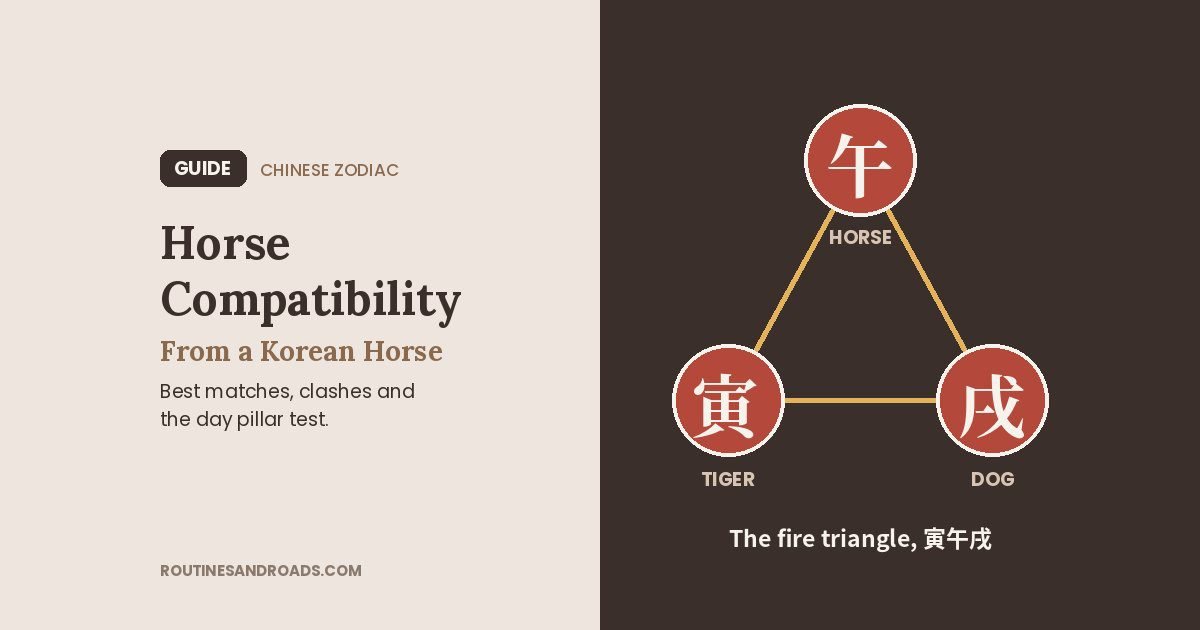
Chinese zodiac horse compatibility charts usually give you the same short answer: Tiger, Dog and Goat are your people, and Rat sits on the other side of the wheel. I’m a Korean born in 1990, the year Koreans call the white horse, so I’ve heard that list for as long as I can remember. What most charts leave out is why those animals line up that way, and the part Koreans care about most: in Korea, the animal is only the first page of a real compatibility reading.
I’ve had compatibility (gunghap, 궁합) read every way you can in Korea: at a philosophy house (cheolhakgwan, 철학관), on saju apps, and on my own with the charts open in front of me. My husband and I fought a lot when we first started dating. We’re both strong-willed, and half the time neither of us understood why the other one was upset. I hadn’t looked at his saju on its own before. When I finally did, during our compatibility reading, a lot of things just made sense, and honestly, we’ve fought a lot less since.
So this is the Horse compatibility guide I’d give a friend: the Korean match chart with the reasons behind it, all 12 pairings one by one, the Korean four-year rule, what 2026 to 2030 look like for Horse couples, a checker you can run with two birthdays, and why Koreans move on to the day pillar before deciding anything. If you’re new here, I’m Emily, a Korean living in the US with my husband and our three dogs.
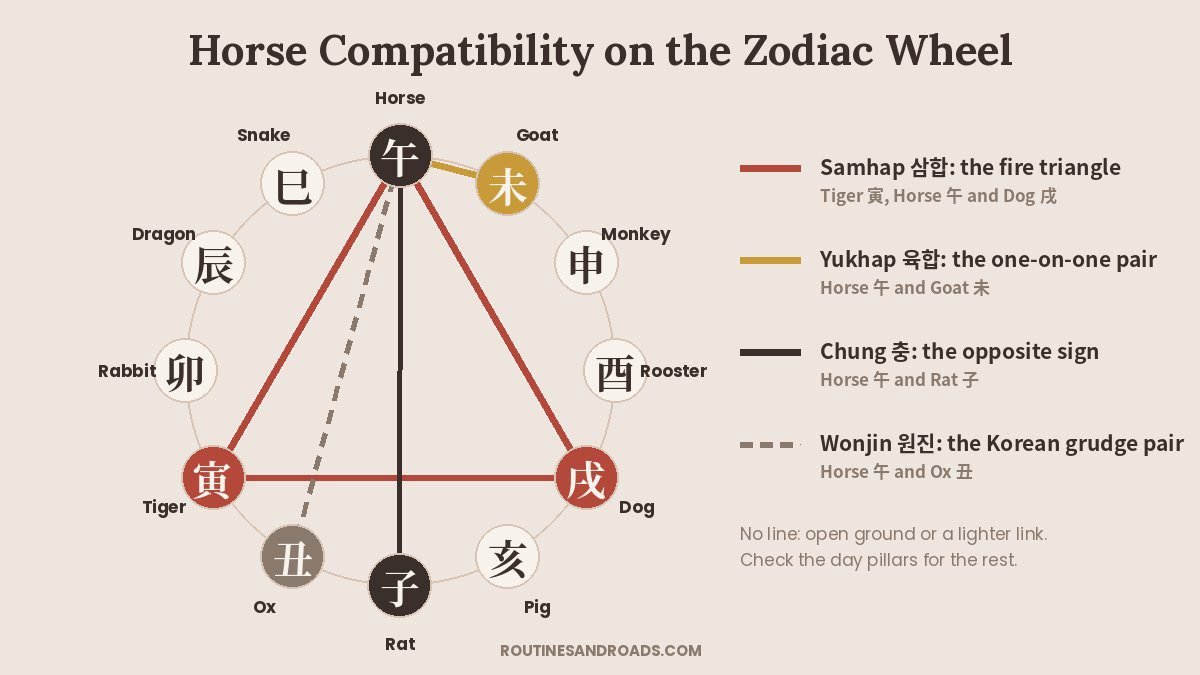
| Best matches (samhap, 삼합) | Tiger and Dog. Tiger, Horse and Dog form the fire triangle 寅午戌 |
| Closest one-on-one pair (yukhap, 육합) | Goat. Horse 午 and Goat 未 combine |
| Same-season friends (banghap, 방합) | Snake and Goat, the three summer signs 巳午未 |
| Opposite sign (chung, 충) | Rat. Rat 子 and Horse 午 sit straight across the wheel |
| The Korean grudge pair (wonjin, 원진) | Ox. Ox 丑 and Horse 午 |
| Horse and Horse | Same sign, listed as self-punishment (jahyeong, 자형) |
| No classic tie | Dragon, Monkey and Rooster. Pig has a hidden link (amhap, 암합) |
| The four-year rule | Four years apart is always the same triangle, so a Tiger four years older or a Dog four years younger |
| What Koreans check next | The day pillar (ilju, 일주): the two day masters, then the two day branches |
| Horse years | 1942, 1954, 1966, 1978, 1990, 2002, 2014 and 2026, counted from Ipchun |
| Best for / Good to know | Best for Horses checking a partner, a friend or a family member. Good to know: born in January or early February? Your animal may be the year before, so check that first |
Chinese Zodiac Horse Compatibility at a Glance
Here’s the whole chart in one place. The first column is the other person’s animal, the second is what Korean saju readers call the link between that animal and the Horse, the third is the element layer underneath it, and the last is what it tends to mean day to day. I’ve kept the Korean words in because that’s how you’ll hear them from any Korean reader, and the names tell you a lot on their own.
| Other sign | Korean link | Element layer | What it tends to mean |
|---|---|---|---|
| Rat 子 (쥐) | Chung 충, the opposite sign | Water shapes fire | Different rhythms, lots of movement |
| Ox 丑 (소) | Wonjin 원진 and hae 해 | Fire feeds earth | Small irritations that need saying out loud |
| Tiger 寅 (호랑이) | Samhap 삼합, fire triangle | Wood feeds fire | Same team, same direction |
| Rabbit 卯 (토끼) | Pa 파, a light break | Wood feeds fire | Different habits, weighed lightly |
| Dragon 辰 (용) | No classic tie | Fire feeds earth | Open ground, the day pillars decide |
| Snake 巳 (뱀) | Banghap 방합, summer group | Fire and fire | A similar temperature |
| Horse 午 (말) | Jahyeong 자형, same sign | Fire and fire | Same pace, you both dig in |
| Goat 未 (양) | Yukhap 육합 and banghap | Fire feeds earth | Naturally close |
| Monkey 申 (원숭이) | No classic tie | Fire shapes metal | Open ground |
| Rooster 酉 (닭) | No classic tie | Fire shapes metal | Open ground |
| Dog 戌 (개) | Samhap 삼합, fire triangle | Fire feeds earth | Loyal and steady |
| Pig 亥 (돼지) | Amhap 암합, a hidden link | Water shapes fire | A quiet pull |
If you’ve looked at other charts, a couple of these might surprise you. Plenty of English charts put Rooster and Ox together on a hard list. In the Korean tables, Ox has a real, named link with the Horse (wonjin), while Rooster has none at all. And Dragon, which some charts call a strong romantic match, is simply open ground in the branch tables. That’s the difference between ranking signs by personality and reading the actual relationships between the branches.
The element layer is the second thing a Korean reader glances at. Every branch has an element, and the Horse is fire. Wood feeds fire, fire feeds earth, and water and metal sit on the shaping side. You’ll see in a minute that the two layers don’t always agree, and that’s normal. The Ox, for example, is a grudge pair on the branches but an earth sign the Horse’s fire feeds.

How Koreans Read Horse Compatibility: Samhap, Yukhap, Chung and Wonjin
The 12 animals aren’t just animals. Each one is an earthly branch (jiji, 지지), and each branch is a time of day, a direction, a month and an element. The Horse is 午, read o in Korean and wu in Chinese: noon, due south, the height of summer and fire. Once you know where each animal sits on that wheel, the compatibility rules stop looking random.
Samhap (삼합): the triangles
Samhap means three combine. Every four steps around the wheel, three branches form a triangle that turns into one element. There are four triangles in total:
| Triangle | Signs | Element |
|---|---|---|
| 寅午戌 | Tiger, Horse, Dog | Fire |
| 申子辰 | Monkey, Rat, Dragon | Water |
| 亥卯未 | Pig, Rabbit, Goat | Wood |
| 巳酉丑 | Snake, Rooster, Ox | Metal |
The Horse’s triangle is fire. Tiger is early spring, where fire is born, Horse is noon, where it peaks, and Dog is late autumn, where it’s stored. Korean readers treat any two signs from the same triangle as people pulling in the same direction.
Yukhap (육합): the one-on-one pairs
Yukhap means six combine. The wheel splits into six pairs that combine on their own: Rat and Ox, Tiger and Pig, Rabbit and Dog, Dragon and Rooster, Snake and Monkey, and Horse and Goat. The Snake, Horse and Goat are also grouped as the three summer signs (banghap, 방합), so the Goat gets the Horse twice. That’s why the Goat shows up near the top of almost every Horse chart, Chinese or Korean.
Chung (충): the opposite sign
Chung is the clash, the sign directly across the wheel. For the Horse that’s the Rat 子: noon against midnight, south against north, fire against water. In Korean, chung doesn’t mean doom. It means movement. Things between the two of you change fast, in both directions.
Wonjin (원진): the Korean grudge pair
This is the one I most wanted to explain, because almost no English chart mentions it and almost every Korean grandmother does. Wonjin (怨嗔) means resentment and anger. Each sign has one wonjin partner, the sign right next to its opposite, and for the Horse it’s the Ox 丑. The six wonjin pairs are Rat and Goat, Ox and Horse, Tiger and Rooster, Rabbit and Monkey, Dragon and Pig, and Snake and Dog.
The idea isn’t one big fight. It’s small things that pile up quietly because nobody says them out loud. When Koreans check ddi gunghap (띠 궁합, animal compatibility), wonjin is usually the first thing they look for after the clash, and you’ll hear people call it wonjinsal (원진살).
The lighter ones: hyeong, hae and pa
Old charts also list self-punishment (hyeong, 형), harm (hae, 해) and break (pa, 파). For a Horse: Horse with Horse is self-punishment, the Ox is harm on top of wonjin, and the Rabbit is a break. Most Korean readers weigh these lightly, more like footnotes than headlines.
One thing to keep in mind: everything above is about the year animal only. A full saju has four pillars, so a Korean reader also checks the month, day and hour, and the day pillar matters most. I’ll get to that below, because it’s the part that changed things for my husband and me.
Horse and Tiger Compatibility
Horse and Tiger is the pairing most charts, Chinese and Korean, put at the top, and the branch tables back it up: Tiger 寅 starts the fire triangle and Horse 午 is its peak. Korean readers describe this pair as two people who would rather be doing something than sitting still. Both love freedom and both like to move, so neither one is waiting around for the other to catch up.
The way the triangle works gives this pair its shape. Tiger lights the fire, and Horse carries it at full strength. Readers often say the Tiger brings the idea and the Horse brings the energy to run with it. Good to know: two fiery people can get restless at the same time, so a shared plan, like a trip, a project or a goal you’re both chasing, tends to keep this pair at its happiest.
The element layer agrees with the triangle here. The Tiger’s branch is wood, and wood feeds fire, so the Tiger feeds the Horse on top of sharing a team with it. On the calendar, a Tiger is usually four years older than a Horse, or eight years younger, and four years is exactly the gap behind the Korean saying that a four-year age difference doesn’t even need a compatibility check. Years to know: 2026 is a fire triangle year for this couple, and 2028 to 2030 is samjae for both of you at the same time. I explain both further down.
Horse and Dog Compatibility
Dog 戌 is the third point of the same fire triangle, so Horse and Dog get the same samhap link as Horse and Tiger, with a different feel. The Dog is late autumn, the season when fire gets stored instead of spent. Korean readers picture the Dog as the one who keeps the Horse’s fire going over the long run: loyal, steady and honest.
If Horse and Tiger is two people running side by side, Horse and Dog is one person running and one person making sure there’s a home to run back to. When people ask whether the Horse and Dog get along, the Korean answer is yes, and it’s one of the pairings readers describe as getting better with time.
Underneath, the Dog’s branch is earth, so the Horse’s fire feeds the Dog. A Dog is usually four years younger than a Horse, or eight years older, the other half of the four-year rule. Years to know: 2030 is a Dog year, which completes the fire triangle, and it’s also the year the Horse, Tiger and Dog all leave samjae together.
Horse and Goat Compatibility
Horse and Goat is the classic one-on-one combination, yukhap 午未, and the two are summer neighbors on top of that. If you only remember one Horse pairing from this post, it’s probably this one. Korean readers call this pair naturally close: the Horse brings the drive and the Goat brings warmth and patience.
This one is a little personal for me. My day pillar is Jeong-mi (丁未), and the 未 at the bottom of it is the Goat. So my own chart has a Horse year and a Goat day sitting side by side, a Horse and Goat combination inside one person. I can’t say what that means for anyone else, but it does make me smile every time I see this pair at the top of a chart.
There’s one more layer that makes this pair special. A Goat born the year right after a Horse always shares the Horse’s year element, because the heavenly stems come in yang and yin pairs. A 1990 Horse is yang metal and a 1991 Goat is yin metal, so on top of the combination, the two year pillars are the same element. On the element level, the Goat’s branch is earth, which the Horse’s fire feeds. Years to know: 2027 is a Goat year, and it combines with every Horse.
A quick language note: in Korean, the eighth animal is yang (양), which means sheep. English charts say Goat, Sheep or Ram depending on the site. They’re all the same sign, 未.
Horse and Snake Compatibility
Snake 巳 and Horse 午 sit right next to each other on the wheel, and in the Korean tables they’re two of the three summer signs, banghap 巳午未. The Snake is early summer and the Horse is midsummer, so you’re living in the same stretch of the year. Korean readers describe this as a same-climate link: you run at a similar temperature, and you don’t have to explain your pace to each other.
The element layer is where this pair gets interesting. Both branches are fire. That means a lot of warmth and a lot of energy in one house, and the first follow-up a Korean reader makes for two fire signs is the rest of the two charts: is there water or earth anywhere to balance all that fire? That’s a full gunghap question rather than an animal one, and I walk through it below.
On the calendar, a Snake is usually one year older than a Horse, or eleven years younger. Good to know: if you were born in January or early February of a Horse year, you may be a Snake yourself in saju, so check both animals by Ipchun before you read anything into this pair.
Is the Horse year good for a Snake? People ask this a lot for 2026. Korean readers would describe 2026 as a same-season year for a Snake, warm and busy, coming right after the Snake’s own year in 2025. For a Snake and Horse couple, it’s a year where you’re both running hot, so planning some rest on purpose is the most common advice I hear.
Horse and Pig Compatibility
Pig 亥 and Horse 午 have no open combination in the tables, but they do have a hidden one, amhap (암합). Every branch carries hidden stems inside it. The Pig carries 壬, yang water, and the Horse carries 丁, yin fire, and 丁 and 壬 are one of the five stem combinations. Korean readers call that a quiet pull, the kind that doesn’t show from the outside.
On the surface, the element layer looks like the opposite: the Pig’s branch is water, and water shapes fire. Korean readers like this kind of layering, two very different temperaments on the outside and a combination underneath. When people ask whether pigs and horses can be together, the Korean answer is yes, and this is one of the pairs with more going on underneath than the animals suggest.
On the calendar, a Pig is usually five years younger than a Horse, or seven years older. The five-year gap adds another layer, because the year stems combine too: a 1990 Horse is 庚 and a 1995 Pig is 乙, and 乙 and 庚 are a combination pair. Years to know: Pigs are in samjae from 2025 to 2027, with 2026 as the middle year.
Horse and Dragon Compatibility
This is the pairing I get asked about most, and it’s the one closest to home, because my husband has always called himself a Dragon. In the branch tables, Dragon 辰 and Horse 午 have no combination and no clash. Korean readers call that open ground. Nothing pulls you together automatically and nothing pushes you apart, so the day pillars end up deciding most of the story.
The element layer leans gently your way: the Dragon’s branch is earth, so the Horse’s fire feeds it. A Dragon is usually two years older than a Horse, or ten years younger. That ten-year gap shares a year stem, so a 1990 Horse and a 2000 Dragon are both 庚, metal. Years to know: 2030 is the Dragon’s clash year, since the Dog sits straight across the wheel from the Dragon.
Here’s the twist, and it’s the reason I keep telling people to check their animal before they check a match. My husband was born a few weeks before Ipchun (입춘), the solar term around February 4 when the saju year changes. By the year on his birth certificate he’s a Dragon, and that’s what he’s said his whole life, the way most Koreans count. In saju, though, he still belongs to the year before, which makes him a Rabbit. Horse and Rabbit is a pa (파) pair in the tables, a light break.
So did our animals explain our early fights? I don’t think they did much at all. What explained them was the next thing I looked at, the day masters, and I’ll show you that further down.
Horse and Monkey Compatibility
Monkey 申 and Horse 午 have no combination and no clash in the classic branch tables, so this is open ground, and the day pillars carry most of the story. The Monkey is early autumn and the Horse is midsummer, two signs that sit a little apart on the wheel without pulling on each other.
The element layer is the more useful one here. The Monkey’s branch is metal, and fire shapes metal, so in Korean terms the Horse is the one who shapes the Monkey. Readers say pairs like this work well when the roles are clear and both people feel respected, and they look to the day masters to see whether the shaping goes the same way or the other way around in the full charts.
On the calendar, a Monkey is usually two years younger than a Horse, or ten years older. The ten-year gap shares a year stem, so a 1980 Monkey and a 1990 Horse are both 庚, metal. Years to know: 2028 is a Monkey year, the Monkey’s own year, and it’s also the year the Horse’s samjae begins, so it’s a big year in a Horse and Monkey house.
Horse and Rooster Compatibility
Rooster 酉 and Horse 午 don’t link at all in the classic branch tables. Some Chinese charts still put the Rooster on the Horse’s hard list based on personality, but in a Korean reading this is open ground, so the day pillars carry it.
Like the Monkey, the Rooster’s branch is metal, so the element layer has the Horse’s fire shaping the Rooster’s metal. The Rooster is mid autumn and the purest metal sign on the wheel, so Korean readers picture a pair where one person brings heat and the other brings polish. Good to know: with no branch link to lean on, the day masters and the day branches tell you much more about this pair than the animals do.
On the calendar, a Rooster is usually three years younger than a Horse, or nine years older. Years to know: 2029 is a Rooster year, which is the middle samjae year for the Horse, and the Rabbit’s clash year too.
Horse and Rat Compatibility
Horse and Rat is the clash, chung 子午. On the wheel they face each other directly: Rat is midnight, north, winter and water, and Horse is noon, south, summer and fire. It’s the most opposite pairing there is, which is why it shows up on every list of signs the Horse isn’t compatible with.
The Korean way of reading it is more interesting than a no. Chung is movement. Two opposite rhythms mean there’s always something happening, and plenty of readers say clash couples are anything but boring. What a Korean reader would tell a Horse and a Rat is to check the day pillars before reading much into the year clash, and to expect to talk things through more than other couples do.
The element layer matches the clash, since the Rat’s water shapes the Horse’s fire. On the calendar, a Rat is six years older or six years younger than a Horse, because six steps is straight across the wheel. Years to know: 2026, the Horse year, is the Rat’s clash year, and 2027, the Goat year, is the Rat’s wonjin year, so for a Rat and Horse couple these two years are the ones to plan together.
Good to know: if one of you was born in January or early February, run the checker below first. A Rat born in late January might be a Pig in saju, and a Horse born in early February might still be a Snake, which changes the whole picture.
Horse and Ox Compatibility
Horse and Ox is the Korean grudge pair, wonjin 丑午, and the classic tables list it as hae (해), harm, on top of that. This is the pairing Korean grandmothers mention most. The idea isn’t that you’ll fight. It’s that small irritations can pile up quietly if nobody says them out loud, so the traditional advice is simple: say small things early, before they turn into big ones.
Here’s the part that surprises people. On the element layer, the Ox’s branch is earth, and the Horse’s fire feeds earth, so underneath the grudge pair, the elements are supportive. And an Ox is usually five years older than a Horse, which brings in the year stems: a 1985 Ox is 乙 and a 1990 Horse is 庚, and 乙 and 庚 combine. So a 1985 Ox and a 1990 Horse are a wonjin pair on the animals and a combination on the year stems at the same time. That’s exactly why Korean readers never stop at the animals.
An Ox can also be seven years younger than a Horse. Years to know: 2026 is the Ox’s wonjin year and 2027 is the Ox’s clash year, since the Goat sits straight across from the Ox. For an Ox and Horse couple, those are the two years to keep talking things through.
Horse and Rabbit Compatibility
Rabbit 卯 and Horse 午 are listed as pa (파), a break, in the classic tables. It’s one of the lighter links, and most Korean readers weigh it lightly. Think different habits more than a real clash, and look at the day pillars for the bigger story.
The element layer points the other way: the Rabbit’s branch is wood, and wood feeds fire, so the Rabbit feeds the Horse. This is the pairing I live with. My husband is a Rabbit by saju even though he’s a Dragon by the calendar, and in our case, our matching day masters had a lot more to do with our early fights than a light break between our animals.
On the calendar, a Rabbit is usually three years older than a Horse, or nine years younger. Years to know: Rabbits are in samjae from 2025 to 2027, and 2029, the Rooster year, is the Rabbit’s clash year.
Horse and Horse Compatibility
Two Horses share the same pace, the same love of freedom and the same need for room. The tables list Horse with Horse as jahyeong (자형), self-punishment, which sounds harsh but mostly means you can both dig in at exactly the same time. Nobody wants to be the one who slows down first.
Koreans have words for sharing a sign. Two people born in the same year are donggap (동갑), and two people with the same animal 12 years apart are ddi-dong-gap (띠동갑). Donggap usually feel like friends fast, and that’s the upside of a Horse and Horse pairing: you get each other without much explaining. Good to know: it works best when each of you has your own thing going and you meet in the middle.
Both of you are fire on the element layer too, so like a Snake and Horse couple, a Korean reader would look at the full charts for some water or earth. Years to know: 2026 is both of your own years at once, and the 2028 to 2030 samjae is yours together as well.
If you want to go deeper on any of the terms in these sections, my post on what saju actually is explains how a full chart is read, and bazi vs saju has a term table in English, Chinese and Korean.
Check Your Horse Match With Both Birthdays
Here’s the part a chart can’t do for you. Put in both birthdays and the time zone each person was born in. The checker finds each animal by Ipchun, the way saju does, tells you the Korean link between the Horse and the other sign, compares your two day masters, and compares your two day branches, the spouse palace I explain below. Add a birth time if you know it. It only changes the animal if one of you was born right around the day the year turns.
Horse Match Checker (Korean Saju Way)
Put in two birthdays. I’ll find each animal by Ipchun (the way saju does it, not Lunar New Year), tell you how a Horse lines up with the other sign in the Korean tables, and compare your day masters and day branches.
Everything runs in your browser. Nothing you type is saved or sent anywhere. This is a starting point the way Korean readers use it, not a verdict on anyone’s relationship.
If neither of you turns out to be a Horse, you'll still see the day master and day branch comparison. To compare any two signs, my Chinese zodiac compatibility calculator runs the full check. For your full four pillars, the month and hour included, use my free bazi calculator.
Why Koreans Say the Day Pillar Matters More Than the Animal
Your year animal is shared by everyone born in the same year, roughly one in twelve people you'll ever meet. Your day pillar (ilju, 일주) is the pillar Korean readers call you. The top character of it, the day master (ilgan, 일간), is how a saju reader describes your core self, and it's the first thing anyone looks at in a compatibility reading.
That's why I call animal compatibility a starter in Korea. At a philosophy house, the reader lays the two charts side by side and starts with the two day masters. Do they combine? Does one feed the other? Are they the same element? The animal relationship comes up, but it's rarely the headline.
The five day master combinations (천간합)
There are ten day masters and five combination pairs. These are the pairings Korean readers love to see, because the two characters pull toward each other on their own:
| Day masters | Elements | How readers picture it |
|---|---|---|
| 甲 Gap and 己 Gi | Wood and Earth | A tree and the soil that holds it |
| 乙 Eul and 庚 Gyeong | Wood and Metal | A vine and the iron that shapes it |
| 丙 Byeong and 辛 Sin | Fire and Metal | The sun on polished jewelry |
| 丁 Jeong and 壬 Im | Fire and Water | A candle reflected on a lake |
| 戊 Mu and 癸 Gye | Earth and Water | A mountain and the rain on it |
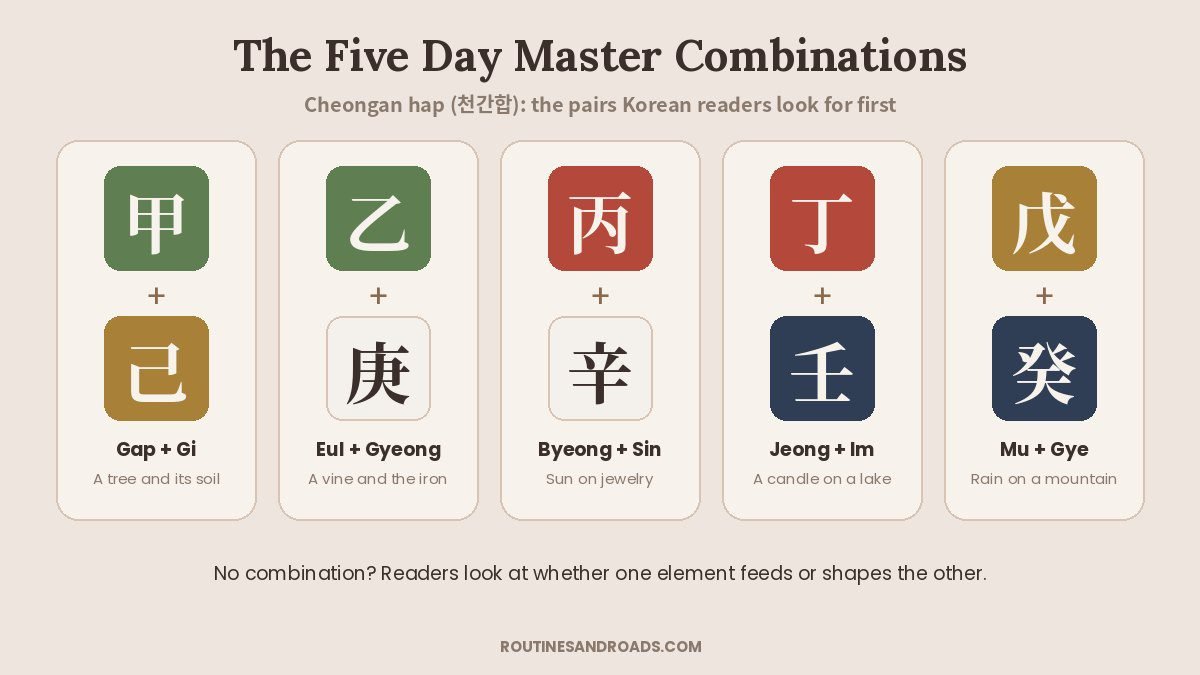
Outside those five pairs, readers go to the five elements cycle. Does one person's element feed the other's? Wood feeds fire, fire feeds earth, earth feeds metal, metal feeds water and water feeds wood. Does one shape the other? Or do you share an element? The checker above runs through the same order, so you can see which one you two land on.
What a Full Korean Gunghap Reading Looks At
Koreans call animal compatibility geot-gunghap (겉궁합), the outside compatibility. It's the version you hear at the dinner table. A full gunghap reading, the kind you'd get at a philosophy house or from a saju app that asks for both birth times, goes through the two charts in layers. Here's the order, and what each layer is looking for.
1. The two animals, found by Ipchun
Everything in the sections above. It's the outside layer, and the only one most English charts cover.
2. The two day masters
The combinations and the five elements cycle from the section above. For most Korean readers, this is where the reading really starts.
3. The two day branches, the spouse palace
The bottom character of the day pillar is called the spouse palace (baeujagung, 배우자궁), the seat of your partner in your own chart. Readers compare the two day branches with the same tables they use for the animals: combinations, triangles, clashes and wonjin. A combination here counts for a lot more than one between the years, and a clash here is read as a lot of movement at home, like moves and schedule changes. The checker above shows this layer too.
4. The five elements across both charts
Each chart has eight characters, and each one has an element. Readers count them up and ask whether one person has what the other is missing. Two fire-heavy charts, for example, are read as warm and fast, and the reader goes looking for water or earth somewhere to balance them. Two charts that fill each other's gaps are one of the most common reasons a reader calls a couple a good fit.
5. The spouse star, where being the man or the woman matters
People often ask whether Horse compatibility is different for a Horse woman and a Horse man. The branch tables don't change with gender. Where gender comes in is the spouse star. In a woman's chart, it's the element that shapes her day master (gwanseong, 관성). In a man's chart, it's the element his day master shapes (jaeseong, 재성). For a Jeong fire day master like mine, water is the spouse star in a woman's chart, and metal is the spouse star in a man's. Readers look at how strong and how settled that star is.
6. Timing: luck cycles and the wedding date
Every chart moves through ten-year luck cycles (daeun, 대운), and readers check whether both people are in steady stretches at the same time. Many Korean families also pick a wedding date with a reader's help (taegil, 택일), and older generations steered clear of holding a wedding in a lunar leap month (yundal, 윤달).
When I read my husband's chart next to mine, layer two is what explained the most. That's the next section.
My Husband and I Share the Same Day Master
When we finally had our compatibility read, the thing that jumped out first wasn't our animals at all. It was that my husband and I have the same day master: Jeong (丁, ding in Chinese), yin fire, the candle.
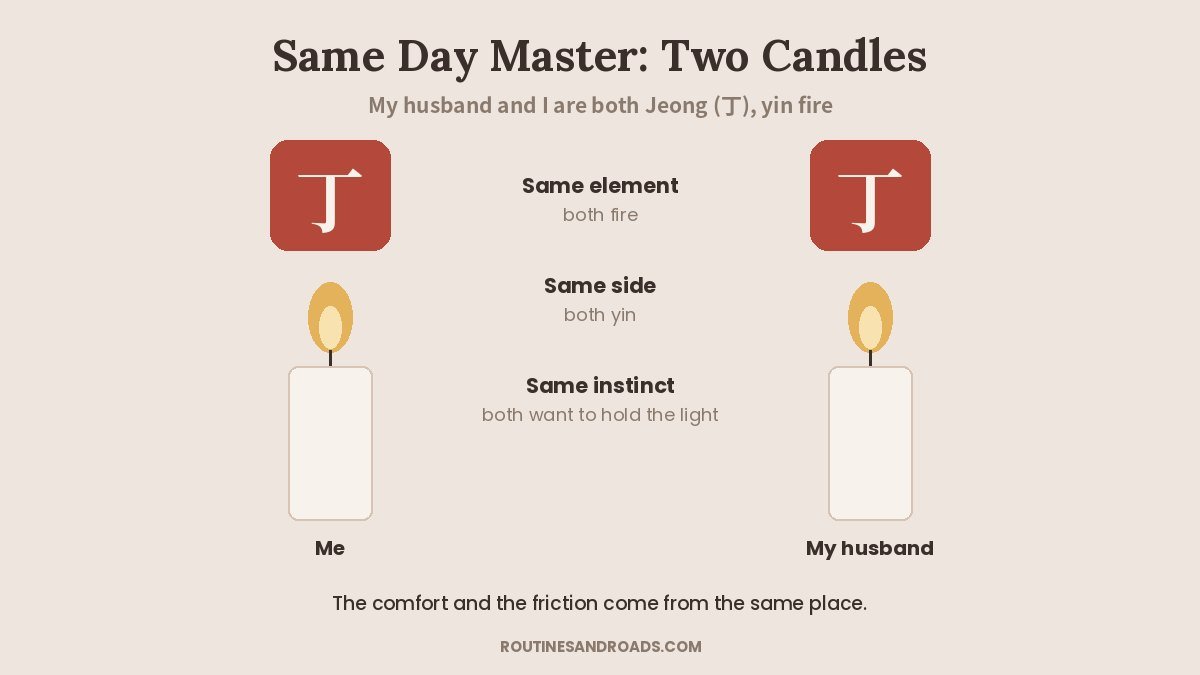
Two candles. Same element, same yin side, the same way of looking at things. In our early days, I think that showed up as two people who both wanted to be the one holding the light. We were both stubborn, both sure we were right, and both confused about why the other one couldn't just see it. I'd never read his saju on its own before that. Once I did, I stopped taking his reactions so personally, because I could see they came from the same place mine did.
I can't promise a chart will do that for anyone else. For us, it changed how we argue more than whether we argue. These days we fight a lot less than we used to, and when we do, I usually understand what's going on underneath.
Good to know if you share a day master with your partner: Korean readers say the comfort and the friction come from the same place. You understand each other quickly, and you also reach for the same role. Taking turns being the one who leads is the advice I've heard most often.
Born in January or February? Check Your Animal Before You Check a Match
This is the step that's easiest to miss on a compatibility chart, and my husband is the perfect example of why it matters. Saju changes the animal at Ipchun, around February 4, not on January 1 and not at Lunar New Year. Anyone born in January, and anyone born in early February before Ipchun, belongs to the year before.
Lunar New Year moves around between January 21 and February 20, so it can land on either side of Ipchun. Here are the Horse years with both dates, so you can see exactly where the line falls:
| Horse year | Korean color name | Ipchun (US Eastern) | Lunar New Year |
|---|---|---|---|
| 1954 | Gap-o 갑오, blue horse | Feb 4, 3:31 AM | Feb 3 |
| 1966 | Byeong-o 병오, red horse | Feb 4, 1:38 AM | Jan 21 |
| 1978 | Mu-o 무오, yellow horse | Feb 3, 11:27 PM | Feb 7 |
| 1990 | Gyeong-o 경오, white horse | Feb 3, 9:14 PM | Jan 27 |
| 2002 | Im-o 임오, black horse | Feb 3, 7:24 PM | Feb 12 |
| 2014 | Gap-o 갑오, blue horse | Feb 3, 5:03 PM | Jan 31 |
| 2026 | Byeong-o 병오, red horse | Feb 3, 3:02 PM | Feb 17 |
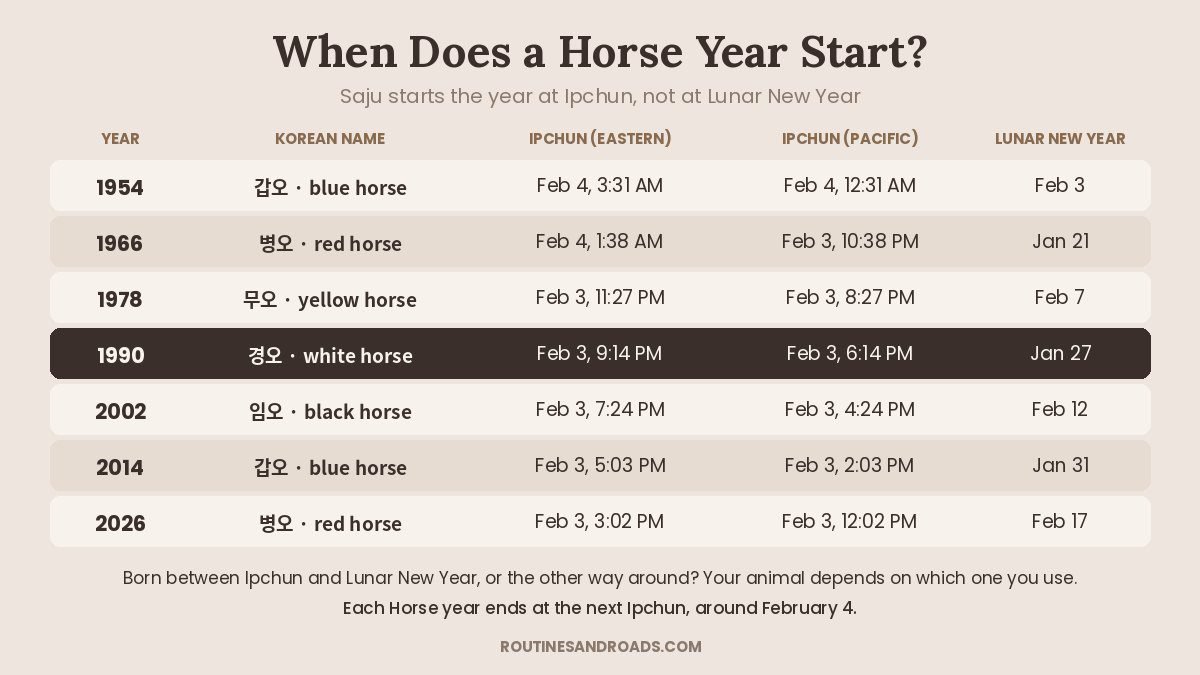
Look at 1966: Lunar New Year fell on January 21, so anyone born between January 21 and February 3 that year grew up being told they were a Horse, but in saju they're still a Snake. Now look at 2026: babies born from Ipchun on February 3 or 4, depending on the time zone, up to February 16 are Horses in saju even though Lunar New Year hadn't arrived yet. Each Horse year ends at the next Ipchun, around February 4 of the following year.
If that's you, check it properly in the checker above, or read the boundary sections in my 1990 and 1991 zodiac posts. A wrong animal means a wrong match, every single time. For any other birthday, my Chinese zodiac calculator shows your animal both ways.
What Koreans Say About White Horse Women
If you're a woman born in a Horse year and you have Korean relatives, you may have already heard this one. Koreans say a woman born in a Horse year has a strong palja (팔자), a strong fate, and the white horse years get it the most. The color comes from the year's heavenly stem: 1990 is Gyeong-o (庚午), gyeong is metal, and metal's color in Korean tradition is white. That's why people born in 1990 are baengmal-tti (백말띠), white horses.
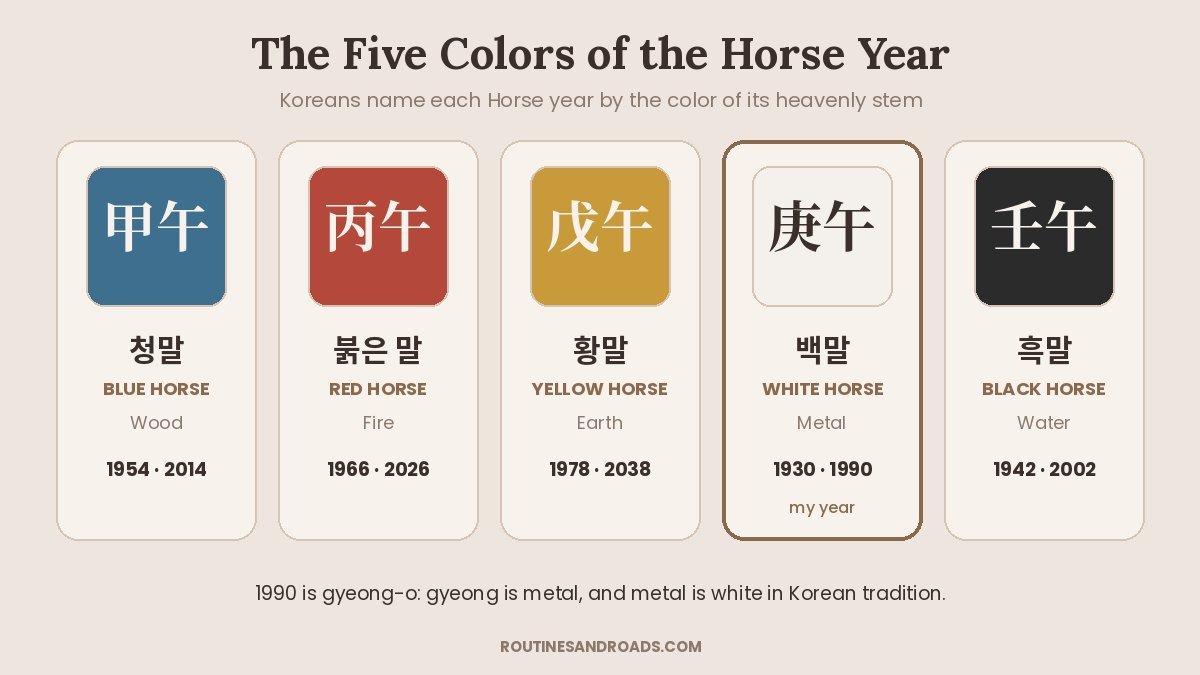
Older generations meant it as a warning: a Horse woman would be too independent, too headstrong. As a 1990 white horse myself, I'll be honest, the stubborn part fits me. I dig in. These days I read it as strength more than a warning.
Japan's fire horse and Korea's white horse
Korea isn't the only place with a Horse year saying about women. In Japan, the version is about the fire horse, hinoeuma (丙午), and it was taken seriously enough to show up in the national statistics: Japan's fertility rate dropped from about 2.0 children per woman to 1.6 in 1966, the last fire horse year, according to a World Bank data blog. 2026 is the next fire horse year, sixty years later.
Good to know: this saying is folklore you hear around the dinner table, and it isn't part of the branch tables a reader uses for compatibility. As a 1990 baby myself, I'll take the strong fate as a compliment. If you're curious about the white horse year itself, my 1990 Chinese zodiac post goes through it from the inside.
Horse Compatibility by Element: Wood, Fire, Earth, Metal and Water Horses
Every Horse year also has a heavenly stem, which gives it an element and, in Korea, a color. You'll see searches like fire horse best compatibility or metal horse compatibility, as if the element changed the animal matches. It doesn't. The branch links above are the same for every Horse. What the element changes is the year stem, and year stems have their own five combinations.
| Horse type | Years | Korean name | Year stem combines with |
|---|---|---|---|
| Wood Horse 甲午 | 1954, 2014 | Gap-o 갑오, blue horse | 己 years: 1949 Ox and 1959 Pig (2009 Ox, 2019 Pig) |
| Fire Horse 丙午 | 1966, 2026 | Byeong-o 병오, red horse | 辛 years: 1961 Ox and 1971 Pig (2021 Ox, 2031 Pig) |
| Earth Horse 戊午 | 1978 | Mu-o 무오, yellow horse | 癸 years: 1973 Ox and 1983 Pig |
| Metal Horse 庚午 | 1990 | Gyeong-o 경오, white horse | 乙 years: 1985 Ox and 1995 Pig |
| Water Horse 壬午 | 2002 | Im-o 임오, black horse | 丁 years: 1997 Ox and 2007 Pig |
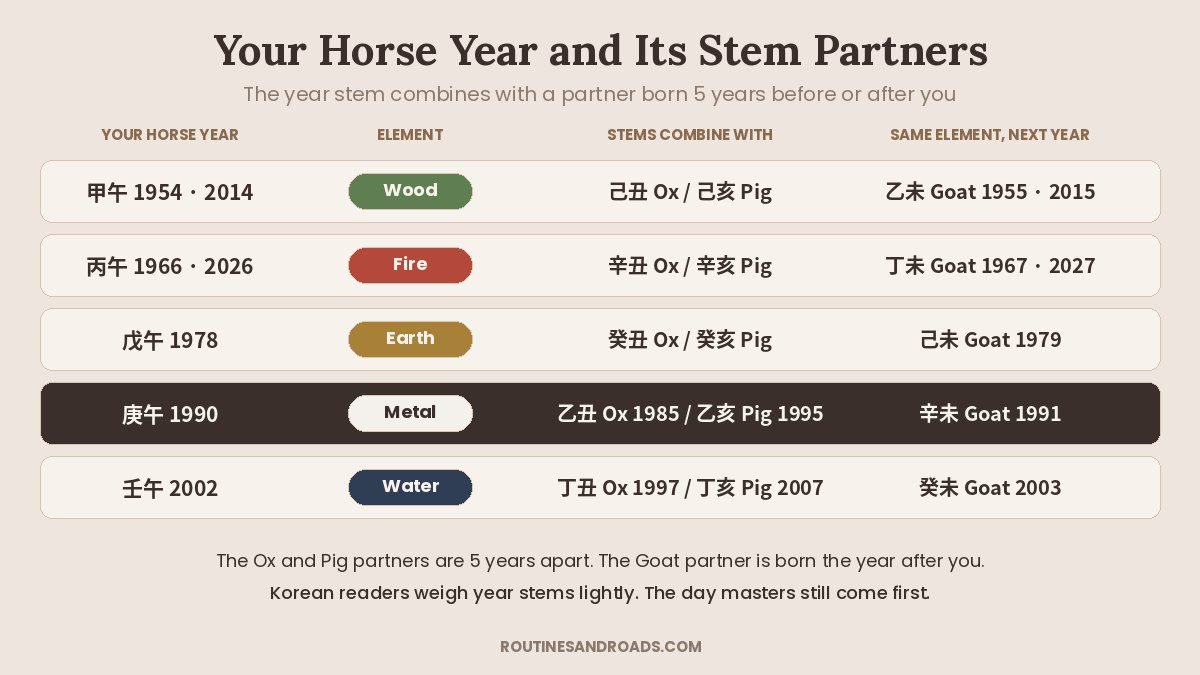
Notice the pattern: the year stem partner is always five years away, so it's always an Ox or a Pig. That's the Korean layering again. A 1985 Ox and a 1990 Horse are a wonjin pair on the animals and a combination on the year stems. A 1995 Pig and a 1990 Horse have a hidden link on the animals and a combination on the year stems on top of it.
The other year to know is the one right after yours. The Goat born the year after a Horse always shares the Horse's element, because the stems come in yang and yin pairs: 1990 is yang metal and 1991 is yin metal. Add the Horse and Goat combination, and the year after you is the closest year pillar match a Horse has. As a 1990 white horse, that makes 1991 metal goats my neighbors in more ways than one, and my 1991 zodiac post covers them.
Good to know: Korean readers weigh the year stem lightly, much less than the day masters. Treat this layer as a bonus, not a verdict.
Horse Compatibility by Age Gap: The Korean Four-Year Rule
There's a Korean saying almost every couple hears sooner or later: ne sal chai-neun gunghap-do an bonda (네 살 차이는 궁합도 안 본다), a four-year age gap doesn't even need a compatibility check. It comes straight from the triangles. Four years apart always lands two people in the same samhap triangle, for every sign, not just the Horse. For a Horse, a partner four years older is a Tiger and a partner four years younger is a Dog.
The same math works for every gap, so here's the whole thing for a Horse. Count in saju years, Ipchun to Ipchun, not calendar years:
| Years apart | Partner is older | Partner is younger |
|---|---|---|
| 0 (donggap) | Horse 午, same sign | Horse 午, same sign |
| 1 | Snake 巳, summer group | Goat 未, yukhap |
| 2 | Dragon 辰, open ground | Monkey 申, open ground |
| 3 | Rabbit 卯, light break | Rooster 酉, open ground |
| 4 | Tiger 寅, fire triangle | Dog 戌, fire triangle |
| 5 | Ox 丑, wonjin | Pig 亥, hidden link |
| 6 | Rat 子, clash | Rat 子, clash |
| 12 (ddi-dong-gap) | Horse 午, same sign | Horse 午, same sign |
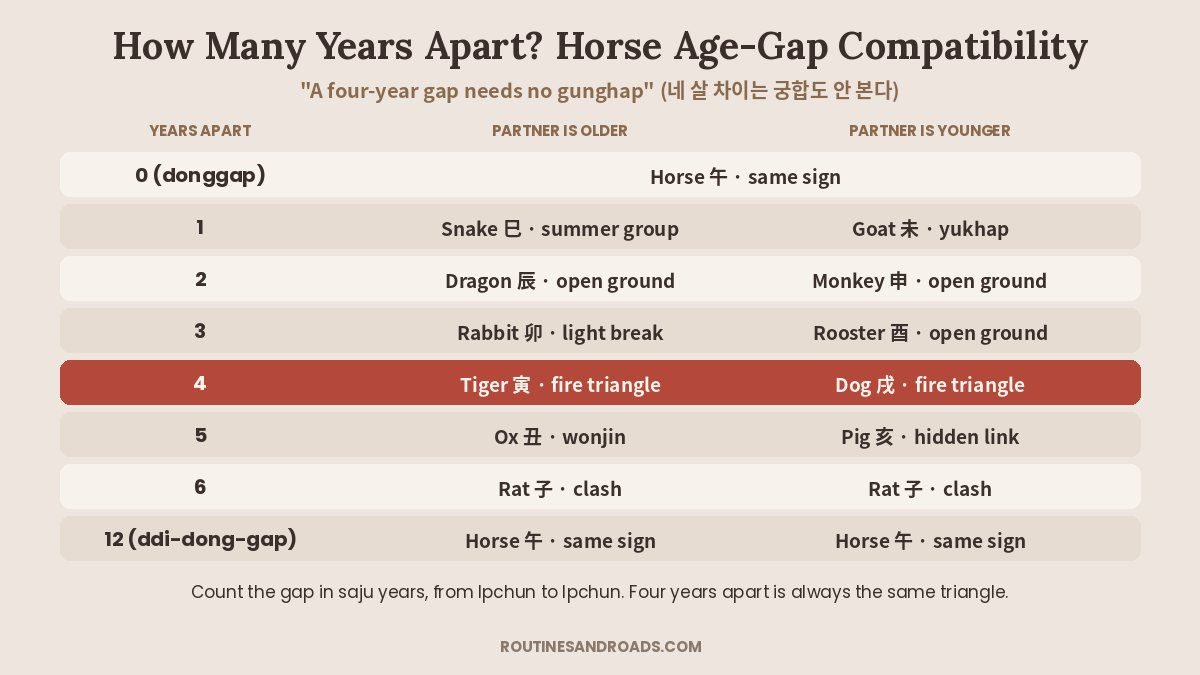
Two more patterns fall out of this. Six years apart is always the clash, for every sign, since six steps is straight across the wheel. And eight years apart is the triangle again, from the other side. For a Horse, that's a Dog eight years older or a Tiger eight years younger.
Good to know: the saying is folk wisdom built on the animals only. It's a fun shortcut, and the day masters still get the final word.
Is 2026 a Good Year for the Horse?
2026 is Byeong-o (병오), the red horse year, so it's the Horse's own year. Koreans call the year of your own animal bonmyeongnyeon (본명년), and the traditional advice is to treat it as a year of change: good for starting things, and worth moving a little more carefully than usual. Every year, I sit down at the start and the end of the year and read my own chart against the new year. That habit is how I got into saju in the first place.
2027 is Jeong-mi (정미), a Goat year, and the Goat is the Horse's yukhap partner. In Korean readings, a year that combines with your animal is usually described as a smoother, more connected one. It's also, fittingly, the same two characters as my day pillar, so I'm curious to see how my own year-start reading looks next time.
What 2026 and 2027 mean for Horse couples
A new year meets your partner's sign the same way it meets yours. In 2026, the Horse year is a fire triangle year for Tiger and Dog partners, a combination year for Goat partners and a same-season year for Snakes. It's the clash year for Rat partners, the wonjin year for Ox partners and a light break year for Rabbits. Pigs, Rabbits and Goats are also in the middle of their samjae.
In 2027, the Goat year, the Ox gets the clash and the Rat gets wonjin, while Pigs and Rabbits join the Goat's wood triangle, and Pigs, Rabbits and Goats finish their samjae.
The Horse's next samjae: 2028 to 2030
Samjae (삼재) is the three-year stretch Koreans treat as a time to move carefully, and it comes around every 12 years by triangle. The Horse's next one runs 2028, the Monkey year when it comes in, 2029, the Rooster year in the middle, and 2030, the Dog year when it leaves. Because samjae goes by triangle, Tigers and Dogs have the exact same years, so a Horse with a Tiger or a Dog goes through it together. And 2030, the leaving year, is also a fire triangle year. How seriously people take samjae varies a lot, and my post on what saju is has the full table for every sign.

How to Read Horse Compatibility the Korean Way, in 3 Steps
- 1. Check both animals by Ipchun. January and early February birthdays belong to the year before. This one step fixes more wrong answers than anything else.
- 2. Look up the Korean link. Samhap and yukhap are the classic good signs, chung and wonjin are the ones to talk through, and no classic tie means open ground. Glance at the element layer and the age gap while you're there.
- 3. Compare the day masters, then the day branches. This is where a Korean reading really starts. A combination, a shared element or one element feeding the other tells you more than the animals do, and the day branches show how you live together.
I've done all three ways of getting a reading: a philosophy house, apps and my own charts. If you just want to start somewhere tonight, put both birthdays in the checker above and read the day master part out loud together. That conversation is the real point of gunghap.
Frequently Asked Questions
If you take one thing from this post, check your animal by Ipchun before you check any match, and then look at the day masters and the day branches. The animal chart is a fun place to start, and the four-year rule is a fun shortcut. The day pillar is where a Korean reading actually begins, and for my husband and me, it was the part that explained everything.
My Chinese zodiac compatibility calculator is up now too, and it works for all 12 signs, not just the Horse. If you ran the checker above, tell me in the comments what came up for the two of you. And if you're a 1990 baby, start with my 1990 Chinese zodiac guide, the white horse year explained by a Korean who was born in it.