The Blue Road Parents Guide: How Violent Is Netflix’s New K-Drama? My 9/10 Review (No Spoilers)
I finished all eight episodes of The Blue Road within two days of Netflix dropping it, and it’s a 9 out of 10 from me. Think of this as The Blue Road parents guide I wish I’d had before pressing play: how violent it gets, how scary it really is, the age I’d pick for a teenager, and how long the whole series takes to binge.
I’m Korean, so I also picked up a few things that don’t come through in the English subtitles, like why the year 2002 matters so much and what the Korean title actually means. Those have their own section further down.
Here’s the short version. It’s a dark crime thriller, not horror, and the crime scenes are the part parents will want to hear about. Quick note: this review is spoiler free. I don’t give away who the killer is or how the series ends.

| Release date | November 20, 2026 (all 8 episodes at once) |
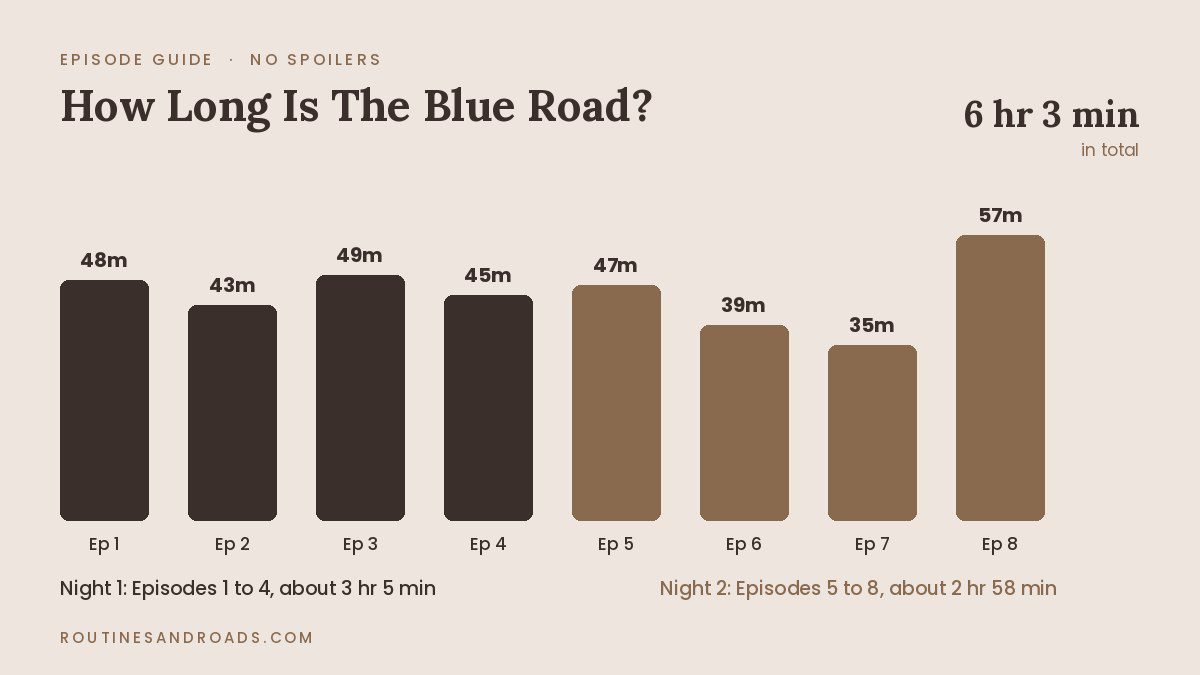
| Episodes and runtime | 8 episodes, 35 to 57 minutes each (6 hours 3 minutes total) |
| Rating | TV-MA in the US, 19+ (youth-restricted) in Korea |
| Genre | Korea-Japan crime thriller with buddy-cop humor |
| Language | Korean and Japanese, with English subtitles on Netflix |
| Setting | Tokyo and Seoul in 2002, during the World Cup |
| Scare level | 2 / 5 (creepy crime scenes, not horror) |
| Violence | Strong: twisted bodies at crime scenes, torture and gang fights |
| Based on | The 2002 Korean-Japanese comic Blue Road |
| Where to watch | Netflix only (it’s a Netflix original) |
| My verdict | 9 / 10, a twisty two-night binge |
| Best for / Good to know | Best for crime thriller fans and anyone who loved D.P. Good to know: the crime scenes are disturbing and there are anti-Korean slurs, so I’d save it for 17 and up |
What The Blue Road Is About (No Spoilers)
The Blue Road is an eight-episode Netflix crime thriller made by Korea and Japan together. It’s directed by Han Jun-hee, the same director behind D.P., and it’s based on a Korean-Japanese comic that first came out in 2002.
The story is set in the summer of 2002, while Korea and Japan are co-hosting the World Cup. A woman is murdered in Tokyo, her body is twisted into an unnatural shape, and the killer leaves a strange message behind. Tokyo detective Hiroshi Inose, played by Eita Nagayama, catches the case, and that’s how he crosses paths with Kim Seok, a detective from the Seoul police played by Son Suk-ku.
At first the two don’t trust each other at all. Then similar murders start turning up in both countries, and they have to work together whether they like it or not. Later the case pulls them as far as Hong Kong. That’s as far as I’ll go.

The two detectives are total opposites, and that’s half the fun. Kim Seok is cool, buttoned-up and always calculating. Inose is hotheaded, breaks the rules and says whatever he’s thinking. Each of them speaks the other’s language only partway, so a lot of their conversations bounce between Korean and Japanese in the same scene.
Meet the Cast of The Blue Road (and Where You’ve Seen Them)
Son Suk-ku as Kim Seok. If you watched D.P. on Netflix, he played Captain Im, the officer in charge of the unit that chases down deserters. He was also in My Liberation Notes and A Killer Paradox. Here he plays a detective from the Seoul police’s mobile investigation unit who keeps almost everything to himself.
Eita Nagayama as Hiroshi Inose. He’s a big name in Japan. You may know him from Monster, the 2023 Kore-eda film, or from Memories of Matsuko. The Blue Road is his first Korean project, and the reporting I read before watching was full of stories about how well he and Son Suk-ku got along.
Kim Shin-rock as Lee Yun-ok. If you watched Hellbound on Netflix, she’ll look familiar. In The Blue Road she plays a Korean-Japanese fixer who helps connect the two sides of the case.
Han Jun-hee, director and co-writer. He made D.P., Coin Locker Girl and Hit-and-Run Squad, and he wrote The Blue Road together with Cho Yu-jin.
Three more names round out the main cast, and you’ve probably seen at least one of them before.
Jung Jae-young. He’s one of those Korean actors who seems to be in everything, from the war movie Silmido to Hong Sang-soo’s Right Now, Wrong Then. History fans might know him from Noryang: Deadly Sea, the 2023 epic about the last sea battle of the Imjin War, which turns out to be a fun connection once you see where The Blue Road goes. Here he plays a powerful pachinko boss in Japan, and that’s all I’ll say.
Choi Sung-eun. Netflix fans may know her from The Sound of Magic or the movie My Name Is Loh Kiwan, and K-drama fans will remember her from Beyond Evil. In The Blue Road she plays a government agent who gets pulled into the case.
Kentaro Sakaguchi. He’s a big star in Japan, and a lot of Korean viewers fell for him in What Comes After Love, the 2024 series he made with Lee Se-young. I’m keeping his role vague on purpose, because it’s tied to one of the show’s big reveals.

The Blue Road Parents Guide by Episode: Runtimes and Intensity
All eight episodes dropped at once on November 20, 2026. Here’s how long each one runs on Netflix and what’s in it content-wise, with no plot spoilers. I double-checked my memory against episode recaps so this is as accurate as I can make it.
| Episode | Intensity | What to expect (no spoilers) |
|---|---|---|
| 1 (48 min) | Heavy | Opens with a woman being tortured to death, which you mostly hear rather than see. Then her twisted body at the crime scene, a chase, a fight and people getting high on a rooftop. |
| 2 (43 min) | Medium | A young woman is kidnapped and held captive, and her escape attempt is very tense. Older murders are talked about but not shown. |
| 3 (49 min) | Lighter | Mostly investigation. A survivor’s account and another body turning up, but nothing as graphic as episode 1. |
| 4 (45 min) | Heavy | A kidnapping, a fight and the most disturbing set piece of the first half, a death at a live performance. |
| 5 (47 min) | Heavy | Someone is abducted, drugged and held captive, and old case photos show twisted bodies. |
| 6 (39 min) | Medium | More gangster and drug-trafficking story, with grim talk about old interrogation sites. More talk than action. |
| 7 (35 min) | Heavy | The second torture scene, shown on screen this time, plus an assault and a violent death. |
| 8 (57 min) | Heavy | Gunfire, people getting shot and blood in the final showdown. Some past killings are described rather than shown. |
That adds up to 6 hours and 3 minutes. Here’s how it splits up if you’d rather not watch it all in one sitting:
| Binge plan | Episodes | Watch time |
|---|---|---|
| Two nights: night 1 | 1 to 4 | About 3 hr 5 min |
| Two nights: night 2 | 5 to 8 | About 2 hr 58 min |
| Three nights: night 1 | 1 to 3 | About 2 hr 20 min |
| Three nights: night 2 | 4 to 6 | About 2 hr 11 min |
| Three nights: night 3 | 7 and 8 | About 1 hr 32 min |
The two-night split is almost exactly even. If you’re watching with a teen and want shorter nights, the three-night plan works well too. Just know the last night is the shortest but also the most intense, since episodes 7 and 8 are both on the heavy side. Episode 8 is the longest, so I’d give the finale a little extra time.
Is The Blue Road Worth Watching? Why I Gave It a 9 out of 10
The chase kept me pressing next. The case keeps moving between Tokyo and Seoul and later Hong Kong, and every time I thought I knew where it was going, it turned somewhere new. That’s exactly why I finished all eight episodes so fast.
The two detectives are a great pair. Kim Seok and Inose start out bickering and testing each other, and watching them slowly learn to trust each other was my favorite part of the whole series. Son Suk-ku and Eita Nagayama are both so good at saying a lot with very few words.
It’s creepy one minute and funny the next. Right after a disturbing crime scene, the two of them will start arguing like a couple of kids, and somehow it works. Those little laughs give you room to breathe in a story this dark.
The history and the 2002 setting give it weight. The whole story sits on top of the World Cup summer and the long, complicated history between Korea and Japan. It’s a serial killer story, but it’s also about how the past keeps catching up with people.
Good to know before you start: episodes 1 to 3 are the setup. They’re the same three episodes the Busan festival audience saw first, and they lay out the case and how the two detectives meet. If episode 1 feels heavy, give it through episode 3, which is also the lightest of the eight.
If You Loved D.P., Will You Like The Blue Road?
A lot of people are finding this show because of D.P., so here’s the quick version. Both come from director Han Jun-hee, and Son Suk-ku is in both, as Captain Im in D.P. and as Kim Seok here. Both shows take heavy subjects seriously but still leave room for dry, awkward humor between the characters.

The big differences are the story and the intensity. D.P. follows military police tracking down army deserters, while The Blue Road is a serial killer case that crosses two countries, and it’s darker and bloodier. If D.P. was about right for you, check the episode table above before you decide who in your house watches this one.
The Blue Road Parents Guide: Violence, Language and More
The Blue Road is rated TV-MA on Netflix in the US. In Korea it’s rated youth-restricted, which means 19 and up. Here’s what’s behind those ratings, with everything at a glance first.
| What parents ask about | How much is in it | Where it’s strongest |
|---|---|---|
| Violence | Strong. Twisted bodies at crime scenes, two torture scenes, kidnappings and gang fights | Episodes 1, 4, 5, 7 and 8 |
| Language and slurs | Rough at times, plus anti-Korean slurs aimed at Kim Seok in Japan | Scattered through the series |
| Sex and nudity | None that I remember, and none in the reviews and recaps I checked | None |
| Drugs, drinking and smoking | Victims drugged with Speed K, drug trafficking, some drinking and smoking | Episode 1 rooftop scene and the gangster storyline |
| Scary moments | 2 out of 5 for me. Creepy crime scenes and sounds, nothing supernatural | Opening of episode 1, then episodes 4 and 7 |
| Animals | No animal scene stuck with me, and no animal gets hurt in the recaps I checked | None |
The Blue Road Age Rating Around the World
Here’s how the ratings line up so far, based on IMDb’s certification list.
| Country | Rating | What it means |
|---|---|---|
| United States | TV-MA | For mature audiences |
| South Korea | 19 | Youth-restricted, adults only |
| Singapore | M18 | 18 and up |
When I checked on November 21, 2026, IMDb’s parents guide for the show didn’t have any details filled in yet, so everything below comes from my own viewing, checked against reviews and episode recaps.
One practical tip: Netflix’s own help page groups TV-MA under “Recommended for Adults,” while TV-14 and PG-13 are “Recommended for Teens.” So if your teen’s profile maturity rating is set at TV-14 or lower, The Blue Road won’t show up on that profile unless you change the setting.
Violence
This is the big one. The killer leaves bodies twisted into unnatural shapes, and the camera does show the crime scenes. A lot of the creepiness comes from the sound, too, with cracking noises that are honestly harder to sit through than the pictures. Episode 1 opens with a woman being tortured to death in an abandoned building in Tokyo, so the series lets you know what it is right away. There’s another torture scene later in the series, plus kidnappings, chases and fights with gangsters.
If you’re watching with a teen, the heaviest episodes are 1, 4, 5, 7 and 8. The episode guide table above shows what’s in each one, so you can plan where to pause.
Language and Slurs
The dialogue gets rough at times. Kim Seok also hears anti-Korean slurs from people in Japan, which is part of the story the show is telling about the two countries. If you’re watching with an older teen, those scenes could open up a real conversation.
If your teen asks why people in the show talk to Kim Seok that way, the short answer is history. Japan ruled Korea from 1910 to 1945, and that past still shapes how a lot of people in both countries see each other. I put more of that background in the history section further down, and it’s an easy way into the conversation.
Does The Blue Road Have Sex Scenes or Nudity?
I don’t remember any sex scenes or nudity in all eight episodes, and the reviews and episode recaps I checked don’t mention any either.
If you’re coming from my Black Doves season 2 parents guide, that series does have sex scenes with some nudity. The Blue Road is a different kind of TV-MA. The mature parts here are the crime scenes, the violence, the drugs and the language. The bond between the two detectives is a friendship, not a romance, so there’s nothing to fast-forward through on that front.
Drinking, Smoking and Drugs
There’s some drinking and smoking, which fits the 2002 setting. Drugs are part of the case, too. Victims are drugged with a street drug the show calls Speed K, drug trafficking runs through the gangster storyline, and episode 1 shows a group of people getting high on a rooftop.
My Call: 17 and Up
I’d say 17 and up, which lines up with the TV-MA rating. A 17-year-old who already likes crime shows will probably be fine, but the crime scenes are disturbing, so I’d wait on it for younger teens. Korea’s rating is even stricter at 19 and up.
Is The Blue Road OK for a 15 or 16 Year Old?
This is the question I’d be asking as a parent, so here’s how I’d think it through. My line is 17, but every teen is different, and you know yours best.
If your 15 or 16 year old already watches TV-MA crime shows and handles them fine, here’s how I’d test the waters:
| Step | What to do | Why |
|---|---|---|
| 1 | Watch the first few minutes of episode 1 together | It’s one of the hardest parts of the whole series, so it’s a good test |
| 2 | Keep an eye on episodes 4 and 7 | They’re the heaviest stretches after the opening |
| 3 | Use episode 3 as a breather | It’s the lightest of the eight |
| 4 | Talk it through afterward | The anti-Korean slurs, the drugs and the way the show uses real history |
None of that needs a long lecture, but a teen who understands the history will get a lot more out of the story.
Is The Blue Road Scary?
Not in a horror way. There are no ghosts and nothing supernatural, and it never followed me home after I turned the TV off. I’d put it at 2 out of 5 on my scare scale: a few moments made me jump, and the crime scenes are creepy, but it’s a crime thriller, not a horror show.
| Scare check | The Blue Road |
|---|---|
| Ghosts or anything supernatural | None |
| Jump scares | A few moments made me jump, but it isn’t built on them |
| Creepiest part | The cracking sounds at the crime scenes |
| Hardest stretch to watch | The first few minutes of episode 1 |
| Other tense stretches | Episodes 4 and 7 |
| My scare level | 2 out of 5 |
If you’re like me and love a tense thriller but stay far away from horror, this one is fine. Just know that the first few minutes of episode 1 are some of the hardest to watch, and the buddy-cop jokes do a lot to lighten things up after that. Episodes 4 and 7 have the other really tense stretches.
Are There Jump Scares in The Blue Road?
A few moments made me jump, but this isn’t a show built on jump scares. The tension comes from the case itself and from the sound. If loud, sharp sounds bother you, keep the volume a little lower during the opening of episode 1 and the crime scenes. The cracking noises were the part that got to me, much more than anything I saw.
The good news for thriller fans who skip horror is that nothing in it is supernatural. There’s always a person behind what’s happening, and the story is about catching them.
Dog Scene Guide
I always check this for my fellow dog people. No dog or animal scene stuck with me in all eight episodes, and the episode recaps I checked don’t describe any animal getting hurt. So there’s nothing to brace yourself for on that front.
If you’re planning a binge night with dogs at home, my lick mat recipes for dogs are what I lean on when I want my three settled for a while.
What the Subtitles Miss (A Korean Viewer’s Notes)
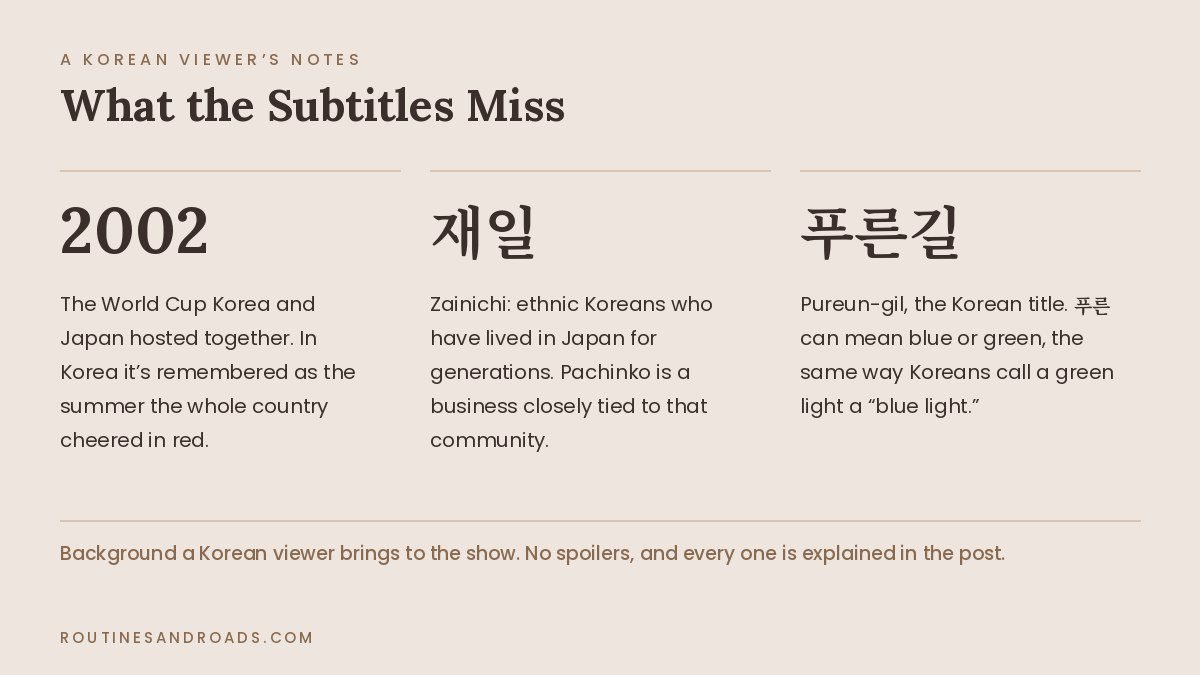
Netflix’s English subtitles do a good job with the words. But there are a few things a Korean viewer brings to this show that the subtitles can’t really carry. Here are the three I kept thinking about.
Why 2002 Matters So Much
In 2002, Korea and Japan hosted the World Cup together. It was the first World Cup in Asia and the first one ever shared by two countries. In Korea, that summer is remembered as the time the whole country poured into the streets in red shirts, cheering for the national team, which made it all the way to the semifinals.
So when the show puts a detective from Seoul and a detective from Tokyo side by side in the summer of 2002, a Korean viewer feels the friendly rivalry and the old tension between the two countries right away, before anyone says a word.
Zainichi Koreans and Pachinko
Zainichi is the word for ethnic Koreans who have lived in Japan for generations. Many of their families came during the years Japan ruled Korea, from 1910 to 1945, and they’ve faced discrimination in Japan for a long time. Pachinko, the noisy pinball-style gambling parlors you see all over Japan, is a business closely tied to that community. If you read the novel Pachinko or watched the show, you already know this background.
The Blue Road touches on both. When pachinko or the Zainichi community comes up, the subtitles translate the words, but not the weight a Korean viewer feels behind them.
Kim Shin-rock’s character Lee Yun-ok is part of that community, and it shows how seriously the team took it. At the Busan festival, director Han Jun-hee said Kim met with many Zainichi Koreans so she could get even the small details of their accent right. That’s one of those things English subtitles can’t show you, but Korean ears pick up on.

What the Korean Title Means
The Korean title is 푸른길, which is pronounced Pureun-gil. Gil means road or path. 푸른 is the tricky part, because in Korean it can mean blue or green. Koreans even call a green traffic light a “blue light.” The word shows up for clear skies, open seas and fresh young leaves, so to my ear the Korean title feels a little more open and hopeful than “The Blue Road” sounds in English.
Is The Blue Road Based on a Manga?
Yes. It’s based on Blue Road, a comic from 2002 that was a Korea-Japan collaboration from the start. It was written by Japanese writer Keishi Edogawa and drawn by Korean artist Kwon Kaya, and it was published in Korea that same year.
When Netflix Korea posted the trailer, the YouTube comments were full of Korean fans asking whether this was really Kwon Kaya’s Blue Road. So for a lot of Korean viewers, this is a story they’ve waited more than twenty years to see on screen. You don’t need to know the comic at all to follow the series. I’m reviewing it purely as a show.
Is The Blue Road Based on a True Story?
No. The serial killer case is fiction, and so are the two detectives. But the show is built on top of real history, and that’s a big reason I loved it. Two pieces of history come up again and again, and knowing them going in makes the story a lot easier to follow. Here’s the quick timeline.
| When | What happened | Where you’ll notice it (no spoilers) |
|---|---|---|
| 1592 to 1598 | The Imjin War: Japan invades Korea twice under Toyotomi Hideyoshi | The killer’s messages borrow imagery from this war |
| 1910 to 1945 | Japan rules Korea | The old Japanese-built houses in Gunsan, and the roots of the Zainichi community |
| 2002 | Korea and Japan co-host the World Cup | The whole story is set that summer |
The Imjin War (1592 to 1598)
Japan invaded Korea twice in the 1590s under the warlord Toyotomi Hideyoshi, and the war left deep scars. It’s the war Admiral Yi Sun-sin is famous for, and Korean kids learn about it in school from a young age. Without giving anything away, the killer’s messages lean on imagery from this war, so when it comes up early in the series, that’s what everyone is talking about.
Japan’s Rule Over Korea and the Old Japanese Houses
Japan ruled Korea from 1910 to 1945. Some Korean port towns still have houses built by Japanese residents during those years, and Koreans call them jeoksan gaok, which roughly means houses left behind by the enemy. Gunsan, the small port city on Korea’s west coast where part of the case plays out, is known for them. When the detectives walk into one of these houses, that setting says a lot without a single line of dialogue.
The 2002 World Cup and the Zainichi Korean community are the other two pieces of real life in the show, and I covered both in the subtitles section above.
Where Was The Blue Road Filmed?
Netflix announced the series was in production in September 2025, and filming wrapped in January 2026. At the Seoul press event, Son Suk-ku listed the places they shot: Tokyo and Nagoya in Japan, Gwangju, Gunsan and Busan in Korea, plus Hong Kong and Kazakhstan. He joked that his sightseeing memories outweigh his filming ones, and said what he remembers most about Kazakhstan is a huge sky full of stars.

That spread matches the story. The case starts in Tokyo, crosses over to Korea and later heads to Hong Kong, and I’ll let you find out for yourself where Kazakhstan fits in.
Even the leads saw a lot of both countries. Nagayama, who loves photography, spent his days off in Korea taking photos in Gwangju, Gunsan and Busan, and Son walked across Tokyo’s Rainbow Bridge with him while they were filming in Japan.
What Critics Are Saying About The Blue Road
Early reviews are strong. Here’s where the scores stood when I checked:
| Source | Score |
|---|---|
| But Why Tho | 9 / 10 |
| FlickOnClick | 4.5 / 5 |
| What’s on Netflix (first 3 episodes, seen at the Busan festival in October) | 4 / 5 |
| IMDb user rating, as shown on JustWatch | 8.2 / 10 |
But Why Tho landed on the same 9 out of 10 I did.
The things critics praise most are the chemistry between Son Suk-ku and Eita Nagayama, the way the show swings between grim and funny, and how it uses Korea-Japan history, which lines up with my favorite parts too. Scores checked November 21, 2026.
Fun Facts I Read Up On Before Watching
I always do a little homework before I press play. Here’s what I found for this one:
- It premiered in Busan. The first three episodes screened at the 31st Busan International Film Festival in October 2026, six weeks before the Netflix release.
- Each lead learned the other’s language. Son Suk-ku and Eita Nagayama both had to deliver lines in the other’s language, and they rehearsed with an interpreter. Son said he memorized some of his Japanese lines almost like music. They also practiced lines on walks in a park in Japan, and Son recorded his Korean lines so Nagayama could listen to them.
- The friendship is real. While filming in Japan, Son visited Nagayama’s home and ate at Nagayama’s favorite curry spot.
- The director wanted something different. Han Jun-hee has said he wanted to move away from the usual buddy-cop formula and pair two characters who could each carry their own story.
What to Watch Next If You Liked The Blue Road
If The Blue Road left you wanting more, here are four I’ve already reviewed that hit a similar spot:
- Under Siege on Netflix: another eight-episode series you can finish over a weekend. It’s a Colombian true story, and I gave it a 9 out of 10 too.
- Possible Love on Netflix: Lee Chang-dong’s new Korean film. I wrote it up as a Korean viewer as well, with notes on the details the subtitles can’t fully explain.
- Heartland on Netflix: a slow-burn mystery thriller with Jessica Chastain that I gave an 8.5 out of 10.
- Black Doves season 2 on Netflix: a moody London spy series with a lot of twists. My parents guide covers how it compares on violence and sex scenes.
Who Should Watch The Blue Road
- Crime thriller fans who like a serial killer case with a lot of twists.
- Anyone who loved D.P. and wants more from Han Jun-hee and Son Suk-ku.
- Buddy-cop fans, especially if you enjoy two partners who start out as rivals.
- Viewers curious about Korea and Japan, and the history between them.
- Grown-ups and older teens, 17 and up, who are fine with disturbing crime scenes.
In the mood for something lighter after all that? My Allen Netflix parents guide covers a sweet family sci-fi comedy from the team behind Bluey.
Watch The Blue Road Trailer
Here’s the official trailer from Netflix’s K-Content channel, with English subtitles. It sets up the two detectives without giving away the big moments.
Frequently Asked Questions
If you’re deciding whether to start it tonight, here’s my best tip: plan on two nights, episodes 1 to 4 and then 5 to 8, and know that the first few minutes of episode 1 are some of the hardest to watch. And if you’re watching with a teen, the crime scenes and the slurs are the two things to know about, so I’d save it for 17 and up.
Have you watched The Blue Road yet? Tell me in the comments whether you caught the 2002 World Cup details, or if there’s another K-drama you’d like me to review next. And if you want another series you can finish over a weekend, here’s my Under Siege parents guide.
About me: I’m Emily. My AMC A-List lets me see up to four movies a week, and on the nights I stay home, I’m on the couch with Netflix, Hulu or Disney+. I write each review right after I watch. Thrillers yes, horror never. See all my Movie & TV Nights reviews.
Got a dog at home too? Here’s how I dehydrate chicken for dog treats, and how I deshed my dogs at home. And every movie and show I’ve reviewed this year is in My 2026 Movie Log.