Is Everest: The Other Side Kid Friendly? I Saw It in IMAX on Opening Night (9/10, No Spoilers)
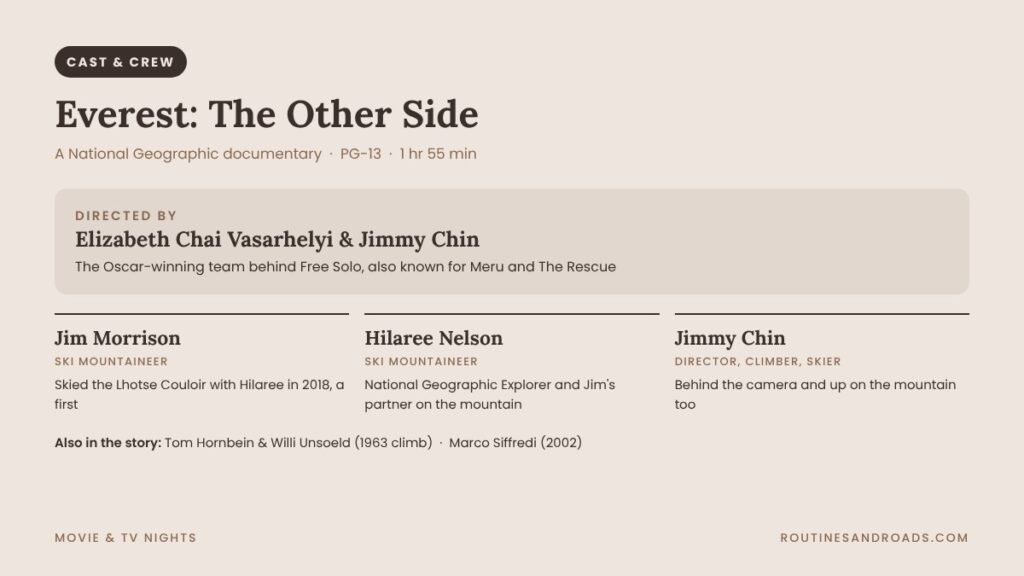
Is Everest The Other Side kid friendly? For teens 13 and up, yes, but it’s a heavy true story, so there are a few things I’d want to know before bringing someone younger. It isn’t scary in a jump-scare way at all. I saw it in IMAX on opening night, October 30, and I’ll walk you through exactly what’s in it below.
Everest: The Other Side is the new National Geographic documentary from Elizabeth Chai Vasarhelyi and Jimmy Chin, the same pair behind Free Solo. It follows ski mountaineers Jim Morrison and Hilaree Nelson and their dream of climbing the north face of Everest and skiing back down it. I went in with zero expectations and walked out giving it a 9 out of 10. It’s one of those movies that really earns the giant screen.
I’ll cover the scare level, the sad parts and when they hit, the dog (yes, there is one), whether IMAX is worth it, how long it really runs, the post-credits question, and how I used AMC’s closed caption device. No ending spoilers, I promise.

| Released | October 30, 2026, in theaters and IMAX |
|---|---|
| Runtime | 1 hr 55 min |
| Rating | PG-13 (thematic material, brief strong language) |
| Genre | Documentary, mountaineering and ski adventure |
| Directors | Elizabeth Chai Vasarhelyi and Jimmy Chin (Free Solo) |
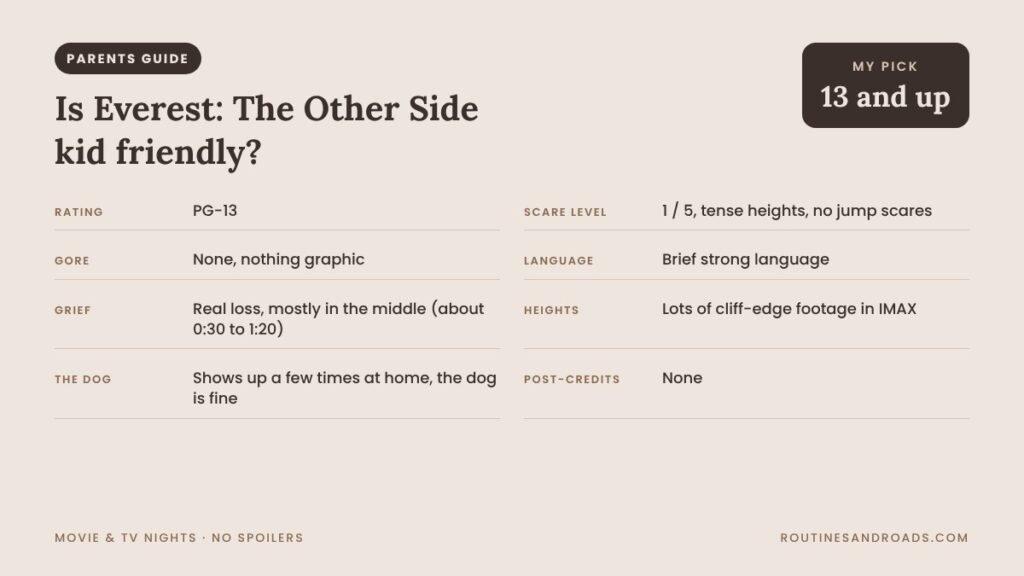
| Scare level | 1 / 5 (tense heights, no jump scares) |
| Animals | Jim and Hilaree’s dog, in a few at-home scenes, and the dog is fine |
| Age guide | 13 and up, in line with the PG-13 rating |
| Post-credits scene | No |
| Where to watch | In theaters and IMAX now (no streaming date yet) |
| My verdict | 9 / 10, worth the IMAX ticket |
| Best for / Good to know | Best for Free Solo fans, skiers, climbers and teens who love the outdoors. Good to know: it’s a true story with real loss, nothing graphic, and my showing started the movie about 20 minutes after the listed time. |
What Everest: The Other Side Is About (No Spoilers)
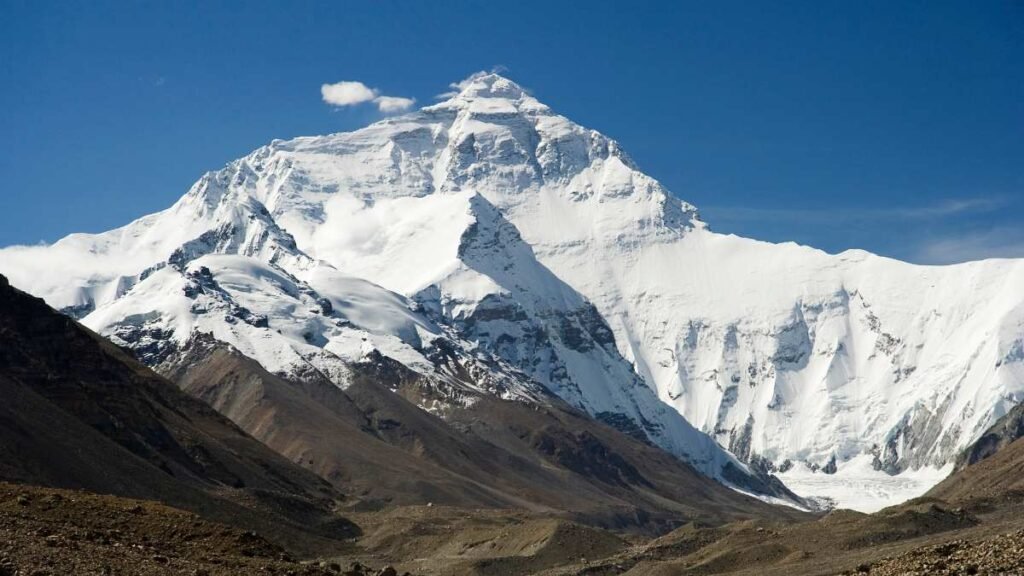
Jim Morrison and Hilaree Nelson are partners in life and in the mountains. Back in 2018, they became the first people to ski down the Lhotse Couloir, on the fourth highest mountain in the world, right next door to Everest. After that, there was really only one bigger line left for them: the north face of Everest, through a long, steep snow gully called the Hornbein Couloir.

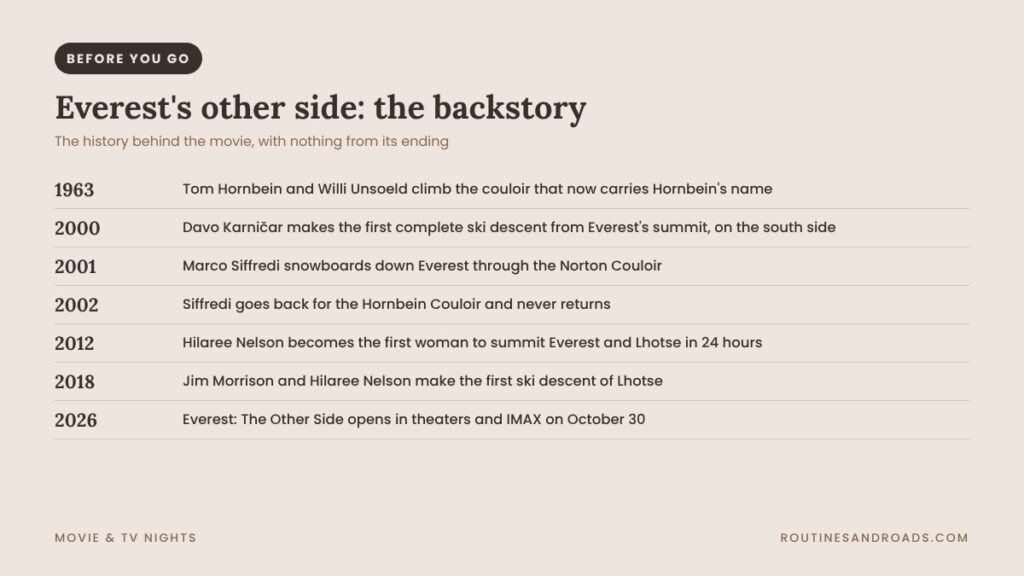
That couloir is named after Tom Hornbein, who climbed it with Willi Unsoeld in 1963. Nobody had ever skied it from the top. In 2002, a young French snowboarder named Marco Siffredi tried to ride it and never came back, and the film tells his story too, so you understand what’s at stake.
The movie follows Jim and Hilaree over several years and more than one expedition. A lot of the footage comes from helmet cameras and small cameras the climbers carried themselves, mixed with huge drone shots of the Himalaya. Jimmy Chin isn’t only behind the camera, either. He’s a climber and skier himself, and he’s right there on the mountain. Hilaree’s two sons show up too, which makes the home scenes feel very real.
What surprised me most is how honest it is. The film doesn’t just cheer for the climb. It asks real questions about risk, about the Sherpa guides who carry so much of the load, and even about whether the filmmakers should keep rolling when things get dangerous.
Is Everest The Other Side Kid Friendly? My Take by Age
It’s rated PG-13 for thematic material and brief strong language. Here’s what that looks like in the theater:
- Gore and violence: None. Nothing is shown in a graphic or gruesome way.
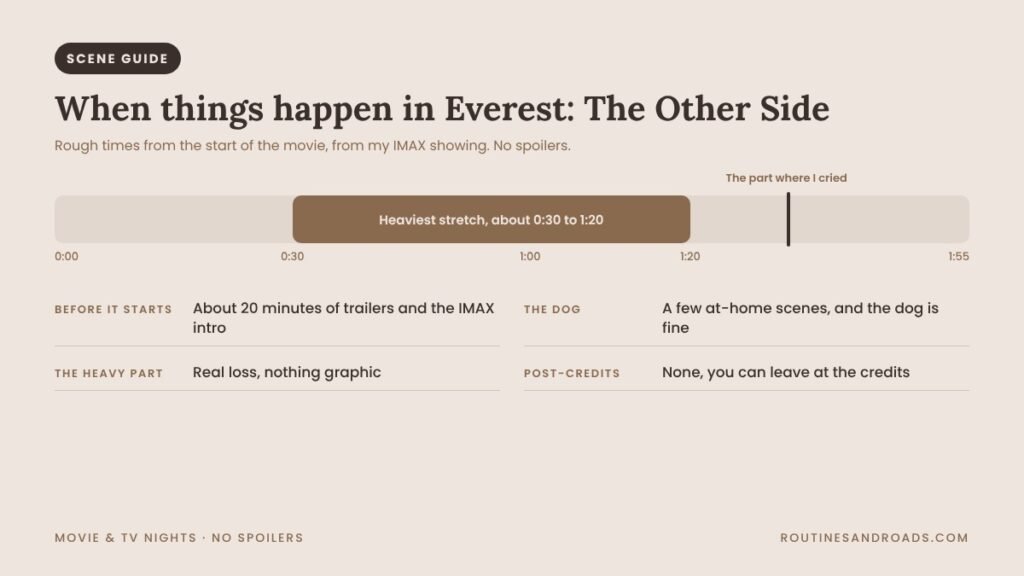
- Death and grief: This is the big one. It’s a true story, and the mountains take real lives in it. You feel the loss, and there are scenes high on Everest where climbers pass people who never made it back down. I won’t say who, but most of these heavy scenes fall in the middle of the movie, roughly 30 minutes to 1 hour 20 minutes in. None of it is bloody or scary to look at.
- Language: A few strong words in tense moments. It’s brief, like the rating says.
- Heights: A lot of edge-of-the-cliff footage on a screen that’s several stories tall. If your kid gets dizzy with heights, it’s intense.
- Mood: Emotional. The heavy parts are sad more than scary. I cried at one point, and those scenes stay with you after.
Here’s how I’d think about it by age:
- 13 and up: Go for it. It’s a great pick for a teen who loves skiing, climbing or hiking, and it gives you a lot to talk about on the drive home.
- 10 to 12: I’d watch the trailer together first. A kid who’s already into climbing might be ready, but the grief is real, so plan to sit next to them.
- Under 10: I’d wait for this one. Not because it’s scary, but because the talk about death is a lot for little ones.
Is Everest: The Other Side Scary?
I’d call it a 1 out of 5 on my scare scale. It’s a documentary, so there are no jump scares or creepy music cues. The tension comes from the mountain itself: thin air, ice, steep snow, and how one small mistake up there can go very wrong.
The film tells you early how dangerous this line is, and that feeling hangs over the whole movie. On an IMAX screen, the drops look enormous, and the ski footage is the most nail-biting part of the whole movie. If you’re someone who gets queasy on a glass bridge, sit a little farther back.
Is Everest: The Other Side Sad?
Yes, and I mean that in the best way. I cried in the theater.
The heaviest stretch is in the middle, roughly 30 minutes to 1 hour 20 minutes in, when real loss comes into the story. The moment that got me came later, in the second half. One of them misses the people they love so much that the tears just come, and then they pull themselves together and keep going. I cried right along with them.
Here’s my rough map of when things happen, so you know what’s coming without knowing what happens:
But it’s not the kind of sad movie that leaves you feeling low. I actually walked out lighter, and a little inspired. If grief is close to home for you right now, it’s still worth seeing. Just bring tissues and give yourself a quiet drive home.
Dog Scene Guide: Is There a Dog in Everest: The Other Side?
Yes! Jim and Hilaree’s dog shows up a few times throughout the movie, in the home scenes with the family between expeditions. Nothing bad happens to the dog in this movie. All the danger in this story is up on the mountain, and it’s about the people.
As a dog mom of three, I always notice the dogs in the at-home moments of a movie like this, and it was sweet to see the family dog in the middle of such a big adventure story. If you have an older dog at home too, this is the daily supplement routine I use for my senior dog.
Why I Gave Everest: The Other Side a 9 out of 10
Honestly, I’ve been feeling close to burnout lately, and this movie gave my tired heart a real boost. Watching people choose something this hard, again and again, just made me think how amazing humans can be.
And during the ski footage, I was nervous the whole time that someone would get hurt. I won’t tell you how it goes, but I walked out of that theater feeling lighter than when I walked in.
Here’s what made it a 9 for me:
- It was made for IMAX. The north face of Everest fills the whole screen. More on the IMAX experience below.
- The climbers filmed it themselves. The helmet camera footage puts you right on the ridge with them. You hear every breath.
- It’s a love story as much as a climbing story. Jim and Hilaree’s partnership is the heart of it, and the film gives their relationship real time.
- It’s honest. It shows the beauty and the cost of this sport side by side, and it trusts you to sit with both.
Who Are Jim Morrison and Hilaree Nelson?
If you go in knowing a little about these two, the movie hits even harder. I read up on both of them before my showing, and here’s the short version.
Hilaree Nelson grew up in Washington State, played basketball in high school, went to Colorado College, and then moved to Europe, where she learned big-mountain skiing. She joined The North Face athlete team in 1999 and went on more than 40 expeditions in 16 countries. In 2012, she became the first woman to summit Everest and Lhotse in a single 24-hour push. In 2018, she was named a National Geographic Adventurer of the Year and became captain of The North Face athlete team. She’s also a mom of two boys, and they’re part of this story too.

Jim Morrison is a ski mountaineer from Walnut Creek, California, who lives in Truckee, up near Lake Tahoe. Away from the mountains, he runs a commercial real estate business, and he’s a North Face athlete too.
Together, they made the first ski descent of Papsura in India in 2017, their first big expedition as a couple. Then in 2018, they skied about 7,000 feet down from the summit of Lhotse, the first ski descent of that mountain. That’s the history they carry with them onto the north face of Everest.
Who Made Everest: The Other Side?
Everest: The Other Side is directed by Elizabeth Chai Vasarhelyi and Jimmy Chin, longtime filmmaking partners. If their names sound familiar, here’s why:
- Free Solo (2018) followed Alex Honnold climbing El Capitan with no ropes and won the Oscar for Best Documentary Feature.
- Meru (2015) won the U.S. Documentary Audience Award at Sundance.
- The Rescue (2021) told the story of the Thai cave rescue.
- Nyad (2023) was their first scripted movie, with Annette Bening and Jodie Foster.

Jimmy Chin is a professional climber, skier and photographer whose work runs in National Geographic, and in 2006 he was part of the first American ski descent of Everest. That’s why the camera can go places most film crews never could. On this movie, he isn’t just directing from base camp. He’s up there on the mountain.
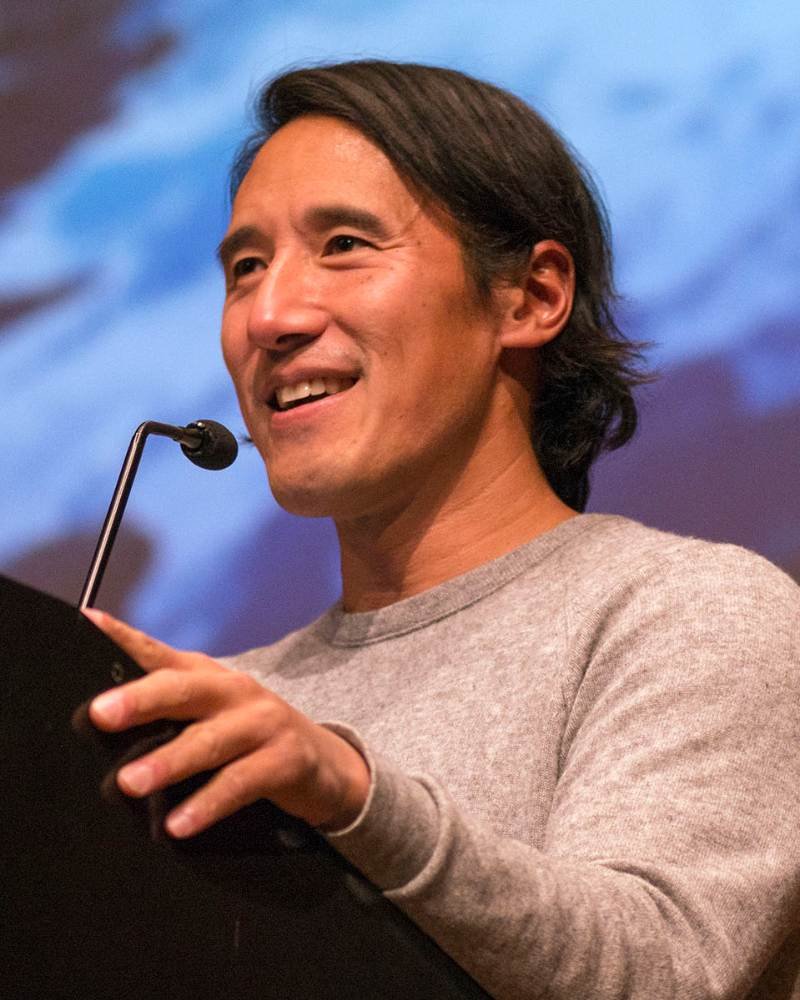
Chai Vasarhelyi is known for finding the human story inside the extreme stuff. In Free Solo it was Alex’s relationship, and here it’s Jim and Hilaree’s partnership and their family. That balance is why I could cry during this movie and still walk out feeling lifted.
Is Everest: The Other Side Worth Seeing in IMAX?

Yes. If you have the choice, this is the one to see in IMAX. Three things made it worth it for me:
- The ski scenes. On that huge screen, you’re right there with them on the steep snow, and it pulls you in completely.
- The scale of the mountain. You really get how massive the north face is, and how tiny a person looks on it.
- The sound. The wind and the climbers’ breathing fill the whole room. You can almost feel how thin the air is.
It’s the kind of documentary that feels small on a TV, so if there’s an IMAX showing near you, go for it.
How I Used AMC’s Closed Caption Device
I used AMC’s closed caption device for this one, and it made a big difference for a documentary. Movies like this are full of names, peaks, routes and interviews recorded outside in the wind. With captions, I didn’t miss a single name.
Here’s exactly how it worked for me:
- Ask for it before the movie. AMC’s assistive moviegoing page says to just ask any AMC crew member. I picked mine up in the lobby before I went in.
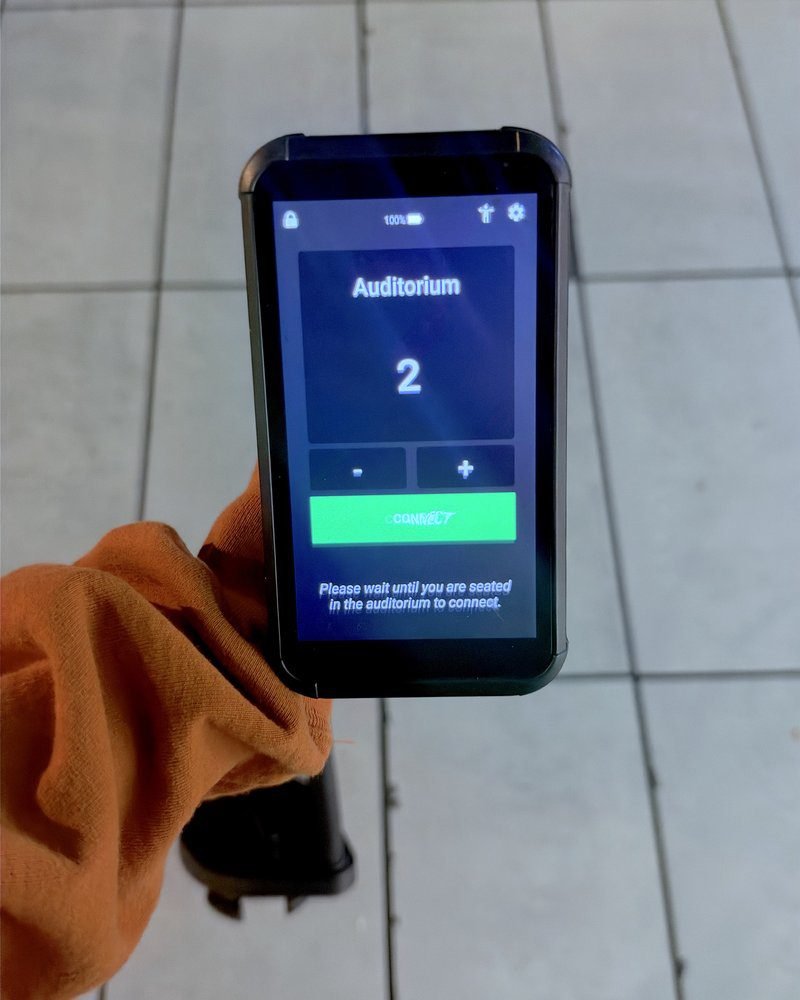
- Set your auditorium number. The screen asks for your auditorium, and you tap plus or minus to change it. Mine was Auditorium 2. It also tells you to wait until you’re in your seat to connect.
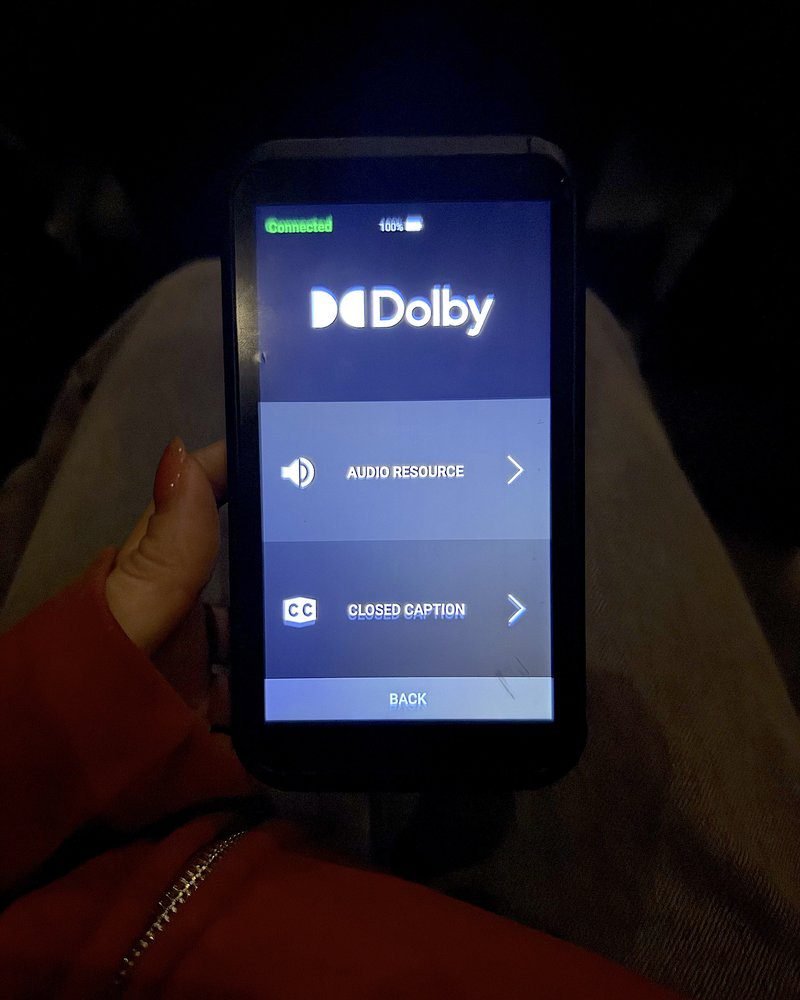
- Pick Closed Caption. Once it connects, you get a small Dolby menu with two choices, Audio Resource and Closed Caption. Tap Closed Caption.
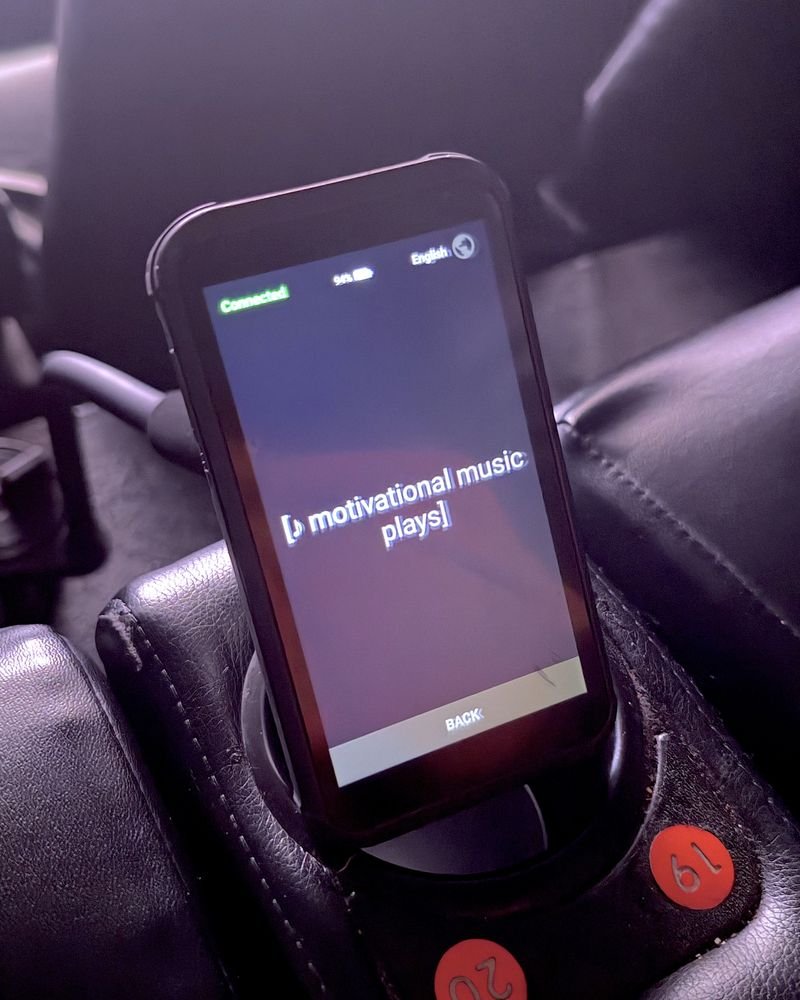
- Put it in your cupholder. The device sits on a bendy arm that fits right in the cupholder, so you can angle the little screen just under the big one. The captions even include sound cues, like when the music swells.
- Hand it back on your way out. Easy.
My tip: grab the caption device before the trailers start, so you’re all set up before the lights go down. Setting it up in the dark is a lot harder.
Is There a Post-Credits Scene in Everest: The Other Side?
No. I stayed all the way to the end of the credits, and there’s no extra scene. You can head out once the credits start. Or, if you’re like me, sit for a minute and let it all sink in.
How Long Is Everest: The Other Side?
The movie runs 1 hour 55 minutes. But plan for closer to 2 hours 20 minutes in the theater, because my 6:30 p.m. showing didn’t start the actual movie until around 6:52. That’s normal at AMC, and the app even warns you that the movie starts 25 to 30 minutes after the listed time.
I’d go to the restroom during the trailers, so you don’t miss any of the climbing.
Before You Go: 3 Things That Helped Me Follow It
I always read up on a movie before I see it, and for this one, it made a huge difference. These are the three things I’d know going in:
- The 2018 Lhotse descent. Lhotse is the fourth highest mountain in the world, right next door to Everest, and Jim and Hilaree skied about 7,000 feet down from its summit. That descent is the reason Everest is the next step for them, and the film assumes you get how big it was.
- The Hornbein Couloir and Marco Siffredi. The Hornbein Couloir is a long, narrow gully that cuts up Everest’s north face, on the Tibet side. Tom Hornbein and Willi Unsoeld climbed it in 1963 on the first traverse of Everest, going up one side of the mountain and down the other. Then in 2001, a young French snowboarder named Marco Siffredi rode down Everest through a different gully, the Norton Couloir. In 2002, he came back for the Hornbein Couloir and never returned. Knowing that someone was lost on this exact line makes every scene on the north face hit harder.
- A few mountain words. These come up again and again:
| Word | What it means |
|---|---|
| Couloir | A steep, narrow gully of snow or ice on a mountain |
| Summit | The very top |
| Base camp | The main camp at the bottom where expeditions start |
| Sherpa | The Himalayan people known for guiding and supporting climbs |
| Supplemental oxygen | Bottled oxygen climbers use at extreme altitude |
| Crevasse | A deep crack in a glacier |
And here’s the whole backstory in one place, with nothing from the movie’s ending:
Who Should See Everest: The Other Side
- Anyone who loves a challenge. If you’re the type who sets a big goal and goes after it, this one will speak to you.
- Sports fans. You don’t have to ski or climb to feel how hard and how athletic every move up there is.
- Anyone feeling burned out and stuck, like I was. Seeing that huge, wild landscape and people who set their hearts on one goal and keep running at it brought a little life back into me. It might do the same for you.
- Free Solo, Meru and The Rescue fans. Same filmmakers, same close-up style.
- Skiers, climbers and hikers. You’ll appreciate every single turn on that face.
- Anyone who loves true stories about partners chasing a big dream.
- Parents with teens 13 and up who love the outdoors.
In the mood for something lighter after this one? Wildwood is a sweet stop-motion pick with lots of animals. And if it makes you want to get outside at a much smaller scale, here’s what tent camping with dogs has really been like in my first year of camping.
Where to Watch Everest: The Other Side
Everest: The Other Side opened in theaters and IMAX on October 30, 2026. National Geographic documentaries usually move to Disney+ and Hulu after their theater run, but no streaming date had been announced when I wrote this. I’ll update this post as soon as it’s out. If you can, see it in IMAX first. This is the movie that format was made for.
Watch the Everest: The Other Side Trailer
Here’s the official trailer from National Geographic, so you can see the scale for yourself.
Frequently Asked Questions
If you’ve been feeling worn out lately, this might be the boost you didn’t know you needed. My advice: see it in IMAX, give it a 13 and up, and grab the closed caption device before the trailers start if you like catching every name. And don’t rush out for a post-credits scene, because there isn’t one.
Next up, I’ve got more opening-weekend reviews on the way. Have you seen Everest: The Other Side yet, or are you waiting for Disney+? Tell me in the comments. And if true stories are your thing, my review of the Matthew Perry documentary on Netflix is another one that stayed with me. For a heavier true story that just opened in theaters, my The Mosquito Bowl parents guide covers Peter Berg’s WWII football movie, which I gave an 8 out of 10.
About me: I’m Emily. My AMC A-List lets me see up to four movies a week, I almost always go solo, and I write each review the same night. Thrillers yes, horror never. I always read up on a movie before I go, and I share that homework here too. See all my Movie & TV Nights reviews.
Got a dog at home too? Here’s what it’s really like tent camping with dogs, and how our three handled it when we camped with no cell service. And every movie I’ve reviewed this year is in My 2026 Movie Log.