Karen Read Documentary Netflix Review: Is The Trials of Karen Read Worth Watching? (8/10, No Spoilers)
I didn’t know anything about Karen Read before I pressed play, so this Karen Read documentary Netflix review comes from a true newcomer. The Trials of Karen Read dropped on Netflix on November 23, 2026, and I watched all three episodes that same day. It’s a 2 hour 25 minute binge, and I’m giving it an 8 out of 10.
Here’s the short version: you don’t need to know anything about the case to follow it, and it’s not scary in a jump scare way at all. The bigger questions people are asking, like whether it’s biased, how much swearing there is, and whether the dog story everyone talks about comes up, take a little more explaining, so I put each one in its own section below.
I also added a case timeline with how both trials ended, plus a heads up before it so you can decide whether you want to know first. And if you’re a dog person like me, there’s a Dog Scene Guide with the background on Chloe, the German shepherd that kept coming up at both trials.
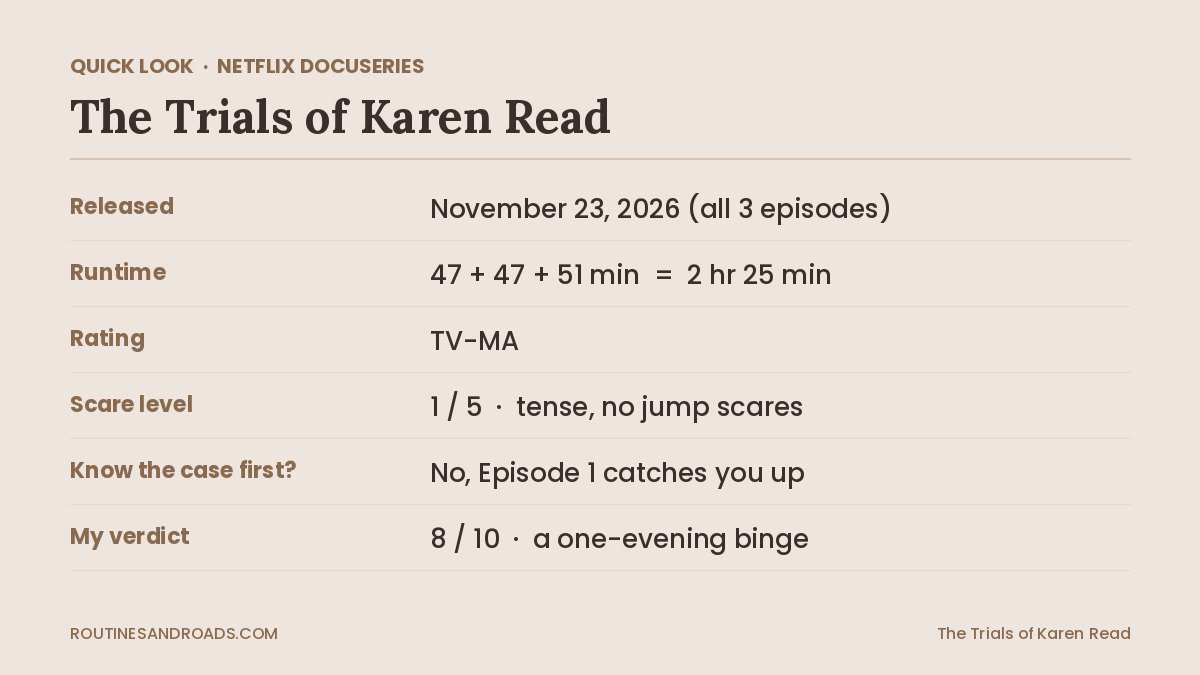
| Release date | November 23, 2026 (all 3 episodes at once) |
| Episodes and runtime | 3 episodes: 47, 47 and 51 minutes (2 hr 25 min total) |
| Rating | TV-MA |
| Genre | True crime documentary series |
| Director | Danielle Johnson Cutts |
| Scare level | 1 / 5 (tense, no jump scares) |
| Need to know the case first? | No. I didn’t, and Episode 1 catches you up |
| Dog talk | See my Dog Scene Guide below |
| Where to watch | Netflix only (it’s a Netflix original) |
| My verdict | 8 / 10, a perfect one-evening binge |
| Best for / Good to know | Best for true crime fans and total newcomers to the case. Good to know: Karen Read didn’t sit down for new interviews, so you hear her through audio from a 2023 interview |
What The Trials of Karen Read Is About (No Spoilers)
In January 2022, during a heavy snowstorm in Canton, Massachusetts, Boston police officer John O’Keefe was found unresponsive in the snow outside a home after a night out with friends. He was later pronounced dead at the hospital. His girlfriend, Karen Read, quickly became the main suspect, and prosecutors said she hit him with her SUV.
Then the story split in two. Online, a growing movement argued that Karen was being framed and that something else happened that night. That movement got loud enough to follow the case all the way into the courtroom, through two separate trials. The series walks through all of it: the investigation, the online theories, and what happened in court.
It comes from Sandpaper Films, the same company behind the Netflix true crime documentary Capturing the Killer Nurse, and it’s directed by Danielle Johnson Cutts. Netflix says the series looks at the case from the first investigation through the online debate and the courtroom battles that followed.

The Trials of Karen Read Episode Guide (No Spoilers)
There are only three episodes, and each one has a clear job. Here’s what to expect from each, without giving anything away.
| Episode | Title | Runtime | What it covers |
|---|---|---|---|
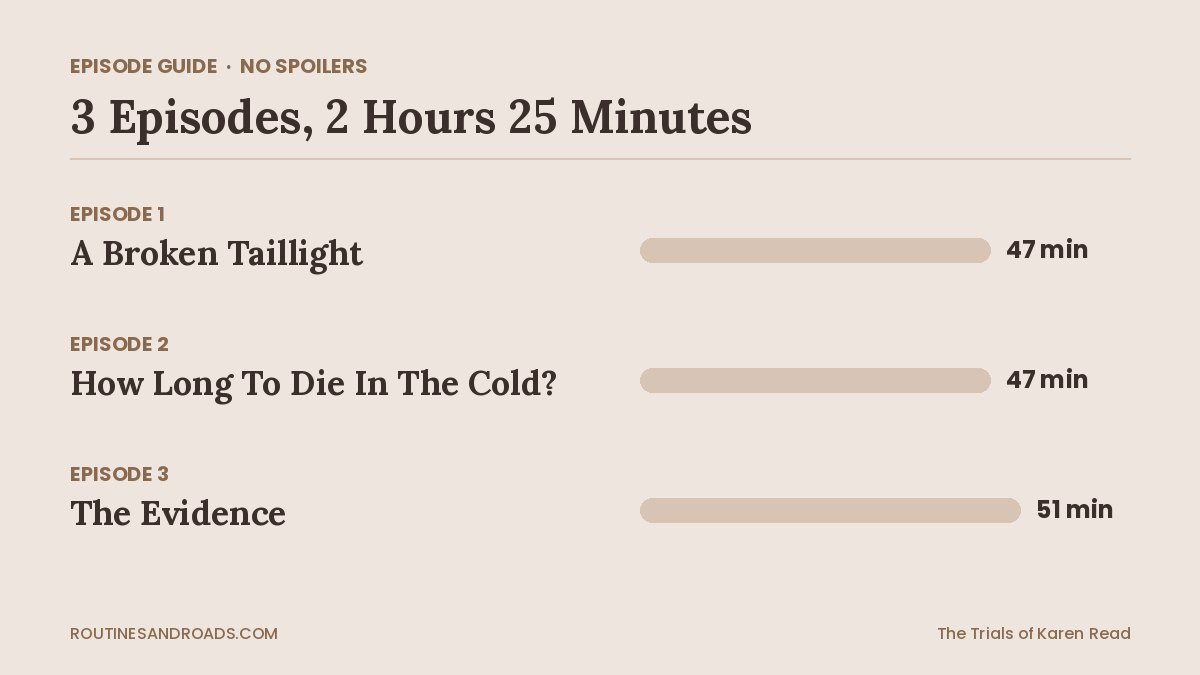
| 1 | A Broken Taillight | 47 min | The night John died, who he was, and why police focused on Karen |
| 2 | How Long To Die In The Cold? | 47 min | A blogger starts raising doubts, Karen gains supporters, and an internet search becomes a big deal |
| 3 | The Evidence | 51 min | The courtroom, the media frenzy, and the jury weighing the evidence |
If you want to split it over two nights, stopping after Episode 2 works well. Episode 3 is the longest and the most courtroom heavy, so it’s nice to start it fresh.
My Karen Read Documentary Netflix Review: 8 Out of 10
I gave this one an 8 because it did the thing I want most from a true crime series: it took a case I knew nothing about and made it easy to follow without dumbing it down. By the end of Episode 1, I understood who everyone was and why the case got so heated. Three parts in particular stuck with me.
The Google search breakdown in Episode 2
A lot of this case hangs on one internet search: someone in the house typed a question about how long it takes to die in the cold. The defense side said the timing of that search pointed to a cover-up. Episode 2 brings in digital expert Ian Whiffin, who explains how that timestamp can be read, step by step. It’s clear enough to follow even if numbers and phone data aren’t your thing, and it’s the part that stuck with me the most.
Hearing from the jurors in Episode 3
You almost never get to hear jurors explain how they thought about a case. Two jurors from the second trial sit down for interviews here, and that alone makes Episode 3 worth it. I won’t say what they talk about, because that’s the ending, but it’s what made Episode 3 stand out for me.
John’s family, and Karen’s own voice
John’s brother Paul and his niece Kayley talk about who John was outside of the headlines, and it reminds you that a real family lost someone here. Karen Read herself didn’t do a new interview, but the series uses audio from a 2023 interview she gave to Boston magazine, and some of that audio had never been released before. Hearing Karen in her own words was one of the moments that stuck with me most.
My tips before you press play
- Watch in order. Each episode builds on the one before it, and Episode 3 won’t land the same if you jump around.
- Keep the who’s who handy. There are several people named Albert, so the table below is there for exactly that, and you can pull it up on your phone while you watch.
- Hold off on Googling the case. The verdicts are public record, so a quick search mid-series can give away how it ends.
- Turn subtitles on if you like them. A lot of the story comes through phone audio, voicemails and courtroom recordings, which can be harder to catch than regular dialogue.
Do You Need to Know the Karen Read Case Before Watching?
Nope. I’m living proof. I went in completely cold, and Episode 1 lays out the night, the people and the charges clearly enough that I never felt lost. Coming in fresh also meant I didn’t have a side going in.
Below I’ve put a who’s who table, plus plain-English explanations of the taillight and the Google search, so you can keep up. My only tip: the timeline further down includes how both trials ended. If you want to watch the series without knowing, read it after you finish Episode 3.
Key People in the Karen Read Case (Who’s Who)
Half the battle with this series is keeping the names straight, because a lot of people share the last name Albert. Here’s the cheat sheet I wish I’d had open on my phone during Episode 1. The roles below are how Netflix and the trial coverage describe them, nothing more.
| Person | Who they are | In the series? |
|---|---|---|
| John O’Keefe | Boston police officer who died in January 2022 | Remembered by his family and friends |
| Karen Read | John’s girlfriend, charged with his death and tried twice | Archive audio from a 2023 interview only |
| Jen McCabe | A friend who was out with John and Karen that night | Interviewed |
| Brian Albert | A fellow Boston police officer; John was found outside his home | Interviewed |
| Chris Albert, Colin Albert, Brian Higgins | Among the people who were out that night or at the Albert home, as Netflix describes them | Interviewed |
| Michael Proctor | Former Massachusetts State Police trooper who led the investigation | Interviewed |
| Ian Whiffin | Digital forensics expert who testified about the phone data | Interviewed |
| Aidan Kearney (“Turtleboy”) | Blogger who built much of the online “Free Karen Read” movement | Did not take part |
| Paul and Kayley O’Keefe | John’s brother and niece | Interviewed |
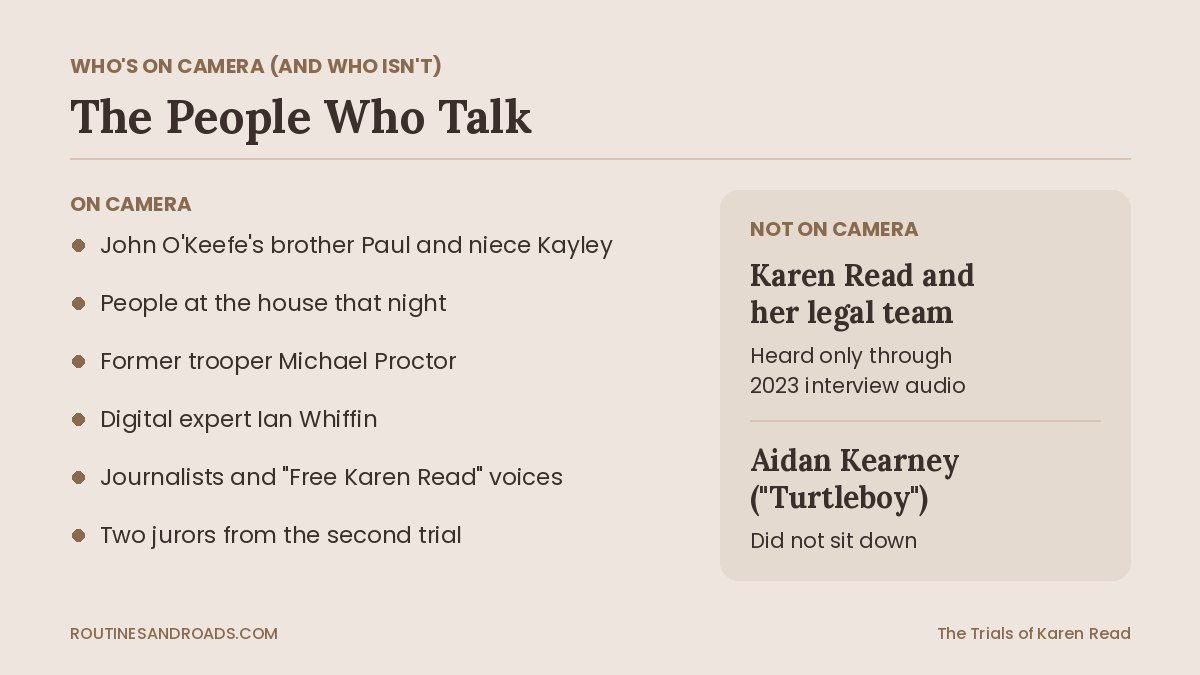
Karen Read and her legal team declined to take part, so you hear Karen only through audio from a 2023 interview she gave to Boston magazine. Some of that audio had never been released before. Netflix also brought in two jurors from the second trial, and they’re some of the most interesting people in the whole series.
What Was the Broken Taillight Evidence?
Episode 1 is literally named after it, so it helps to know why it mattered. Prosecutors pointed to pieces of a taillight found near where John was lying, and Karen’s SUV had a broken taillight. Some witnesses also said they heard Karen say “I hit him” at the scene that morning. Put together, that’s why police focused on her so quickly.
Karen’s supporters saw the same evidence completely differently, and that’s where the story starts to split. I won’t go further than that, because how the taillight question plays out in court is a big part of Episode 3. What I will say is that the series takes its time with the physical evidence, including testing of Karen’s SUV that RogerEbert.com mentions in its review, so you’re not just hearing opinions.
The Google Search Question, Explained Simply
This is the single most argued-about detail in the case, and Episode 2 is named after it. Here’s the plain version, without spoilers.
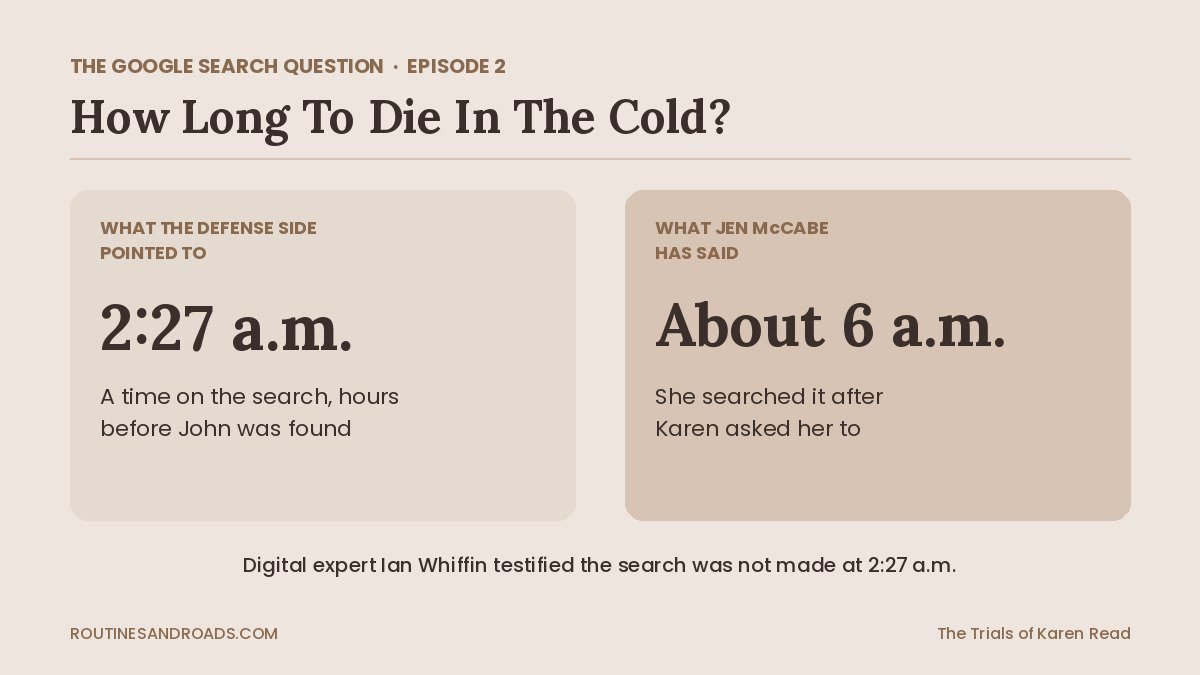
- The search: someone in the Albert home looked up how long it takes to die in the cold, typed with a typo, on the morning John was found.
- Why it became huge: Karen’s defense side pointed to a 2:27 a.m. time on that search. If someone searched it in the middle of the night, hours before John was found, it would suggest they knew he was outside.
- The other side: Jen McCabe has said she made the search around 6 a.m., after Karen asked her to look it up.
- The expert: digital expert Ian Whiffin testified that McCabe didn’t make the search at 2:27 a.m. In the series, he walks through how a browser’s timestamp can show when a tab was opened rather than when a search was typed.
As someone who had never heard any of this before, this was the clearest part of the whole series for me. You don’t have to be good with phones or data to follow it, and it’s a good example of how one detail can take on a life of its own online.
Who Is Turtleboy in the Karen Read Case?
If you watch Episode 2, you’ll hear this name a lot. Turtleboy is the online name of Aidan Kearney, a blogger who became one of the loudest voices saying Karen was framed. He’s the blogger the Episode 2 description refers to, and he helped turn the case into a national story with his videos and posts.
RogerEbert.com calls the part of the series about him and his followers its strongest material, because it shows how an online audience can shape what the public believes about a case. Kearney himself was charged with witness intimidation in connection with the case, and he didn’t sit down for this series. So, like Karen, he’s a big presence in the story without being on camera.
Is The Trials of Karen Read Biased?
Here’s the honest answer: it depends a lot on who agreed to be on camera. The people from the house, John’s family, the former lead investigator and the jurors all talk. Karen, her lawyers and Turtleboy don’t. So you get a lot of time with one side and archive audio from the other.
Critics read that differently. Decider’s Joel Keller felt the first episode leans toward seeing Karen as guilty, and connected that to who’s being interviewed, though he still recommended watching. Heaven of Horror felt the opposite: their reviewer said it lays out the facts and theories without pushing an opinion, and came away unsure what to believe. RogerEbert.com said the series mostly avoids feeling exploitative, and that its strongest material is about how the online true crime world can shape what the public believes.
Coming in with zero background, my tip is simple: keep in mind who said yes to being interviewed, and you’ll get a lot more out of it. The series gives you plenty to think about either way.
Why Did the Karen Read Case Get So Big?
I kept asking myself this in Episode 1, because on paper it starts like a lot of sad local news stories. By the end of the series, I understood. A few things came together at once:
- Police on both sides of the story. John was a Boston police officer, and he was found outside the home of another Boston police officer. That’s a big part of why so many people questioned the investigation.
- Evidence people read in opposite ways. The taillight, the injuries and the Google search all had two very different explanations, which is exactly what keeps true crime fans arguing.
- An online movement. “Free Karen Read” grew from blog posts and videos into crowds outside the courthouse.
- Two trials. The first ended in a mistrial, so the whole thing played out again a year later, with even more attention.
Netflix itself tags the series with “Social Media” and “Media Circus,” and that’s a pretty good summary. Part of what makes it watchable is that it’s as much about the crowd around the case as the case itself.
Karen Read Case Timeline (Read This After You Watch)
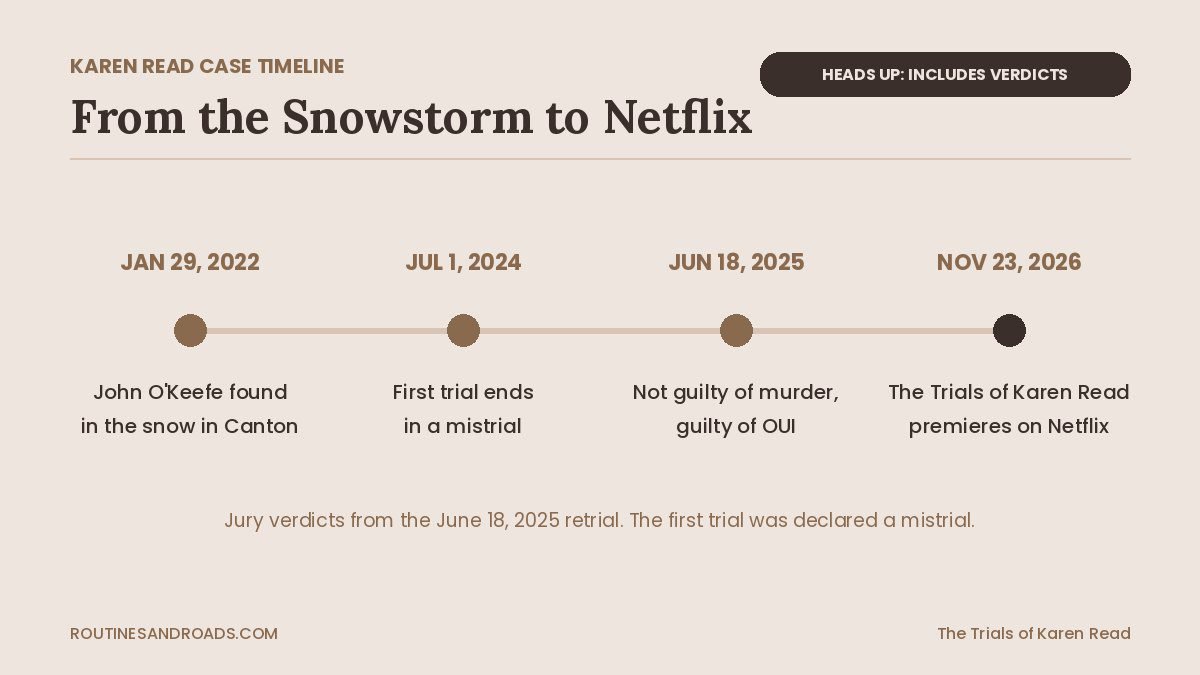
Heads up: this timeline includes how both trials ended. If you’d rather find out in the series, jump ahead to the next section.
| Date | What happened |
|---|---|
| January 28, 2022 | John O’Keefe and Karen Read go out with friends at a bar in Canton, Massachusetts |
| January 29, 2022 | John is found unresponsive in the snow outside a home in Canton and later pronounced dead at the hospital |
| After the investigation | Karen is charged with second-degree murder, manslaughter while operating under the influence, and leaving the scene of a collision resulting in death |
| July 1, 2024 | The first trial ends in a mistrial when the jury can’t reach a unanimous verdict |
| July 2024 | Netflix announces a documentary series about the case |
| April 2025 | The second trial begins |
| June 18, 2025 | The jury finds Karen not guilty of second-degree murder, manslaughter and leaving the scene, and guilty of operating a vehicle under the influence of alcohol |
| November 23, 2026 | The Trials of Karen Read premieres on Netflix |
Dog Scene Guide: What to Know About Chloe the German Shepherd
If you follow my reviews, you know I always check on the animals. Here’s my honest note for dog people: the three episodes are built around the taillight, the Google search and the evidence at trial, which is exactly what the episode titles say. I didn’t come away with a dog storyline to time out for you, so I’m not going to guess how many minutes Chloe gets.
But since Chloe comes up whenever people talk about this case, here’s the background from the trials themselves. Chloe is a German shepherd that belonged to the Albert family, the family whose home John was found outside. Karen’s defense pointed to marks on John’s arm and argued they could have come from a dog. Prosecutors called their own experts to say otherwise. At the 2024 trial, Chloe’s owner testified that the dog went to live on a farm in Vermont during the investigation.
For my fellow dog parents: our oldest girl is 14 now, and she rides in a stroller on longer outings these days. Here’s how I knew my senior dog needed a stroller, if you’re starting to wonder about your own.
The Trials of Karen Read Parents Guide: Why Is It Rated TV-MA?
Netflix rates the series TV-MA, which means it’s meant for adults. Netflix doesn’t list specific content reasons on the title page, so here’s what I’d want a parent to know.

Language
There’s some swearing. It’s not constant, but there’s enough that I noticed it.
Real footage and heavy topics
This is about a real man’s death, so the subject itself is the heavy part. The series uses real police body camera footage, and it talks about a night of drinking, angry voicemails, and the online harassment some of the people involved went through. It’s the kind of grown-up material that’s hard to explain to a younger kid.
Is The Trials of Karen Read scary?
I’d call it a 1 out of 5. It’s tense in the way a courtroom drama is tense, but there are no jump scares and nothing designed to frighten you.
My call: 17 and up
I’d follow the TV-MA rating and save it for 17 and up. For an older teen who’s into law, journalism or how social media works, it could be a good one to watch together and talk about after.
Other Karen Read Documentaries (and How This One Is Different)
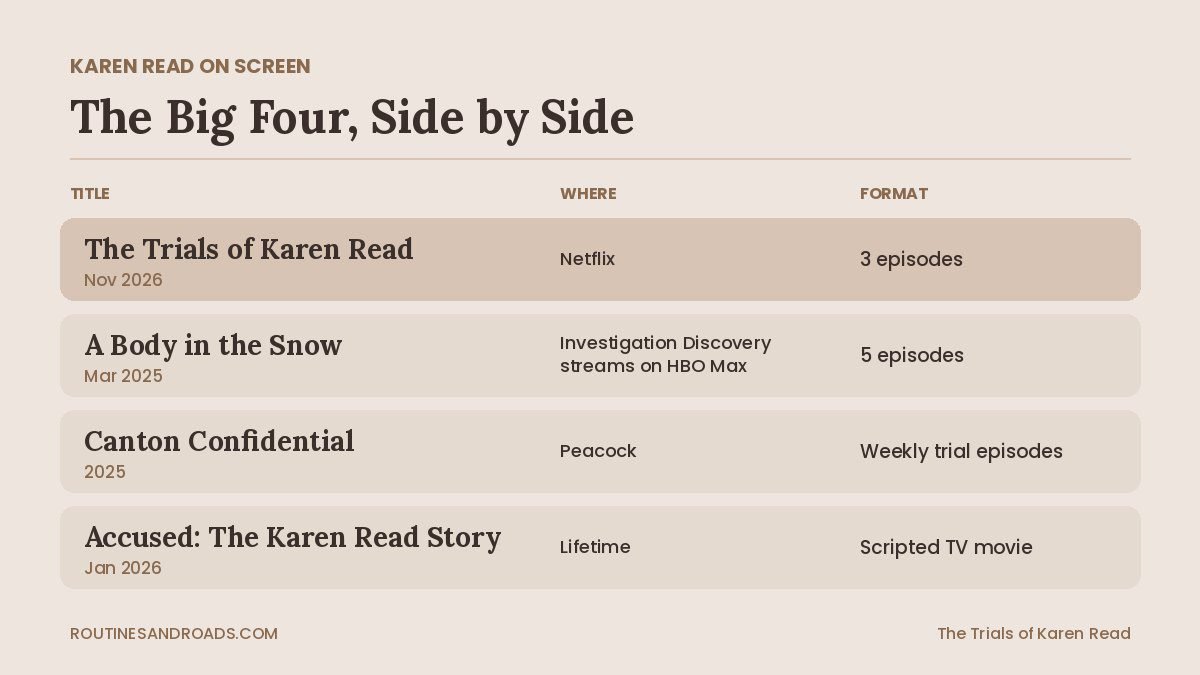
This isn’t the first time the case has been on screen. Here are the other big ones, so you know what’s what.
| Title | Where | Format | Released |
|---|---|---|---|
| The Trials of Karen Read | Netflix | 3-episode docuseries | November 2026 |
| A Body in the Snow: The Trial of Karen Read | Investigation Discovery, streaming on HBO Max | 5-episode docuseries | March 2025 |
| Canton Confidential: The Karen Read Murder Trial | Peacock | Weekly trial coverage episodes | 2025 |
| Accused: The Karen Read Story | Lifetime | Scripted TV movie starring Katie Cassidy | January 2026 |
I haven’t seen the others, so I can’t rank them for you. What I can say is that the Netflix series is the one that covers both trials from start to finish in under two and a half hours, with jurors from the second trial on camera. The Investigation Discovery series premiered in March 2025, before the second trial started.
The Trials of Karen Read vs A Body in the Snow
These are the two you’ll see compared most, and the biggest difference is who’s talking. A Body in the Snow, the five-part Investigation Discovery series, came out in March 2025, before the second trial, and Karen Read herself took part in that one, which the ABA Journal wrote about at the time. So if hearing Karen tell her own story on camera is what you want, that’s the one with her in it.
The Trials of Karen Read is the opposite. Karen only appears through archive audio, but the people from the Albert home, John’s family, the former lead investigator and two jurors from the second trial all sit down. It also covers both trials, start to finish, plus the online movement, in about two and a half hours. As a newcomer, that made it a good place for me to start, and I’d guess a lot of people will end up watching both.
What Critics Are Saying About The Trials of Karen Read
When I checked Rotten Tomatoes on November 23, 2026, there weren’t enough reviews yet for a Tomatometer score. Here’s what the first reviews said:
- RogerEbert.com felt the series mostly avoids exploitation and neat answers, and is at its best on how the online movement shaped the case.
- Decider gave it a Stream It, calling it a straightforward look at a high-profile case with a clear point of view.
- Heaven of Horror gave it 3 out of 5 and called it a fascinating watch: the first episode feels open and shut, the second makes you question it, and the third leaves you unsure.
So far, critics agree it’s gripping and easy to binge. Where they split is on balance, which is exactly why I gave that question its own section above.
Who Should Watch The Trials of Karen Read
- True crime fans who love courtroom detail and expert testimony
- Total newcomers who want the whole story in one evening (that was me)
- Anyone curious about how social media and online movements can shape a real case
- People who watched the earlier Karen Read documentary and want the second trial and the jurors’ side
In the mood for something lighter after all that? My A Dog’s Perfect Christmas parents guide is the total opposite, and it’s a cozy holiday pick for the whole family.
What to Watch After The Trials of Karen Read
If you finish this and want more real stories, here are a few I’ve already reviewed that make a good next pick:
- The One About Matthew Perry: another three-part Netflix docuseries, much more emotional and less about a mystery.
- The Altruists: an eight-episode Netflix series based on a true story, if you liked the courtroom and money side of things.
- Last Breath: a true story I watched at home, and a nice change of pace if you want tension without a trial.
- Drummer Boy: if you’re in the mood for how a real story gets turned into a movie, my review digs into what’s true and what isn’t.
Watch The Trials of Karen Read Trailer
Here’s the official trailer from Netflix, if you want a feel for the tone before you start.
Frequently Asked Questions
If you’re new to the case like I was, the best way to watch is in order, ideally in one evening, and to hold off on the timeline until after Episode 3. And as you watch, keep in mind who agreed to be on camera. That one thing changes how a lot of scenes land.
I’m reviewing more new streaming releases this week, so check back soon. Did you follow the Karen Read trials when they were happening, or was this your first time too? Tell me in the comments. And if you liked this one, my Matthew Perry documentary Netflix review is another three-part Netflix docuseries I’d recommend.
About me: I’m Emily. I watch new Netflix, Hulu and Disney+ releases at home the week they drop, and my AMC A-List lets me see up to four movies a week on the big screen. Thrillers, true crime, horror, I watch it all now and write each review the same night. I always read up on a story before I watch, and I share that homework here too. See all my Movie Nights reviews.
Got a dog at home too? Here’s the daily supplement routine I use for my three dogs, and what it is really like tent camping with dogs. And every movie and series I’ve reviewed this year is in My 2026 Movie Log.